


Introduction
DM Water Furnace systems play an important role in modern industries. Many manufacturing plants use demineralized (DM) water to improve furnace performance, protect equipment, and reduce maintenance costs. Since DM water contains almost no dissolved minerals, it helps prevent scale formation and corrosion inside furnace cooling systems, boilers, and heat exchangers.
Moreover, industries need stable heating to produce high-quality products. Even a small amount of mineral buildup can reduce heat transfer and increase energy consumption. Therefore, manufacturers choose DM water because it keeps furnace systems clean and efficient. As a result, production becomes more reliable, equipment lasts longer, and operating costs decrease.
Whether the furnace operates in a steel plant, glass factory, power station, or chemical industry, high-purity DM water supports smooth and continuous operations. Consequently, it has become an essential part of many industrial heating processes.
What Is DM Water?
DM water, also known as demineralized water, is highly purified water that contains very low levels of dissolved salts and minerals. Manufacturers produce it by removing ions such as calcium, magnesium, sodium, chloride, sulfate, silica, and iron through advanced water treatment technologies.
Most industries produce DM water using several purification stages.
- Multimedia filtration removes suspended particles.
- Activated carbon filters eliminate chlorine and organic matter.
- Reverse osmosis removes most dissolved salts.
- Ion exchange resins remove the remaining minerals.
- Mixed-bed polishers provide ultra-pure water.
Because the purification process removes hardness-causing minerals, DM water becomes suitable for applications where even small impurities can create serious operational problems.
Why DM Water Is Important in Furnace Systems
Industrial furnaces operate at extremely high temperatures. Therefore, every cooling component must perform efficiently. When ordinary water flows through cooling jackets or heat exchangers, minerals begin to settle on metal surfaces.
Eventually, those deposits create hard scale.
Scale blocks heat transfer.
As a result, furnaces consume more fuel to achieve the same temperature.
Higher fuel consumption increases production costs.
Furthermore, mineral deposits restrict water flow, causing localized overheating. If overheating continues, expensive furnace parts may crack or fail.
DM water prevents these problems because it contains almost no hardness minerals. Consequently, cooling remains efficient and equipment operates safely.
DM Water Furnace Applications
DM water supports many furnace-related operations across different industries.
DM Water Furnace for Cooling Systems
Most industrial furnaces include water-cooled panels or jackets.
DM water removes heat efficiently while preventing mineral deposits.
Therefore, cooling remains consistent even during continuous operation.
Moreover, cleaner cooling channels reduce maintenance requirements.
DM Water Furnace for Boiler Feed Water
Many furnace systems generate steam.
Steam quality directly affects industrial performance.
Since DM water contains almost no dissolved minerals, it produces cleaner steam.
Consequently, boiler tubes remain cleaner, and steam systems operate efficiently.
DM Water Furnace for Heat Exchangers
Heat exchangers transfer thermal energy between different process streams.
However, scale reduces heat transfer efficiency.
DM water prevents mineral buildup.
As a result, heat exchangers maintain stable operating temperatures and consume less energy.
DM Water Furnace for Induction Furnaces
Induction furnaces depend on continuous cooling.
Their induction coils generate significant heat during operation.
DM water absorbs this heat without leaving mineral deposits.
Therefore, induction coils remain cleaner and perform efficiently for longer periods.
DM Water Furnace for Vacuum Furnaces
Vacuum furnaces require clean operating conditions.
Any contamination can reduce product quality.
DM water minimizes contamination risks because it contains almost no dissolved impurities.
Consequently, manufacturers achieve higher precision and consistent production quality.
Key Benefits of DM Water Furnace Systems
Industries prefer DM water because it delivers several practical advantages.
Prevents Scale Formation
DM water contains almost no hardness minerals.
Therefore, calcium and magnesium deposits cannot accumulate inside furnace cooling systems.
This keeps heat transfer surfaces clean.
Reduces Corrosion
Minerals and dissolved salts increase corrosion.
DM water reduces these contaminants.
As a result, pipelines, valves, pumps, and furnace components remain protected.
Improves Heat Transfer
Clean metal surfaces transfer heat more efficiently.
Consequently, furnaces require less fuel.
Lower energy consumption reduces production costs.
Increases Equipment Life
Clean cooling systems experience less wear.
Therefore, industries replace expensive furnace parts less frequently.
Longer equipment life also reduces capital expenditure.
Reduces Maintenance Costs
Scale removal requires shutdowns.
However, DM water minimizes scaling.
Therefore, maintenance becomes faster and less expensive.
Improves Product Quality
Stable furnace temperatures produce consistent manufacturing conditions.
Consequently, finished products achieve better quality and fewer defects.
pH Impact of DM Water in Furnace Systems
Many industries depend on DM water every day.
- Steel manufacturing
- Metal processing
- Foundries
- Glass manufacturing
- Pharmaceutical production
- Chemical processing
- Power generation
- Electronics manufacturing
- Food processing
- Automobile manufacturing
- Aerospace industry
- Engineering industries
How a DM Water Furnace System Works
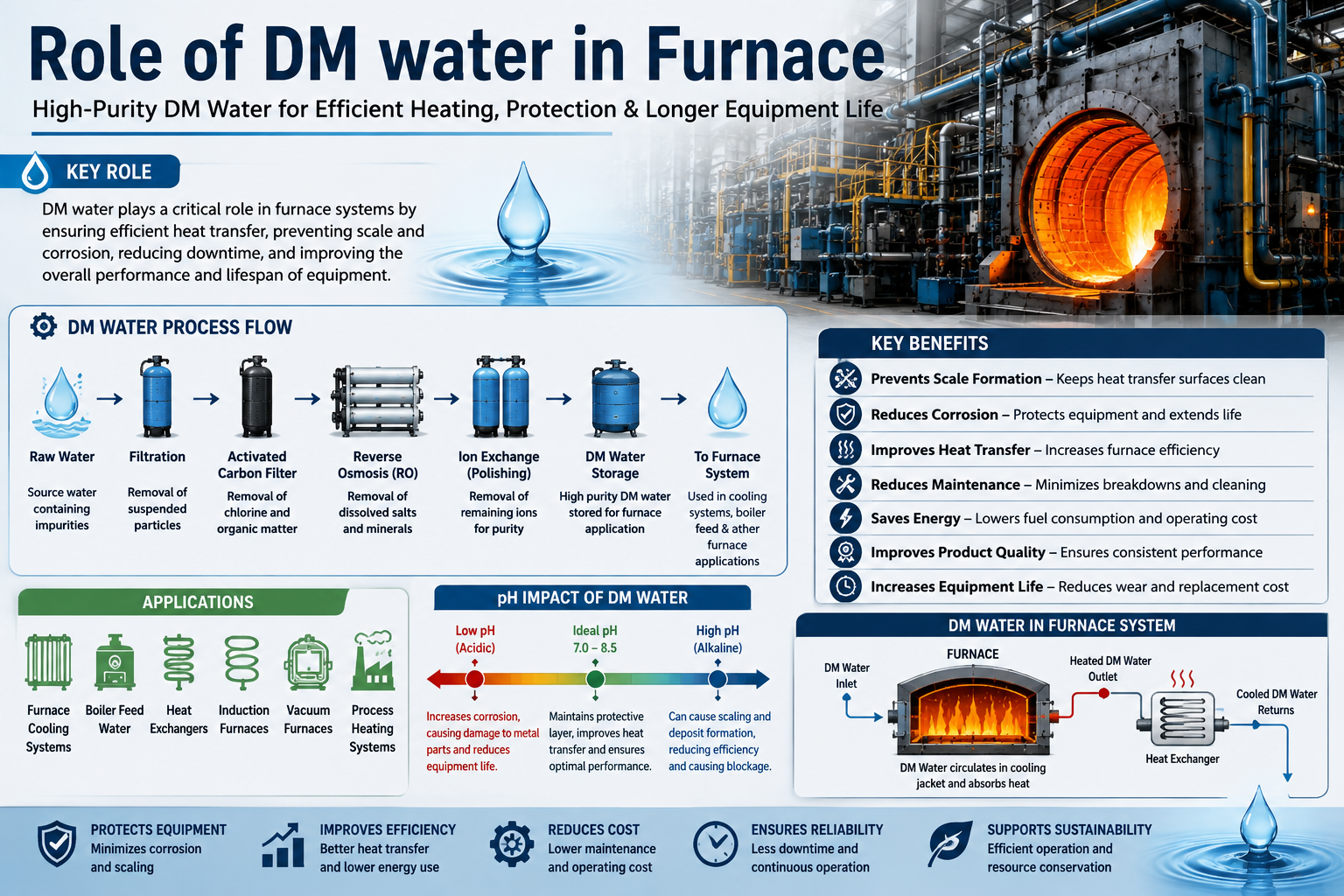
A DM Water Furnace system uses highly purified water to cool furnace components and improve heat transfer. Since DM water contains almost no dissolved minerals, it protects the system from scale and corrosion.
The working process includes the following steps:
- Raw water enters the water treatment plant.
- A multimedia filter removes suspended particles.
- An activated carbon filter removes chlorine and organic impurities.
- A reverse osmosis (RO) system removes most dissolved salts.
- Ion exchange resins remove the remaining minerals.
- A mixed-bed polisher produces high-purity DM water.
- The DM water flows to the furnace cooling system or boiler.
- The cooling circuit absorbs heat from furnace components.
- Heat exchangers remove the absorbed heat.
- The cooled DM water returns to the system for continuous circulation.
Because the water remains clean, the furnace operates efficiently and requires less maintenance.
DM Water Furnace in Different Manufacturing Industries
DM Water Furnace in Steel Manufacturing
Steel plants operate furnaces at very high temperatures. Therefore, reliable cooling is essential. DM water keeps cooling jackets and heat exchangers free from scale. As a result, steel manufacturers improve production efficiency and reduce unexpected shutdowns.
DM Water Furnace in Foundries
Foundries melt metals every day. Consequently, furnace cooling systems experience continuous thermal stress. DM water removes heat efficiently and protects cooling channels from mineral deposits.
DM Water Furnace in Glass Manufacturing
Glass production requires precise temperature control. Even small temperature variations can affect product quality. Therefore, manufacturers use DM water to maintain stable furnace temperatures and consistent glass production.
DM Water Furnace in Power Plants
Power plants use furnace systems together with boilers and steam generators. DM water prevents scale inside boiler tubes and improves steam quality. Consequently, power plants achieve higher thermal efficiency and lower maintenance costs.
DM Water Furnace in Chemical Industries
Chemical manufacturing often involves high-temperature reactors and furnace systems. DM water protects cooling circuits from corrosion and contamination. As a result, production remains stable and equipment lasts longer.
DM Water Furnace in Electronics Manufacturing
Electronics manufacturers require clean production environments. DM water supports furnace cooling without introducing impurities that could affect sensitive components.
Advantages of Using DM Water Furnace Systems
Companies invest in DM Water Furnace systems because they provide many operational benefits.
- Improves furnace efficiency.
- Reduces energy consumption.
- Prevents mineral deposits.
- Minimizes corrosion.
- Extends equipment life.
- Lowers maintenance costs.
- Reduces production downtime.
- Improves heat transfer.
- Maintains stable operating temperatures.
- Protects cooling jackets.
- Increases production reliability.
- Supports better product quality.
- Reduces cleaning frequency.
- Improves overall plant productivity.
- Supports sustainable manufacturing.
Each of these advantages helps industries increase profitability while maintaining reliable production.
Problems Caused by Ordinary Water in Furnace Systems
Using untreated water may seem economical at first. However, it often creates expensive operational problems.
Common issues include:
- Scale formation
- Corrosion
- Reduced heat transfer
- Higher fuel consumption
- Blocked cooling channels
- Pump damage
- Valve failures
- Frequent maintenance
- Equipment overheating
- Shorter furnace life
- Increased operating costs
- Production delays
Therefore, industries prefer DM water instead of untreated water.
Best Practices for Using DM Water in Furnace Systems
To achieve the best performance, industries should follow these practices:
- Monitor water conductivity regularly.
- Check pH before operation.
- Test silica levels.
- Inspect pipelines for leaks.
- Replace ion exchange resins on time.
- Clean filters periodically.
- Maintain RO membranes.
- Record water quality data.
- Calibrate monitoring instruments.
- Schedule preventive maintenance.
- Inspect pumps regularly.
- Maintain cooling flow rates.
- Check heat exchangers frequently.
- Train maintenance personnel.
- Follow manufacturer recommendations.
These simple practices improve equipment reliability and reduce operating costs.
Common Maintenance Tips
Regular maintenance helps the system operate efficiently for many years.
Inspect the cooling circuit every month.
Replace damaged seals immediately.
Monitor water pressure daily.
Clean strainers regularly.
Flush the cooling system whenever contamination appears.
Check conductivity meters frequently.
Replace exhausted resins before water quality declines.
Maintain proper circulation throughout the cooling loop.
Additionally, document every maintenance activity. Accurate records help identify recurring problems and improve long-term system performance.
Statistics That Highlight the Importance of High-Purity Water
Recent industry reports show why manufacturers invest in purified water systems.
- The International Energy Agency (IEA) reports that improving industrial energy efficiency remains one of the most effective ways to reduce operating costs and emissions.
- The U.S. Department of Energy states that cleaner heat transfer surfaces help industrial systems operate more efficiently and reduce unnecessary energy losses.
- The American Society of Mechanical Engineers (ASME) recommends high-purity water for many boiler and steam applications to minimize scale and corrosion.
- According to EPRI (Electric Power Research Institute), poor water quality is one of the leading causes of corrosion and deposit-related equipment problems in power generation systems.
These findings highlight the importance of maintaining high water quality in furnace operations.
Frequently Asked Questions (FAQs)
1. What is a DM Water Furnace?
A DM Water Furnace is an industrial furnace system that uses demineralized (DM) water for cooling, heat transfer, or boiler feed applications. Since DM water contains very few dissolved minerals, it helps prevent scale, reduces corrosion, and improves furnace efficiency.
2. Why is DM water used in furnace systems?
Industries use DM water because it protects furnace equipment from mineral deposits. Moreover, it improves heat transfer, reduces maintenance costs, increases equipment life, and supports continuous production. As a result, manufacturers achieve higher productivity and lower operating expenses.
3. Which industries use DM Water Furnace systems?
Many industries depend on DM Water Furnace systems, including:
- Steel manufacturing
- Metal processing
- Glass manufacturing
- Foundries
- Chemical processing
- Pharmaceutical manufacturing
- Power plants
- Food processing
- Electronics manufacturing
- Automobile manufacturing
- Aerospace industries
- Engineering industries
These industries require clean cooling systems and reliable furnace performance.
4. How often should DM water quality be tested?
Most industries monitor DM water daily or weekly, depending on the application. Operators usually check conductivity, pH, silica, and total dissolved solids (TDS). Regular testing helps maintain water purity and protects expensive furnace equipment.
5. Can DM water improve furnace efficiency?
Yes. DM water improves furnace efficiency by preventing scale formation and reducing corrosion. Consequently, heat transfers more effectively, fuel consumption decreases, and maintenance requirements become lower. Therefore, industries experience better productivity and longer equipment life.
Conclusion
A DM Water Furnace is an essential solution for industries that depend on high-temperature manufacturing processes. It protects cooling systems, boilers, heat exchangers, and furnace components from scale and corrosion. As a result, equipment operates more efficiently and lasts longer.
Furthermore, DM water improves heat transfer, lowers energy consumption, reduces maintenance costs, and supports consistent product quality. Because of these advantages, industries such as steel, power generation, pharmaceuticals, glass manufacturing, chemicals, and electronics continue to invest in advanced DM water systems.
In addition, maintaining proper water quality through regular monitoring of conductivity, pH, and silica levels helps maximize furnace performance. Preventive maintenance and routine inspections further increase system reliability and reduce downtime.
As industrial processes become more advanced, the demand for high-purity water will continue to grow. Therefore, installing a reliable DM water system is a smart investment for manufacturers that want to improve efficiency, reduce operational costs, and extend the life of their furnace equipment.