DI Water in PCB Cleaning is one of the most important processes in modern electronics manufacturing. Printed Circuit Boards (PCBs) power almost every electronic device, including smartphones, computers, medical equipment, automotive systems, and industrial machines. However, even a tiny amount of dust, flux residue, oil, or ionic contamination can reduce the performance of a PCB. Therefore, manufacturers use deionized (DI) water to clean circuit boards without leaving mineral deposits or harmful residues.
Unlike ordinary tap water, DI water contains almost no dissolved minerals or salts. As a result, it removes contaminants effectively while protecting sensitive electronic components. Moreover, DI water helps manufacturers improve product quality, reduce failures, and meet strict industry standards. In this guide, you will learn the role of DI water in PCB cleaning, its benefits, cleaning methods, applications, challenges, and best practices for achieving reliable electronic products.
What Is DI Water?
Deionized (DI) water is highly purified water that has had its dissolved mineral ions removed through an ion exchange process. During purification, positive ions such as calcium, magnesium, sodium, and iron are replaced with hydrogen ions. Similarly, negative ions such as chloride, sulfate, and nitrate are replaced with hydroxide ions. These hydrogen and hydroxide ions then combine to form pure water.
Because of this process, DI water has very low electrical conductivity and contains very few contaminants. Consequently, it becomes suitable for cleaning delicate electronic components where purity is essential.
Unlike tap water, DI water does not leave white mineral stains or conductive residues after drying. Therefore, it is widely used in electronics manufacturing, laboratories, pharmaceuticals, semiconductor production, and PCB cleaning.
Understanding PCB Cleaning
Printed Circuit Boards connect electronic components through conductive copper tracks. During manufacturing, several production steps introduce contaminants onto the board surface.
Common contaminants include:
- Flux residue
- Dust particles
- Fingerprints
- Oil and grease
- Solder paste residue
- Ionic contaminants
- Chemical residues
- Metal particles
If manufacturers do not remove these contaminants, they may experience electrical leakage, corrosion, short circuits, reduced insulation resistance, and poor solder joint reliability.
Therefore, PCB cleaning has become an essential quality control process.
Why DI Water PCB Cleaning Is Important
Electronic devices continue to become smaller and more powerful. Consequently, PCB components are now placed much closer together. Even microscopic contamination can create serious reliability issues.
DI water provides an effective cleaning solution because it removes ionic contamination without introducing additional minerals.
Moreover, manufacturers choose DI water because it supports consistent cleaning quality across large production volumes.
The importance of DI water PCB cleaning includes:
- Improved electrical reliability
- Better insulation resistance
- Reduced corrosion
- Cleaner board surfaces
- Longer product life
- Higher manufacturing yield
- Better customer satisfaction
- Compliance with IPC cleaning standards
Therefore, DI water has become the preferred cleaning medium for many electronics manufacturers.
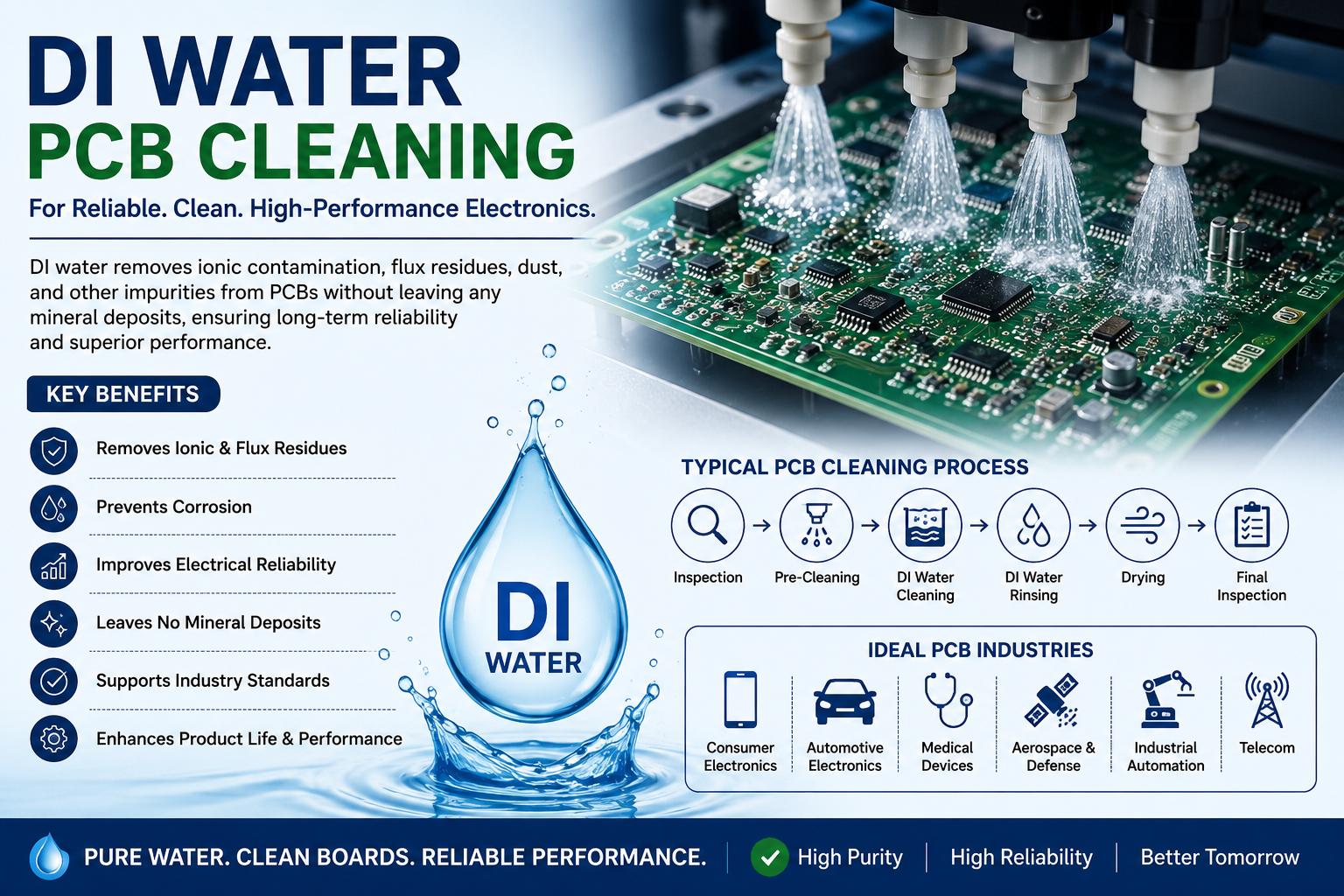
How DI Water Cleans Printed Circuit Boards
DI water works because pure water naturally attracts and dissolves many contaminants. During PCB cleaning, manufacturers often combine DI water with approved cleaning agents to remove stubborn residues.
The cleaning process generally follows several steps.
Step 1: Initial Inspection
Technicians inspect the PCB for visible contamination.
Step 2: Pre-Cleaning
Loose dust and particles are removed using air blowers or soft brushes.
Step 3: Cleaning
DI water sprays or ultrasonic cleaning systems remove contaminants from the PCB surface.
Step 4: Rinsing
Fresh DI water rinses away dissolved residues and cleaning chemicals.
Step 5: Drying
Hot air or vacuum drying removes remaining moisture before testing.
Finally, the clean PCB moves to quality inspection.
Types of Contaminants Removed by DI Water
DI water effectively removes many different contaminants found during PCB manufacturing.
These include:
- Ionic salts
- Dust
- Flux residues
- Finger oils
- Organic contamination
- Solder residues
- Processing chemicals
- Cleaning chemical residues
Additionally, DI water helps remove microscopic particles that ordinary cleaning methods may miss.
As a result, the final PCB performs more reliably in demanding applications.
Why Tap Water Should Never Be Used
Many people wonder why ordinary water cannot clean electronic circuit boards.
The answer is simple.
Tap water contains dissolved minerals, chlorine, calcium, magnesium, iron, and other impurities.
These contaminants may:
- Leave conductive residues
- Cause corrosion
- Reduce insulation resistance
- Create mineral deposits
- Damage electronic components
- Increase failure rates
Therefore, professional electronics manufacturers avoid using untreated water during PCB cleaning.
Benefits of DI Water PCB Cleaning
DI water offers several advantages over ordinary water. Because it contains almost no dissolved minerals, it cleans printed circuit boards without leaving harmful deposits. As a result, manufacturers can produce reliable electronic products with fewer defects.
1. Removes Ionic Contamination
One of the biggest benefits of DI Water PCB Cleaning is its ability to remove ionic contamination. During soldering, assembly, and handling, small amounts of ionic residues remain on the PCB surface. These residues can absorb moisture from the air.
Consequently, they may create leakage currents or electrical shorts over time. DI water dissolves and removes these ions effectively. Therefore, the board performs more reliably throughout its service life.
-
Prevents Corrosion
Corrosion is a major reason for electronic failure. When minerals or salts remain on a PCB, moisture can react with them and slowly damage copper traces and solder joints.
However, DI water leaves almost no minerals after cleaning. As a result, the risk of corrosion decreases significantly. Furthermore, manufacturers can improve the long-term reliability of electronic products.
-
Improves Electrical Performance
Modern PCBs contain tiny conductive paths placed very close together. Even a small amount of contamination can interfere with electrical signals.
DI water removes conductive residues that may affect circuit performance. Therefore, electronic devices operate more accurately and consistently.
Moreover, improved insulation resistance reduces unwanted current leakage.
-
Leaves No Mineral Deposits
Unlike tap water, DI water dries without leaving white stains or mineral spots.
This clean finish improves product appearance and prevents contamination during final assembly. Consequently, manufacturers reduce the need for additional cleaning steps.
-
Extends Product Life
A clean PCB experiences fewer electrical failures during operation.
Because contaminants are removed before product assembly, the circuit board remains stable for many years. Therefore, electronic devices last longer and require fewer repairs.
-
Supports Industry Standards
Electronics manufacturers must follow strict quality requirements.
DI water helps companies meet IPC cleanliness standards and customer quality specifications. As a result, manufacturers can confidently supply products for medical devices, automotive electronics, aerospace systems, and industrial equipment.
-
Reduces Manufacturing Defects
Contaminated circuit boards often fail during testing.
However, effective DI water cleaning removes contamination before final inspection. Consequently, production yield increases while rework costs decrease.
DI Water In PCB Cleaning Methods
Different manufacturers use different cleaning methods depending on PCB design, contamination level, and production volume.
Spray Cleaning
Spray cleaning is one of the most common industrial methods.
High-pressure DI water sprays remove dust, flux residues, and processing chemicals. This method works well for high-volume manufacturing because it provides consistent cleaning.
Ultrasonic Cleaning
Ultrasonic cleaning uses high-frequency sound waves together with DI water.
Tiny bubbles form inside the cleaning solution. When these bubbles collapse, they remove contamination from difficult-to-reach areas.
Therefore, ultrasonic cleaning is ideal for complex circuit boards with dense electronic components.
Batch Cleaning
Small manufacturers often use batch cleaning systems.
Several PCBs are cleaned together inside a chamber using DI water and approved cleaning solutions. Afterwards, multiple DI water rinses remove any remaining residues.
Inline Cleaning
Large electronics factories generally use automated inline cleaning systems.
PCBs move continuously through different cleaning stages.
These stages include:
- Pre-wash
- Main wash
- DI water rinse
- Final rinse
- Drying
Because the process is fully automated, manufacturers achieve consistent quality while increasing production speed.
Quality Standards for DI Water In PCB Cleaning
Water quality directly affects cleaning performance.
Manufacturers regularly monitor several important parameters.
These include:
- Electrical resistivity
- Conductivity
- Total Dissolved Solids (TDS)
- Silica level
- pH value
- Organic carbon
- Bacterial contamination
High-purity DI water typically has very low conductivity and very high resistivity. Therefore, it removes contaminants without introducing new impurities.
Regular water testing also ensures consistent cleaning quality throughout production.
Industries That Use DI Water In PCB Cleaning
Many industries depend on reliable electronic assemblies. Consequently, they use DI water during PCB manufacturing.
Common industries include:
- Consumer electronics
- Automotive electronics
- Medical equipment
- Aerospace
- Defense
- Telecommunications
- Industrial automation
- Robotics
- Renewable energy
- Semiconductor manufacturing
Each of these industries requires clean circuit boards to ensure reliable performance.
Equipment Used for DI Water In PCB Cleaning
Manufacturers use specialized equipment to produce consistent cleaning results.
Common equipment includes:
- DI water generation systems
- Ion exchange units
- Reverse osmosis systems
- Mixed-bed polishers
- Ultrasonic cleaning machines
- Spray cleaning systems
- Inline PCB cleaning machines
- Conductivity meters
- Resistivity meters
- Hot air drying systems
- Vacuum drying equipment
- Water filtration units
Regular maintenance of this equipment ensures stable water quality and efficient cleaning.
Common Challenges in DI Water In PCB Cleaning
Although DI water offers many benefits, manufacturers must manage certain challenges carefully.
Maintaining Water Purity
DI water gradually absorbs contaminants from the environment.
Therefore, companies continuously monitor water quality and replace exhausted ion exchange resins when necessary.
Proper Drying
Water remaining on a PCB may affect sensitive electronic components.
Therefore, manufacturers use heated air or vacuum drying systems to remove moisture completely.
Equipment Maintenance
Cleaning systems require routine inspection.
Filters, pumps, and ion exchange resins must remain in good condition to maintain cleaning efficiency.
Controlling Microbial Growth
Stored DI water may support bacterial growth if systems are not maintained properly.
Therefore, regular sanitization and monitoring help maintain water purity.
Handling Complex PCB Designs
Modern PCBs often contain extremely small components.
Consequently, manufacturers must carefully select cleaning pressure, temperature, and drying conditions to avoid damaging sensitive parts.
Best Practices for DI Water In PCB Cleaning
Following the right cleaning practices helps manufacturers achieve consistent PCB quality while reducing production defects. Moreover, it improves equipment life and lowers maintenance costs.
Follow these best practices for effective DI Water PCB Cleaning:
- Use high-purity DI water with consistent quality.
- Monitor water conductivity and resistivity regularly.
- Replace ion exchange resins before they become exhausted.
- Remove loose dust before washing the PCB.
- Use approved cleaning chemicals when necessary.
- Rinse thoroughly with fresh DI water.
- Dry PCBs completely before testing or assembly.
- Maintain cleaning equipment on a regular schedule.
- Test cleaned PCBs for ionic contamination.
- Train operators to follow standard cleaning procedures.
By following these practices, manufacturers can improve reliability and reduce product failures.
Common Mistakes to Avoid
Even with high-quality DI water, poor cleaning practices can reduce PCB performance.
Avoid these common mistakes:
- Using tap water instead of DI water.
- Reusing contaminated rinse water.
- Skipping the final DI water rinse.
- Drying PCBs incompletely.
- Ignoring water quality checks.
- Using excessive cleaning pressure.
- Delaying cleaning after soldering.
- Failing to maintain filtration systems.
Avoiding these errors helps maintain high manufacturing standards.
Real-World Applications of DI Water In PCB Cleaning
DI water is used across many electronics manufacturing sectors because cleanliness directly affects product reliability.
Consumer Electronics
Manufacturers of smartphones, laptops, tablets, and smart devices use DI water to remove flux residues and microscopic particles before final assembly.
Automotive Electronics
Modern vehicles contain dozens of PCBs for engine control, braking systems, infotainment, battery management, and safety features. Clean circuit boards improve long-term reliability.
Medical Devices
Medical equipment requires extremely clean electronic assemblies. DI water helps manufacturers meet strict quality and safety standards.
Aerospace and Defense
Aircraft and defense electronics operate in demanding environments. Therefore, manufacturers use DI water to ensure dependable PCB performance.
Industrial Automation
Factories rely on sensors, PLCs, control panels, and robotic systems. DI water cleaning improves the durability of these electronic components.
Industry Statistics
The growing demand for reliable electronics has increased the importance of high-purity cleaning processes.
- According to Grand View Research (2024), the global printed circuit board market continues to grow due to rising demand for consumer electronics, automotive electronics, and industrial automation.
- IPC reports that ionic contamination is one of the leading causes of long-term PCB reliability failures.
- According to MarketsandMarkets (2024), the electronics manufacturing industry continues to invest in advanced cleaning technologies to improve product quality and reduce defects.
- Modern electronics manufacturing facilities monitor water quality continuously because even small changes in conductivity can affect cleaning performance.
These trends highlight why DI water remains an essential part of PCB manufacturing.
Expert Insight
“Cleanliness is one of the most important factors affecting long-term electronic reliability.” — IPC (Association Connecting Electronics Industries)
“High-purity water significantly improves manufacturing consistency and reduces contamination-related failures.” — Electronics Manufacturing .
Why Choose a Reliable DI Water Supplier?
Choosing the right DI water supplier is just as important as selecting the correct cleaning equipment.
A trusted supplier offers:
- Consistent water purity
- Reliable system performance
- Technical support
- Routine maintenance services
- Customized water treatment solutions
- Long-term operational savings
Working with an experienced supplier helps manufacturers maintain consistent PCB quality and reduce downtime.
Frequently Asked Questions (FAQs)
1. What is DI Water PCB Cleaning?
DI Water PCB Cleaning is the process of using deionized water to remove flux, dust, ionic contamination, and other residues from printed circuit boards without leaving mineral deposits.
2. Why is DI water preferred over tap water?
DI water contains almost no dissolved minerals. Therefore, it cleans PCBs effectively without causing corrosion, scaling, or conductive residue.
3. Which industries use DI water for PCB cleaning?
Consumer electronics, automotive, aerospace, medical devices, telecommunications, industrial automation, and defense industries commonly use DI water.
4. Does DI water improve PCB reliability?
Yes. DI water removes contaminants that can cause corrosion, electrical leakage, and short circuits. As a result, PCB reliability and lifespan improve significantly.
5. Can DI water damage electronic components?
No. When manufacturers follow proper cleaning and drying procedures, DI water is safe for PCB cleaning and is widely used throughout the electronics industry.
Conclusion
DI Water PCB Cleaning plays a critical role in producing reliable, high-quality printed circuit boards. It removes ionic contamination, prevents corrosion, improves electrical performance, and extends the life of electronic products. Furthermore, it helps manufacturers comply with industry standards while reducing defects and maintenance costs.
As electronic devices become smaller and more advanced, the need for cleaner circuit boards continues to grow. Consequently, investing in high-purity DI water systems and following proper cleaning practices allows manufacturers to improve product quality, increase production efficiency, and build long-lasting electronic devices. Whether in consumer electronics, automotive systems, medical equipment, or aerospace applications, DI water remains an essential solution for achieving dependable PCB performance.