


High Grade Distilled Water for Silver Nanoparticles Solutions
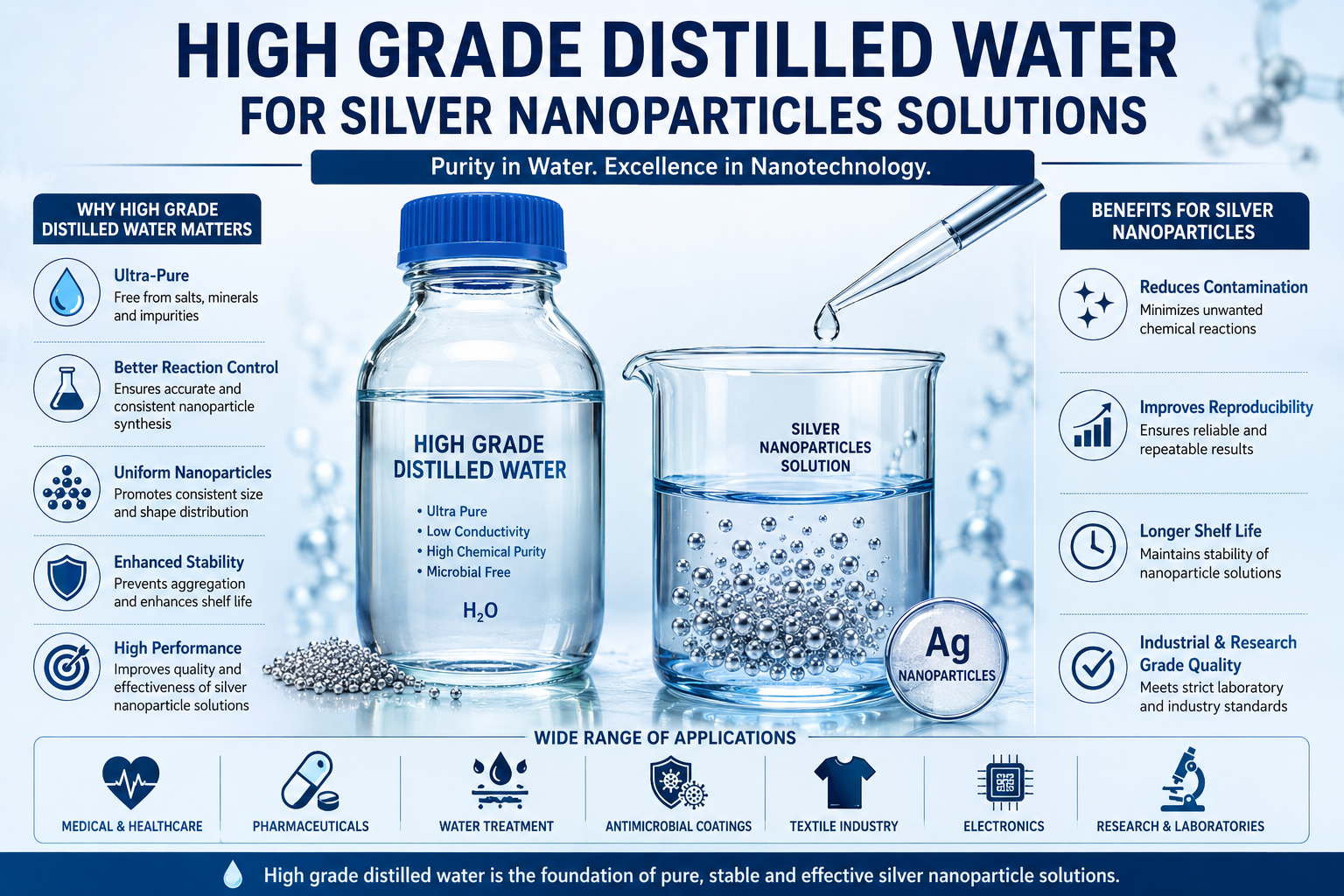
Silver nanoparticles have become an essential material in modern science and industry. Researchers use them in healthcare, pharmaceuticals, coatings, electronics, water treatment, textiles, and laboratory studies. However, the quality of the final nanoparticle solution depends heavily on the water used during preparation. High Grade Distilled Water plays a vital role because it contains extremely low levels of dissolved salts, minerals, microorganisms, and organic impurities. As a result, it provides a clean environment for nanoparticle synthesis and storage. Furthermore, it reduces unwanted chemical reactions and improves the consistency of experimental results.
If researchers use ordinary water instead of high-grade distilled water, contaminants may interfere with particle formation. Consequently, the nanoparticles may become unstable, larger than expected, or contaminated. Therefore, laboratories and manufacturers prefer high-grade distilled water for producing reliable silver nanoparticle solutions.
What Is High Grade Distilled Water?
High Grade Distilled Water is purified water produced through repeated distillation and advanced purification techniques. During this process, water evaporates and then condenses, leaving behind minerals, salts, heavy metals, bacteria, and many dissolved impurities.
High-grade distilled water offers:
- Extremely low mineral content
- Low electrical conductivity
- High chemical purity
- Minimal microbial contamination
- Excellent consistency
- Reliable laboratory performance
- Long-term storage stability
Because of these qualities, it is widely used in nanotechnology laboratories and research facilities.
Why High Grade Distilled Water Matters for Silver Nanoparticles
Prevents Chemical Contamination
Minerals such as calcium, magnesium, sodium, and iron can react with silver ions. Consequently, unwanted compounds may form during synthesis.
High-grade distilled water removes these impurities and protects the reaction.
Produces Uniform Nanoparticles
Researchers aim for nanoparticles with a consistent size and shape.
Since high-grade distilled water contains very few contaminants, particle growth remains controlled. As a result, the solution becomes more uniform.
Improves Reaction Accuracy
Laboratory experiments require repeatable results.
Because purified water minimizes unexpected reactions, scientists obtain reliable data in repeated experiments.
Supports Better Stability
Stable nanoparticle solutions remain effective for a longer period.
Therefore, using high-grade distilled water helps prevent particle aggregation and sediment formation.
High Grade Distilled Water During Silver Nanoparticle Synthesis
Preparing Chemical Solutions
Researchers first dissolve silver salts and reducing agents.
High-grade distilled water ensures accurate solution preparation without introducing unwanted ions.
Mixing Reactants
The reaction begins after mixing different chemicals.
Since contaminants remain minimal, nanoparticles form under controlled conditions.
Washing Nanoparticles
Researchers wash synthesized nanoparticles several times.
High-grade distilled water removes remaining chemicals while preserving nanoparticle quality.
Final Dispersion
Finally, nanoparticles disperse into purified water for storage.
This step improves suspension stability and prevents contamination.
Benefits of High Grade Distilled Water for Silver Nanoparticles
Using High Grade Distilled Water offers several practical benefits.
- Improves nanoparticle purity
- Reduces unwanted reactions
- Maintains consistent particle size
- Enhances product stability
- Increases laboratory accuracy
- Supports repeatable research
- Extends storage life
- Prevents mineral deposits
- Reduces microbial contamination
- Improves manufacturing quality
- Supports pharmaceutical standards
- Enhances industrial reliability
These benefits make purified water an essential raw material for nanoparticle production.
Common Problems Without High Grade Distilled Water
Particle Aggregation
Minerals encourage nanoparticles to stick together.
Consequently, solution stability decreases.
Reduced Antibacterial Performance
Impurities may interfere with silver ion activity.
As a result, antimicrobial performance may decline.
Poor Reproducibility
Different water qualities produce different experimental outcomes.
Therefore, researchers cannot easily repeat results.
Lower Product Quality
Manufacturers may experience inconsistent batches.
This inconsistency affects customer confidence and product performance.
Applications of Silver Nanoparticles Made with High Grade Distilled Water
High-quality nanoparticle solutions serve many industries.
They are commonly used in:
- Medical research
- Pharmaceutical development
- Drug delivery systems
- Wound dressing materials
- Antimicrobial coatings
- Water purification research
- Biosensors
- Food packaging research
- Textile finishing
- Electronic components
- Diagnostic devices
- Nanotechnology laboratories
- University research
- Chemical analysis
- Environmental studies
Each application requires highly purified water to maintain product quality.
High Grade Distilled Water vs Ordinary Water
Many people believe clean tap water is sufficient. However, this assumption is incorrect.
Ordinary water may contain:
- Dissolved salts
- Calcium
- Magnesium
- Chlorides
- Sulfates
- Heavy metals
- Organic matter
- Microorganisms
These contaminants can interfere with nanoparticle synthesis.
In contrast, High Grade Distilled Water provides a much cleaner reaction environment. Therefore, it supports higher purity and better experimental accuracy.
Best Practices for Using High Grade Distilled Water
To achieve the best results, laboratories should follow proper handling practices.
- Store water in sterile containers.
- Keep containers tightly sealed.
- Avoid repeated exposure to air.
- Use clean laboratory glassware.
- Prepare fresh solutions whenever possible.
- Prevent cross-contamination.
- Monitor water quality regularly.
- Check conductivity before use.
- Follow laboratory SOPs.
- Purchase water from reliable suppliers.
Following these practices helps maintain consistent nanoparticle quality.
Quality Parameters to Check
Before using High Grade Distilled Water, laboratories should evaluate several quality indicators.
Important parameters include:
- Electrical conductivity
- Resistivity
- Total dissolved solids (TDS)
- pH
- Total organic carbon (TOC)
- Microbial count
- Heavy metal concentration
- Silica content
- Endotoxin level (when required)
- Storage conditions
Regular testing ensures consistent laboratory performance.
Industries That Depend on High Grade Distilled Water
Many industries rely on purified water for nanoparticle production.
These include:
- Pharmaceutical companies
- Biotechnology laboratories
- Medical device manufacturers
- Chemical industries
- Research institutions
- Universities
- Electronics manufacturers
- Water treatment companies
- Cosmetic manufacturers
- Nanotechnology companies
Each industry requires high-quality water to maintain strict quality standards.
Internal Links
To improve your website’s SEO, naturally add links to related pages such as:
- Distilled Water Manufacturing Process
- Distilled Water vs Deionized Water
- Benefits of Distilled Water for Laboratories
- Applications of Distilled Water in Pharmaceuticals
- Why High Purity Water Matters in Research
These internal links improve user experience and strengthen topical authority.
Frequently Asked Questions
1. Why is high grade distilled water used for silver nanoparticles?
High grade distilled water removes minerals and contaminants that can interfere with nanoparticle synthesis. As a result, researchers obtain cleaner, more stable, and more consistent silver nanoparticle solutions.
2. Can ordinary distilled water replace high grade distilled water?
For basic applications, it may work. However, advanced laboratory research and pharmaceutical manufacturing require high grade distilled water because it offers greater purity and consistency.
3. Does water quality affect nanoparticle size?
Yes. Water impurities influence nucleation and particle growth. Therefore, high grade distilled water helps produce nanoparticles with a more uniform size distribution.
4. Which industries use silver nanoparticles prepared with high grade distilled water?
Pharmaceutical, biotechnology, medical device, electronics, water treatment, textile, and nanotechnology industries commonly use these solutions.
5. How should high grade distilled water be stored?
Store it in sterile, sealed containers away from contamination and direct sunlight. Furthermore, use clean laboratory equipment to maintain water purity.
Conclusion
High Grade Distilled Water is one of the most important components in silver nanoparticle solutions. It improves purity, stability, repeatability, and overall product performance. Moreover, it minimizes contamination and supports accurate research outcomes. Laboratories, pharmaceutical companies, and nanotechnology manufacturers depend on high-grade distilled water because it provides a reliable foundation for successful nanoparticle synthesis. Therefore, choosing high-quality purified water is not just a laboratory requirement—it is a critical step toward producing safe, effective, and consistent silver nanoparticle solutions.