


Pyrogen in Distilled Water: Risks, Sources, Detection, and Prevention
Water plays a critical role in pharmaceutical production, laboratories, healthcare, biotechnology, and medical device manufacturing. However, water purity is not only about removing minerals or microorganisms. Pyrogen in distilled water can remain a serious safety concern if purification systems fail or storage practices are poor.
Pyrogens can trigger fever, inflammation, and severe reactions when contaminated water enters the human body through injections or medical equipment. Therefore, manufacturers must understand where pyrogens come from, how they affect products, and how to eliminate them effectively.
This guide explains everything about pyrogen contamination in distilled water, including its sources, health risks, testing methods, prevention strategies, and industrial importance.
What Is Pyrogen in Distilled Water?
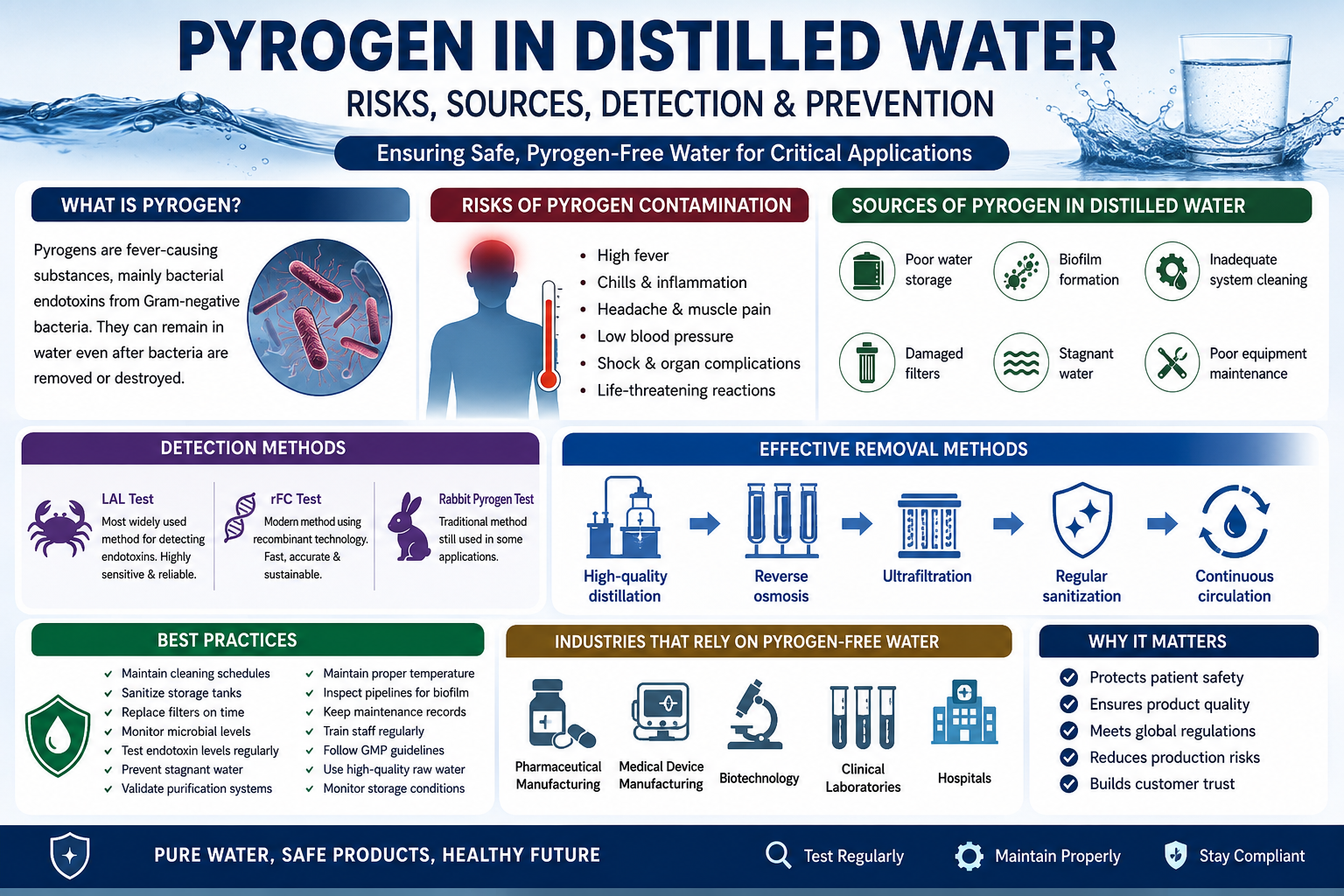
A pyrogen is any substance that causes fever after entering the bloodstream. Although different pyrogens exist, bacterial endotoxins remain the most common and dangerous.
These endotoxins originate from the outer membrane of Gram-negative bacteria. Even after bacteria die, their endotoxins remain active. Therefore, distilled water may appear clear and bacteria-free while still containing harmful pyrogens.
Unlike living bacteria, endotoxins resist normal sterilization methods. Consequently, they require specialized removal techniques.
Why Is Pyrogen in Distilled Water Dangerous?
Pyrogen contamination creates serious risks, especially in pharmaceutical and healthcare applications.
When pyrogens enter the bloodstream, they stimulate the immune system. As a result, patients may experience several reactions.
These include:
- High fever
- Chills
- Severe inflammation
- Low blood pressure
- Headache
- Muscle pain
- Shock in severe cases
- Organ complications
- Increased recovery time
- Rarely, life-threatening conditions
Therefore, industries that manufacture injectable medicines must maintain strict pyrogen control.
Understanding Endotoxins: The Most Common Pyrogen
Endotoxins are lipopolysaccharides (LPS) found in Gram-negative bacteria.
When bacteria grow in water systems, they eventually die and release endotoxins. Although distillation removes many contaminants, improper system maintenance may still allow endotoxin contamination.
Moreover, endotoxins remain stable even after heat sterilization. Therefore, removing bacteria alone does not guarantee pyrogen-free water.
Common Sources of Pyrogen in Distilled Water
Several factors contribute to pyrogen contamination.
1. Poor Water Storage
Improper storage tanks encourage bacterial growth. Consequently, endotoxin levels increase over time.
2. Biofilm Formation
Biofilms develop inside pipelines and storage tanks. These biofilms continuously release endotoxins into water.
3. Inadequate System Cleaning
Without regular sanitization, microorganisms multiply rapidly. As a result, pyrogen contamination becomes more likely.
4. Damaged Filters
Old or damaged filters lose efficiency. Therefore, contaminants pass through the purification system.
5. Stagnant Water
Standing water creates favorable conditions for bacterial growth. Consequently, endotoxin production increases.
6. Poor Equipment Maintenance
Neglected distillation units may lose purification efficiency over time.
How Pyrogen in Distilled Water Affects Different Industries
Pharmaceutical Manufacturing
Injectable medicines require pyrogen-free water because even tiny endotoxin levels may harm patients.
Medical Device Manufacturing
Medical devices often require high-purity water during cleaning. Therefore, pyrogen contamination must remain under strict control.
Biotechnology
Cell cultures respond negatively to endotoxins. Consequently, contaminated water affects research accuracy and product quality.
Clinical Laboratories
Laboratories rely on pure water for testing. Pyrogens can interfere with sensitive experiments.
Hospitals
Sterile processing departments use purified water to clean instruments. Therefore, pyrogen-free water supports patient safety.
Regulatory Standards for Pyrogen in Distilled Water
International organizations establish strict endotoxin limits.
Some important standards include:
- United States Pharmacopeia (USP)
- European Pharmacopoeia (EP)
- Japanese Pharmacopoeia (JP)
- Good Manufacturing Practices (GMP)
- World Health Organization (WHO) guidelines
Manufacturers must regularly monitor endotoxin levels to maintain compliance.
How Pyrogen in Distilled Water Is Detected
Testing remains essential because pyrogens cannot be seen with the naked eye.
Common testing methods include:
Limulus Amebocyte Lysate (LAL) Test
The LAL test is the most widely used endotoxin detection method. It offers high sensitivity and fast results.
Recombinant Factor C Test
This modern method detects endotoxins without using horseshoe crab blood. Additionally, it supports sustainable testing.
Rabbit Pyrogen Test
Some manufacturers still use this traditional test, although modern alternatives have largely replaced it.
Effective Methods to Remove Pyrogen in Distilled Water
Removing pyrogens requires multiple purification steps.
High-Quality Distillation
Properly maintained multi-effect distillation systems remove most endotoxins effectively.
Reverse Osmosis
RO systems reduce microorganisms before water reaches the distillation stage.
Ultrafiltration
Ultrafiltration membranes capture large endotoxin molecules.
Regular Sanitization
Routine cleaning prevents bacterial growth inside pipelines and storage tanks.
Continuous Water Circulation
Moving water discourages bacterial growth and minimizes biofilm formation.
Scheduled Maintenance
Routine inspections help identify worn components before contamination occurs.
Best Practices to Prevent Pyrogen in Distilled Water
Following good operational practices significantly reduces contamination risks.
Recommended practices include:
- Maintain strict cleaning schedules.
- Sanitize storage tanks regularly.
- Replace filters on time.
- Monitor microbial levels.
- Test endotoxin levels frequently.
- Prevent stagnant water.
- Validate purification systems.
- Maintain proper water temperature.
- Inspect pipelines for biofilm.
- Keep detailed maintenance records.
- Train staff regularly.
- Follow GMP guidelines.
- Perform periodic system validation.
- Use high-quality raw water.
- Monitor storage conditions continuously.
Why Routine Monitoring Matters
Routine monitoring helps identify contamination before it affects production.
Moreover, continuous testing reduces product recalls and improves customer confidence.
Regular monitoring also:
- Protects patient safety
- Maintains regulatory compliance
- Reduces manufacturing risks
- Extends equipment life
- Improves production consistency
- Supports quality assurance
- Minimizes downtime
- Prevents costly failures
Pyrogen in Distilled Water vs Microbial Contamination
Many people assume bacteria and pyrogens are the same. However, they differ significantly.
Bacteria are living microorganisms.
Pyrogens are toxic substances that often remain even after bacteria die.
Therefore, sterile water does not always mean pyrogen-free water.
Manufacturers must test for both microbial contamination and endotoxins.
Why High-Purity Water Systems Are Essential
Modern purification systems combine multiple technologies to achieve excellent water quality.
These systems commonly include:
- Pretreatment
- Reverse osmosis
- Electrodeionization
- Multi-effect distillation
- Ultrafiltration
- UV disinfection
- Continuous monitoring
- Automated sanitization
Together, these technologies help maintain consistently safe distilled water.
Internal Links
You can also read:
- Benefits of Deionised Water for Labs
- Distilled vs Deionized Water: Key Differences
- Distilled Water Uses in Cosmetic Manufacturing
- What Are the Key Applications of DM Water in Manufacturing?
External References
For additional technical guidance, refer to:
- United States Pharmacopeia (USP)
- World Health Organization (WHO)
- FDA Water System Guidelines
Frequently Asked Questions
1. What is pyrogen in distilled water?
Pyrogen in distilled water refers to fever-causing substances, mainly bacterial endotoxins, that may remain in water if purification or storage systems are not properly maintained.
-
Can distilled water contain endotoxins?
Yes. Although distillation removes many contaminants, poor maintenance, biofilm formation, or improper storage can introduce endotoxins into distilled water.
-
How do industries detect pyrogen in distilled water?
Industries commonly use the Limulus Amebocyte Lysate (LAL) test, Recombinant Factor C test, and other validated methods to measure endotoxin levels.
-
Why is pyrogen-free water important?
Pyrogen-free water protects patients, ensures pharmaceutical quality, supports laboratory accuracy, and helps manufacturers comply with global regulatory standards.
-
How can manufacturers prevent pyrogen contamination?
Manufacturers should sanitize systems regularly, monitor endotoxin levels, maintain equipment, prevent biofilm formation, validate purification systems, and follow GMP practices.
Conclusion
Pyrogen in distilled water remains one of the most critical quality concerns for pharmaceutical manufacturers, laboratories, biotechnology facilities, and healthcare organizations. Although distilled water removes many impurities, endotoxins can still appear if purification systems, storage tanks, or distribution pipelines are not properly maintained.
Therefore, organizations should combine effective purification technologies with routine endotoxin testing, preventive maintenance, and strict hygiene practices. Moreover, regular monitoring helps maintain regulatory compliance while protecting both products and patients. By implementing these best practices, industries can consistently produce safe, high-quality distilled water that meets modern quality standards.