


pH Value of DM Water
Introduction
The pH value of DM water is an important parameter in many industrial and laboratory applications. DM water, or demineralized water, undergoes a purification process that removes dissolved minerals, salts, and ions. As a result, it becomes highly pure and suitable for applications that require clean water.
Many people assume that DM water always has a pH of 7. However, the actual pH can vary depending on storage conditions, exposure to air, and the testing method. Therefore, understanding the pH value of DM water is essential for maintaining quality and ensuring process efficiency.
In this blog, we will explain the pH of DM water, factors that affect it, its industrial significance, and best practices for monitoring water quality.
What Is DM Water?
DM water stands for demineralized water. Manufacturers produce it by removing dissolved ions such as calcium, magnesium, sodium, chloride, and sulfate.
The purification process often includes:
- Ion exchange systems
- Reverse osmosis systems
- Mixed-bed resin units
- Water polishing units
As a result, DM water contains very low levels of dissolved solids and minerals.
What Is the pH Value of DM Water?
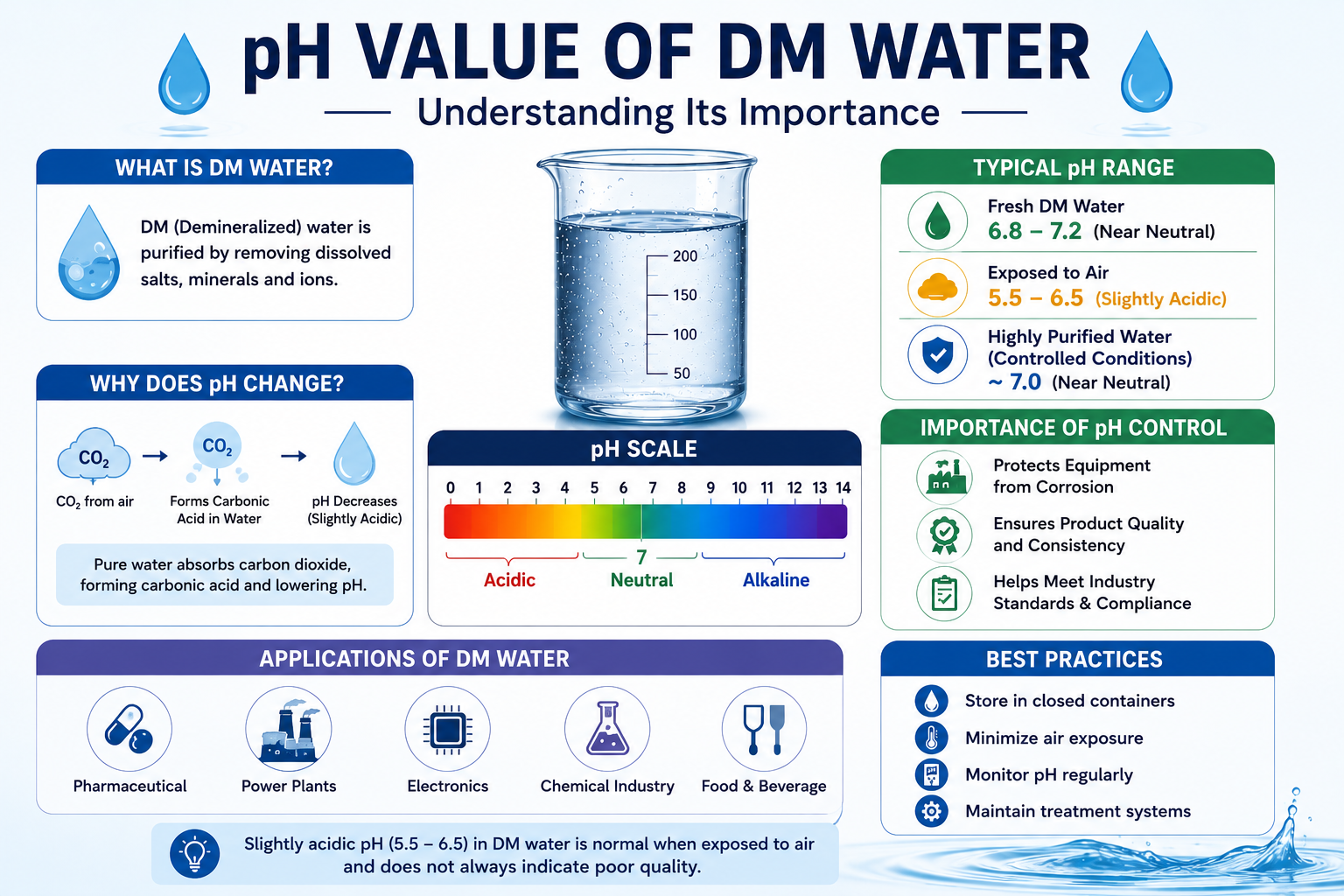
Freshly produced DM water typically has a pH close to 7. This value indicates a neutral condition.
However, the pH does not always remain stable. When DM water comes into contact with air, it absorbs carbon dioxide. Consequently, carbonic acid forms in the water, causing the pH to decrease.
In most cases:
- Fresh DM water: pH 6.8–7.2
- Exposed DM water: pH 5.5–6.5
- Highly purified water in controlled systems: near pH 7
Therefore, pH measurements can vary depending on environmental conditions.
Why Does the pH of DM Water Change?
Several factors influence the pH value of DM water.
Carbon Dioxide Absorption
Carbon dioxide from the atmosphere dissolves easily in pure water. As a result, carbonic acid forms and lowers the pH.
Storage Conditions
Open containers allow more air exposure. Consequently, the water absorbs additional carbon dioxide and becomes slightly acidic.
Water Purity Level
Highly purified water reacts quickly to small environmental changes. Therefore, even minor contamination can affect pH readings.
Temperature
Temperature influences chemical reactions and measurement accuracy. As a result, pH values may vary at different temperatures.
Testing Equipment
Poor calibration can produce inaccurate results. Therefore, regular calibration is necessary for reliable measurements.
Is Low pH in DM Water a Problem?
A slightly lower pH does not always indicate poor water quality.
In fact, DM water often becomes mildly acidic because it lacks minerals that normally buffer pH changes. Therefore, a pH between 5.5 and 6.5 is common when DM water remains exposed to air.
However, industries should investigate sudden or extreme pH changes. These changes may indicate contamination, equipment issues, or process failures.
Importance of pH Value in Industrial Applications
Many industries rely on precise water quality standards. Therefore, monitoring pH remains an essential part of quality control.
Pharmaceutical Industry
Pharmaceutical manufacturers use DM water for:
- Equipment cleaning
- Product formulation
- Laboratory testing
- Process rinsing
Consistent pH helps maintain product quality and regulatory compliance.
Power Plants
Boilers and turbines require high-purity water. Proper pH control helps reduce corrosion and improve system performance.
Electronics Manufacturing
Electronic components are highly sensitive to contamination. Therefore, manufacturers monitor pH to ensure cleaning effectiveness and product reliability.
Chemical Processing
Many chemical reactions depend on specific pH conditions. As a result, accurate pH control improves process consistency.
Food and Beverage Industry
Water quality directly affects product taste and safety. Therefore, manufacturers routinely monitor pH levels during production.
How to Measure the pH of DM Water
Accurate pH measurement requires proper techniques.
Follow these steps:
- Use a calibrated pH meter.
- Collect a fresh water sample.
- Minimize exposure to air.
- Measure the sample immediately.
- Record the temperature.
- Clean the electrode before testing.
- Verify calibration regularly.
These practices improve measurement accuracy and reduce errors.
Benefits of Monitoring DM Water pH
Regular monitoring provides several advantages.
Improved Product Quality
Stable water quality supports consistent manufacturing results.
Better Equipment Protection
Proper pH control helps reduce corrosion and maintenance costs.
Enhanced Process Efficiency
Reliable water quality improves operational performance.
Regulatory Compliance
Many industries must meet strict water quality standards. Therefore, monitoring pH helps maintain compliance.
Reduced Downtime
Early detection of water quality issues prevents unexpected production interruptions.
Common Myths About DM Water pH
Myth 1: DM Water Always Has a pH of 7
This statement is not always true. Air exposure often lowers the pH.
Myth 2: Low pH Means Poor Water Quality
Not necessarily. Slight acidity often occurs naturally because DM water absorbs carbon dioxide.
Myth 3: pH Is the Only Indicator of Water Quality
Water quality also depends on conductivity, resistivity, and total dissolved solids.
Myth 4: pH Never Changes During Storage
Storage conditions can significantly influence pH values.
Best Practices for Maintaining DM Water Quality
To maintain high-quality DM water:
- Store water in closed containers.
- Use high-quality storage tanks.
- Monitor conductivity regularly.
- Test pH periodically.
- Inspect treatment systems.
- Replace exhausted resins promptly.
- Prevent contamination during handling.
- Follow industry quality standards.
These practices help maintain consistent water performance.
Frequently Asked Questions
What is the normal pH range of DM water?
Fresh DM water usually has a pH between 6.8 and 7.2. However, exposure to air may lower it to 5.5–6.5.
Why does DM water become acidic?
DM water absorbs carbon dioxide from the atmosphere. Consequently, carbonic acid forms and reduces the pH.
Is DM water safe for industrial use when pH is below 7?
Yes. Slight acidity is common in exposed DM water and does not necessarily indicate poor quality.
How often should pH be monitored?
The frequency depends on the application. However, critical industries often perform daily or continuous monitoring.
Does pH affect equipment performance?
Yes. Improper pH levels can contribute to corrosion and process inefficiencies.
What is the difference between DM water and distilled water?
DM water removes ions through ion exchange, while distilled water uses evaporation and condensation for purification.
Conclusion
The pH value of DM water plays an important role in quality control and industrial performance. Although freshly produced DM water is nearly neutral, exposure to air can lower its pH over time. Therefore, industries should monitor pH regularly and follow proper storage practices.
By understanding the factors that affect pH, businesses can maintain water quality, protect equipment, and improve process efficiency. As a result, DM water remains one of the most valuable resources in modern industrial operations.