


Introduction
Water plays a vital role in manufacturing. Almost every production facility uses water during its operations. However, regular water is not always suitable for industrial applications. It often contains minerals, salts, and impurities that can affect product quality and equipment performance.
As a result, many industries choose demineralized water, commonly known as DM water. This purified water helps manufacturers improve efficiency, reduce maintenance costs, and protect valuable equipment.
What Is DM Water?
DM water is water that has undergone a treatment process to remove dissolved minerals and impurities. Common minerals found in untreated water include calcium, magnesium, sodium, chloride, and sulfate.
Although these minerals are harmless in many situations, they can create serious challenges in industrial environments. Therefore, manufacturers use water treatment systems to achieve the purity levels required for production.
Because DM water contains very low levels of dissolved solids, it helps prevent scaling, corrosion, and contamination.
Why Industries Use DM Water
Many manufacturing processes require precision and consistency. Even a small amount of contamination can affect product quality. In addition, mineral deposits can damage expensive equipment.
Over time, untreated water can create scale inside pipelines, boilers, and heat exchangers. Consequently, equipment becomes less efficient and maintenance costs increase.
DM water helps eliminate these issues. Furthermore, it supports stable production conditions and improves overall operational performance.
DM Water in Boiler Operations
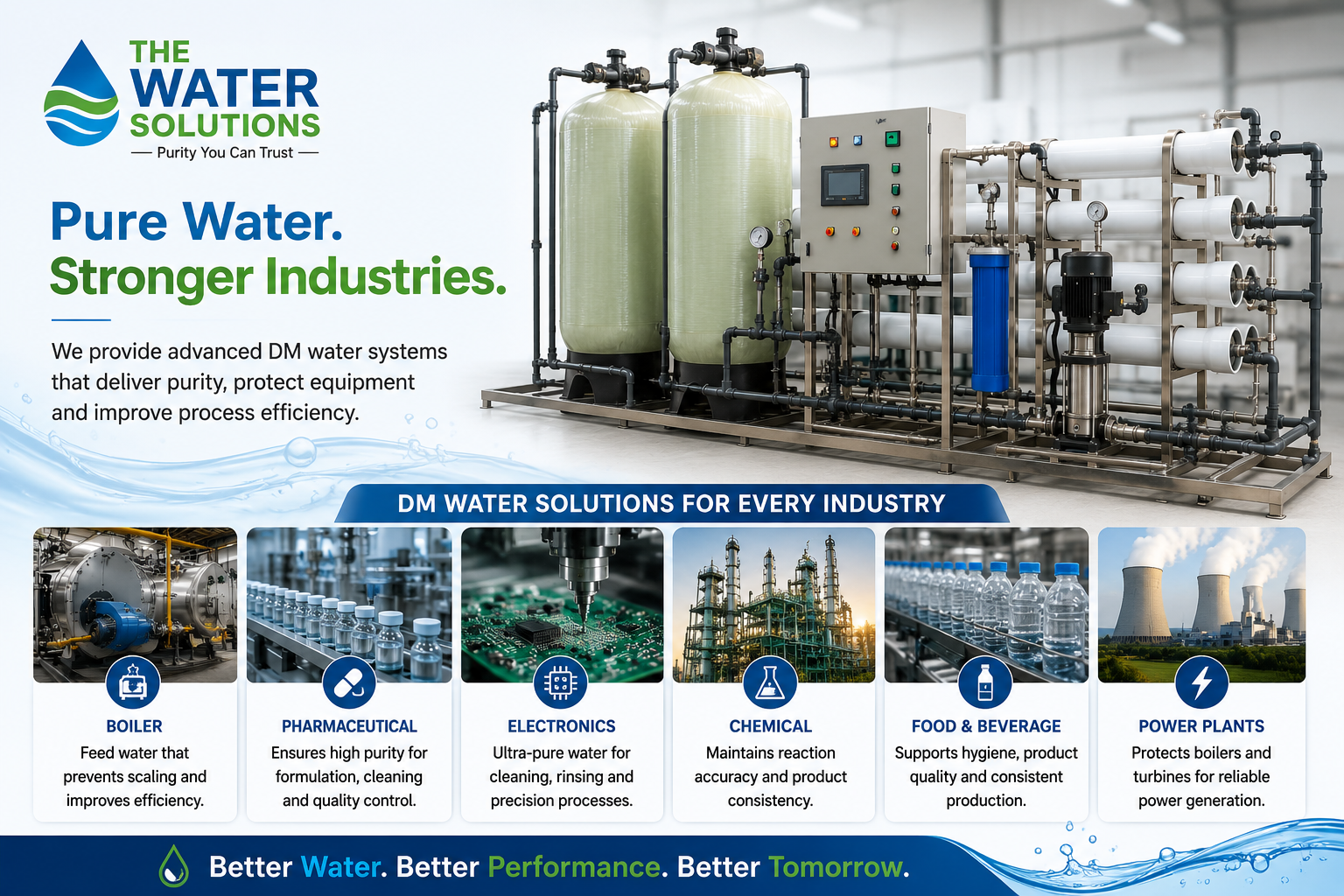
One of the most common uses of DM water is boiler feed applications. Boilers generate steam for heating, cleaning, and power generation processes.
When untreated water enters a boiler, minerals begin to accumulate on internal surfaces. As a result, scale forms and reduces heat transfer efficiency.
Therefore, boilers consume more energy and require additional maintenance. In severe cases, mineral buildup can even cause equipment failure.
DM water removes the minerals responsible for scale formation. Consequently, manufacturers benefit from lower operating costs, better energy efficiency, and longer equipment life.
Pharmaceutical Manufacturing
The pharmaceutical industry requires extremely pure water. Product safety and quality depend on maintaining strict production standards.
For this reason, pharmaceutical companies use DM water during formulation, equipment cleaning, laboratory testing, and quality control activities.
Moreover, purified water helps manufacturers comply with industry regulations while maintaining product consistency.
Electronics Manufacturing
The electronics industry also depends on high-purity water. Components such as semiconductors and circuit boards require clean manufacturing environments.
Even small amounts of contamination can affect product performance. Therefore, manufacturers use DM water for cleaning and rinsing electronic components.
As technology continues to advance, the demand for high-quality water also continues to grow.
Chemical Processing
Chemical manufacturing often involves sensitive reactions. However, unwanted minerals can interfere with these processes.
DM water provides a controlled environment that supports accurate and consistent production results. In addition, it reduces contamination risks and improves process efficiency.
Because of these benefits, many chemical manufacturers include DM water systems in their production facilities.
Food and Beverage Production
Water quality directly affects food and beverage products. Minerals and contaminants can influence taste, appearance, and product stability.
Therefore, manufacturers use DM water to support hygiene standards and maintain product consistency.
Furthermore, purified water helps companies meet regulatory requirements while improving production quality.
Automotive Manufacturing
Modern automotive manufacturing requires clean water for several processes. For example, manufacturers use DM water during battery production, painting operations, and component cleaning.
Because DM water contains very few dissolved minerals, it helps prevent surface defects and improves finishing quality.
As a result, manufacturers achieve better production outcomes and reduce equipment-related issues.
Long-Term Benefits of DM Water
The benefits of DM water extend beyond product quality. Manufacturers often experience lower maintenance costs and improved equipment reliability.
In addition, cleaner systems help reduce downtime and support efficient operations.
Over the long term, these advantages can generate significant cost savings. Therefore, many companies view DM water as a valuable investment.
Frequently Asked Questions
1. What is DM water and why is it used in manufacturing?
DM water is demineralized water that contains very low levels of dissolved minerals. Manufacturers use it to prevent scaling, corrosion, and contamination during production.
2. Which industries commonly use DM water?
Industries such as pharmaceuticals, electronics, chemicals, food processing, automotive manufacturing, and power generation frequently use DM water.
3. How does DM water improve equipment performance?
DM water prevents mineral deposits from forming inside industrial equipment. This improves efficiency, reduces maintenance needs, and extends equipment life.
4. Is DM water better than regular water for industrial applications?
Yes. DM water contains fewer impurities and minerals, making it more suitable for sensitive manufacturing processes and high-performance equipment.
Conclusion
The applications of DM water in manufacturing continue to expand as industries demand higher levels of efficiency and quality. Whether it is used in boilers, pharmaceuticals, electronics, chemicals, food production, or automotive manufacturing, DM water helps create a more reliable production environment.
By removing dissolved minerals and impurities, DM water protects equipment, improves product consistency, and supports efficient operations. As manufacturing standards evolve, high-purity water will remain an essential requirement for businesses that want to maintain a competitive edge.