


DI water is widely used in plating and metal-finishing processes where water quality and contamination control are important. Plating involves depositing a metal coating onto a surface to improve appearance, corrosion resistance, wear resistance, or other surface properties.
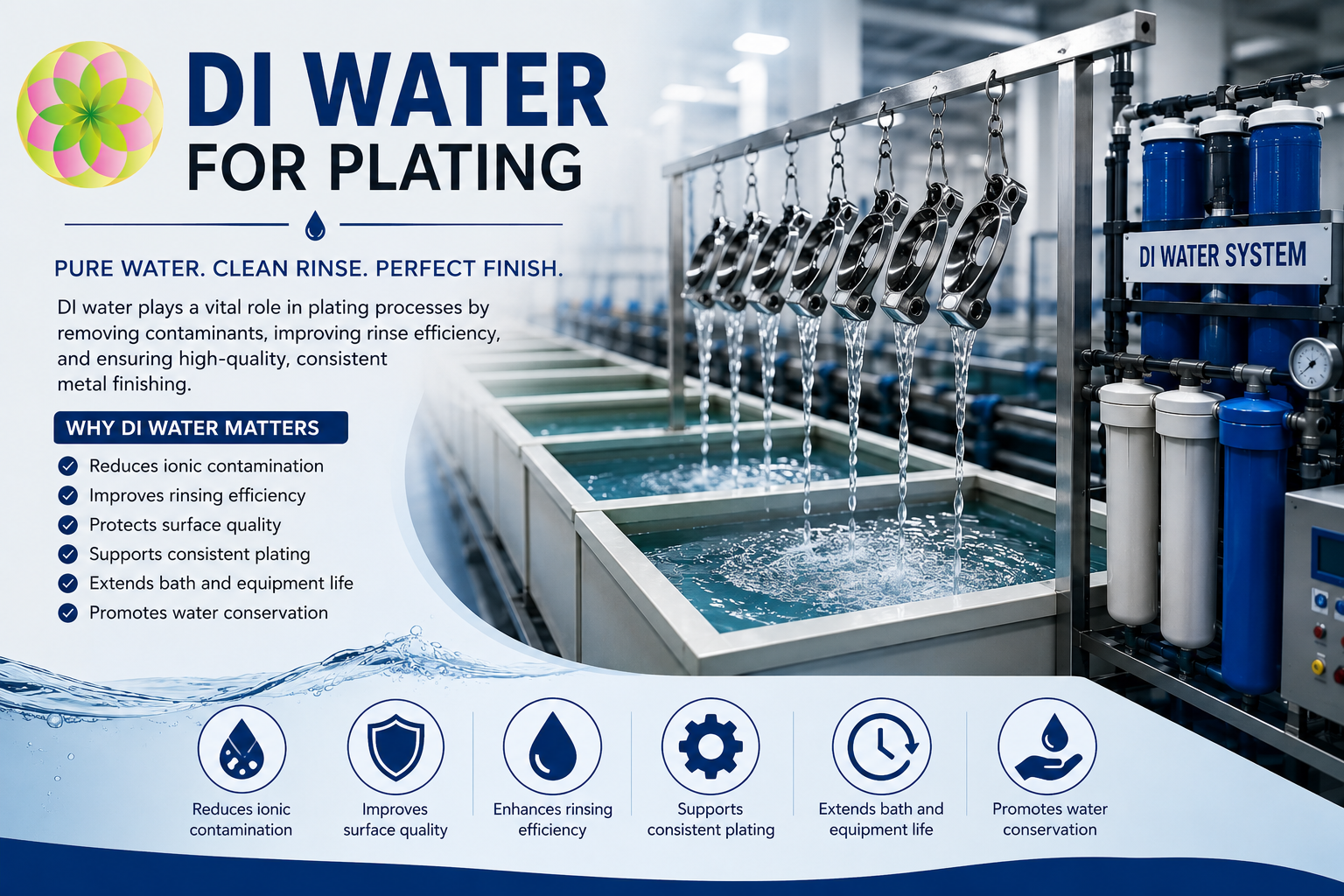
During plating, components often pass through several cleaning, activation, plating, and rinsing stages. Therefore, the quality of the rinse water can affect the overall process. DI water contains far fewer dissolved ions than ordinary water. As a result, it can help reduce unwanted mineral and ionic contamination during critical rinse stages.
What Is DI Water?
DI water, or deionized water, is water that has undergone a purification process to remove many dissolved charged ions.
Ordinary water can contain minerals such as calcium, magnesium, sodium, chloride, sulfate, and other dissolved substances. These minerals may not cause problems in normal applications. However, plating processes can require tighter control of contamination.
A DI water system commonly uses ion-exchange technology. Many industrial systems also combine pretreatment, reverse osmosis, deionization, and polishing stages to achieve the required water quality.
The required purity depends on the plating process. Therefore, manufacturers should select water quality according to their process specifications instead of using the same specification for every application.
Why DI Water Is Important for Plating
Plating requires a clean and controlled surface. Before plating, manufacturers may clean the component, remove grease, activate the surface, and perform other chemical treatments.
After each chemical stage, the component usually requires rinsing. The rinse removes chemical residues before the component enters the next stage.
If the rinse water contains a high level of dissolved minerals, those substances can remain on the surface or enter another process tank. Consequently, contamination can build up over time.
DI water can reduce this source of ionic contamination. Therefore, it is useful for critical rinsing applications where surface cleanliness matters.
The U.S. EPA’s metal-finishing guidance specifically recommends deionized, distilled, or reverse-osmosis water as rinse water where hard water could reduce cleaning effectiveness.
DI Water for Plating Rinsing
Rinsing is one of the most important applications of DI water in plating.
When a component leaves a plating bath, a small amount of process solution can remain on its surface. This phenomenon is commonly called drag-out. The component then carries some of the solution into the rinse tank.
A well-designed rinse system removes this chemical carryover.
DI water can provide a cleaner water source for critical rinse stages. Therefore, it can help reduce the introduction of additional dissolved ions during rinsing.
However, DI water alone cannot eliminate contamination. Proper drainage, tank design, rinse flow, agitation, and process control also matter.
The EPA recommends several rinse-water management techniques, including countercurrent rinsing, flow controls, conductivity controls, and production-activated rinse systems.
DI Water in Electroplating
Electroplating uses an electrical process to deposit a metal coating onto another material. Common plating metals include copper, nickel, chromium, zinc, tin, and others. The coating can improve corrosion protection, wear resistance, appearance, or other properties.
DI water can support different stages of an electroplating line.
Pre-Plating Rinse
Before plating, components may pass through cleaning and surface-preparation baths. DI water can help remove residues from these treatments before the component enters the plating bath.
Intermediate Rinse
Components may require several rinses between chemical treatments. DI water can help limit the transfer of unwanted ions from one stage to another.
Final Rinse
A final rinse can remove remaining process residues before drying. In sensitive applications, DI water can help reduce mineral residues on the finished surface.
Chemical Solution Preparation
Some plating formulations may require purified water during bath preparation or chemical replenishment. However, manufacturers should follow the chemical supplier’s specifications because each formulation has different requirements.
DI Water for Different Plating Processes
Different plating processes have different operating conditions. Therefore, the role of DI water can vary between applications.
Nickel Plating
Nickel plating provides corrosion resistance, wear resistance, and an attractive surface finish. Clean rinsing can help reduce contamination between nickel-plating stages.
Copper Plating
Copper plating is common in electrical, electronic, decorative, and industrial applications. Controlled rinse water can help maintain cleaner surfaces and reduce unwanted ionic carryover.
Zinc Plating
Zinc plating commonly provides corrosion protection for steel and other components. Proper rinsing helps remove treatment residues before subsequent processing.
Chrome Plating
Chrome finishing requires careful process control. Suitable rinse water can help maintain surface cleanliness between treatment stages.
Tin Plating
Tin plating can provide useful surface properties such as corrosion resistance and solderability. Controlled rinsing can help maintain process consistency.
The correct water specification should always depend on the actual plating chemistry and production requirements.
DI Water and Surface Cleanliness
Surface preparation has a major influence on plating quality.
Oil, grease, dirt, oxides, and other contaminants can interfere with coating adhesion. Therefore, manufacturers usually clean and activate components before plating.
Rinsing then removes chemicals from the previous treatment.
DI water can support this process by reducing the amount of dissolved ionic material introduced during rinsing. Consequently, it can help maintain cleaner process conditions.
However, DI water does not replace proper cleaning. A contaminated component will remain contaminated even if the final rinse uses high-purity water.
DI Water and Conductivity
Conductivity is an important parameter for monitoring DI water.
Dissolved ions increase the electrical conductivity of water. Therefore, a change in conductivity can indicate a change in ionic purity.
Manufacturers can monitor conductivity to identify problems such as:
- Exhausted ion-exchange resin
- Poor RO performance
- Contamination in storage tanks
- Distribution-system contamination
- Chemical carryover
- Treatment-system malfunction
Regular conductivity monitoring can provide an early warning before water-quality problems affect production.
However, conductivity does not measure every possible contaminant. Therefore, additional testing may be necessary for sensitive plating applications.
DI Water and pH in Plating
pH plays an important role in plating because it can affect surface preparation, plating-bath stability, metal deposition, corrosion behavior, and rinse performance. However, DI water does not have one fixed pH value that applies to every plating process. Because deionized water contains very few dissolved ions, it can quickly absorb carbon dioxide from the air, which may lower its measured pH. Therefore, manufacturers should control pH according to the specific plating bath, rinse stage, and chemical manufacturer’s requirements.
In electroplating, maintaining the correct pH helps support stable chemical reactions and consistent metal deposition. If the pH moves outside the recommended range, the process may experience issues such as uneven coating, poor adhesion, surface discoloration, excessive deposits, or reduced plating efficiency. Therefore, operators should regularly monitor the pH of plating baths and other process solutions where pH control is required.
For DI water used for rinsing, conductivity and ionic purity are often more useful indicators than pH alone. DI water can have a variable pH reading, especially after exposure to air. As a result, operators should avoid using the pH of fresh DI water as the only measure of its quality. Instead, they should follow the process specification and monitor parameters such as conductivity, resistivity, and specific contaminants when required.
Overall, DI water supports cleaner rinsing by reducing dissolved ionic contaminants, while proper pH control helps maintain stable plating chemistry. Both factors should be managed together to achieve consistent plating performance.
DI Water and Plating Defects
Plating defects can have many causes. Water quality is only one possible factor.
Common causes include:
- Poor surface cleaning
- Incorrect bath concentration
- Incorrect current density
- Incorrect temperature
- Contaminated plating chemicals
- Excessive drag-out
- Poor rinsing
- Contaminated rinse tanks
- Equipment problems
- Incorrect process time
Therefore, operators should investigate the complete process when defects occur.
If conductivity suddenly increases in a DI water system, operators should inspect the purification equipment and rinse tanks. At the same time, they should check the plating bath and surface-preparation stages.
DI Water and Cross-Contamination
Cross-contamination occurs when chemicals or contaminants move from one process stage to another.
For example, a component leaving a nickel-plating bath can carry some solution into the next rinse tank. If the rinse system does not remove this material effectively, contamination can increase.
DI water can help reduce the introduction of additional dissolved ions. However, good rinse design remains essential.
Manufacturers can improve rinse performance by using:
- Proper drainage time
- Countercurrent rinsing
- Controlled water flow
- Multiple rinse stages
- Suitable agitation
- Conductivity monitoring
- Regular rinse-tank cleaning
- Drag-out reduction
How DI Water Is Produced
Industrial DI water production often uses several treatment stages.
1. Pretreatment
Pretreatment removes suspended solids and other contaminants that could damage downstream equipment.
2. Reverse Osmosis
Reverse osmosis reduces dissolved salts and many other contaminants from the feed water.
3. Deionization
Ion-exchange technology removes remaining charged ions.
4. Polishing
Some applications require additional purification to achieve a higher-quality water specification.
5. Storage and Distribution
The treated water then moves through a storage and distribution system.
Every stage matters. Even high-quality water can become contaminated if the storage tank or distribution system is poorly maintained.
DI Water Storage for Plating
Proper storage helps maintain water quality after purification.
Manufacturers should consider:
- Closed storage tanks
- Suitable tank materials
- Clean distribution pipes
- Regular tank inspection
- Proper circulation
- Reduced dead legs
- Routine conductivity monitoring
- Preventive maintenance
If purified water remains stagnant for long periods, contamination risks can increase. Therefore, system design should match the required production pattern.
DI Water and Water Conservation
Plating lines can use significant amounts of rinse water. Therefore, manufacturers should control water flow instead of continuously using excessive fresh water.
Countercurrent rinsing can reduce fresh-water demand because cleaner water enters the final rinse stage and then flows toward earlier, more contaminated stages.
Other useful approaches include:
- Flow restrictors
- Conductivity controls
- Timer controls
- Spray rinsing
- Multiple rinse tanks
- Drag-out reduction
- Production-activated rinse systems
EPA guidance identifies these approaches as useful methods for improving rinse-water management in metal-finishing operations.
DI Water and Wastewater Management
Plating wastewater can contain metals and chemicals from cleaning, surface preparation, plating, and rinsing operations. EPA documentation identifies pollutants associated with electroplating and metal-finishing wastewater, including metals such as copper, nickel, chromium, zinc, tin, and others. Therefore, DI water does not make plating wastewater automatically safe.
Once DI water contacts a plating bath or contaminated component, it can contain process chemicals and metal residues.
Manufacturers should therefore collect and treat plating wastewater according to applicable environmental requirements.
Good rinse management can also reduce unnecessary water consumption and help control the amount of contaminants entering wastewater treatment.
Best Practices for Using DI Water for Plating
Manufacturers can improve process consistency by following a controlled water-management program.
- Define the required water quality.
- Monitor DI water conductivity regularly.
- Check rinse-tank quality.
- Maintain the purification system.
- Control rinse-water flow.
- Reduce drag-out.
- Use countercurrent rinsing where suitable.
- Keep storage tanks clean.
- Maintain distribution piping.
- Record water-quality readings.
- Investigate sudden conductivity changes.
- Follow chemical supplier recommendations.
- Treat plating wastewater appropriately.
These steps help connect water quality with overall plating-process control.
Benefits of DI Water for Plating
Using DI water in suitable plating applications can provide several benefits.
Reduced Ionic Contamination
DI water contains fewer dissolved ions than untreated water. Therefore, it can reduce unwanted mineral contamination during critical rinsing.
Cleaner Rinsing
Clean rinse water can help remove chemical residues without adding significant mineral contamination.
Better Process Control
Regular water-quality monitoring gives operators more control over rinse conditions.
Improved Surface Cleanliness
Lower ionic contamination can support cleaner surfaces in applications that require controlled finishing conditions.
Reduced Risk of Water-Related Defects
Although water is only one process variable, controlling water quality can reduce one potential source of contamination.
Frequently Asked Questions
1. Why is DI water used for plating?
DI water is used to reduce ionic contamination during critical rinsing and, where specified, other plating-related processes. It can help maintain cleaner process conditions.
2. Is DI water required for every plating process?
No. The requirement depends on the plating chemistry, rinse stage, product specification, and process sensitivity.
3. Can DI water improve plating quality?
DI water can support consistent plating by reducing unwanted ionic contamination. However, surface preparation, bath chemistry, temperature, current density, and rinsing also affect plating quality.
4. How do manufacturers monitor DI water?
Conductivity or resistivity is commonly used to monitor ionic purity. Additional tests may be required when a process has specific contamination limits.
5. Can DI water reduce plating wastewater?
DI water itself does not eliminate wastewater. However, efficient rinse design, flow control, and countercurrent rinsing can reduce water consumption and improve wastewater management.
Conclusion
DI water is an important water-quality option for plating and metal-finishing applications that require controlled rinsing and low ionic contamination. It can support surface cleanliness, reduce unwanted mineral residues, and improve control of critical rinse stages.
However, DI water works best as part of a complete plating process. Manufacturers should also control surface preparation, plating chemistry, rinse flow, conductivity, equipment condition, storage, and wastewater management.
With the right water specification and regular monitoring, DI water for plating can help manufacturers maintain cleaner processes and more consistent metal-finishing results.