


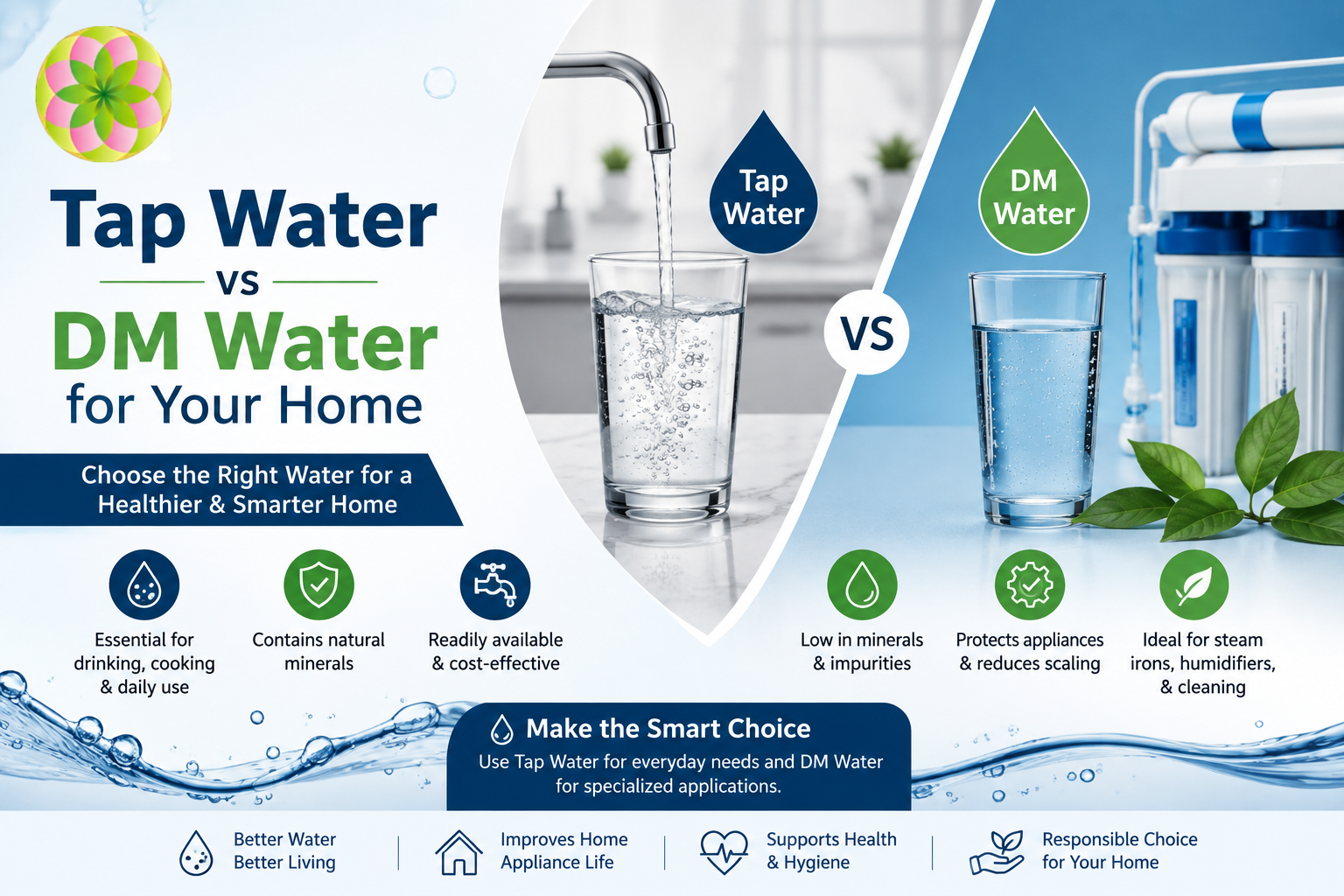
DM Water and tap water serve very different purposes at home. Tap water is supplied for regular household needs such as drinking, cooking, bathing, and cleaning. DM water, also called demineralized water, has most dissolved mineral ions removed through a water treatment process.
At first, these two types of water may look the same. However, their mineral content, electrical conductivity, treatment process, and suitable applications can differ greatly. Therefore, choosing between tap water and DM water depends on how you plan to use the water.
USGS explains that normal water contains dissolved substances and minerals, while distilled and deionized water contain far fewer dissolved ions.
This guide explains the difference between tap water and DM Water, where each type works best, and why you should not automatically replace drinking water with demineralized water.
What Is Tap Water?
Tap water is water delivered through a household water supply system. Depending on the source, it may come from surface water, groundwater, or another treated supply.
Before reaching your home, a water supplier may use several treatment steps. These steps can include filtration, disinfection, and other processes designed to control contaminants.
However, tap water is not chemically identical everywhere. Its mineral content can vary according to the source, geology, treatment process, and distribution system.
Tap water can contain dissolved minerals such as calcium and magnesium. It can also contain other dissolved substances. The exact composition depends on the local water supply.
Therefore, homeowners should check their local water quality information when they want to understand what their tap water contains. The U.S. EPA also recommends testing household drinking water when there is a specific reason to check its quality.
What Is DM Water?
DM Water means demineralized water. Manufacturers produce it by removing many dissolved mineral ions from water.
A demineralization system can use ion-exchange technology. Some systems combine different treatment methods to achieve a lower ionic content.
During ion exchange, unwanted cations and anions are exchanged with hydrogen and hydroxide ions. These ions then combine to form water.
As a result, DM water contains much lower concentrations of many dissolved ions than ordinary tap water.
USGS describes deionized water as highly purified water commonly used in laboratory applications. It also notes that even very pure water can still contain some ions.
This point is important because DM Water does not automatically mean sterile water. Demineralization mainly targets dissolved ionic substances. It does not guarantee the removal of every possible contaminant or microorganism.
Tap Water vs DM Water: The Main Difference
The biggest difference between tap water and DM water is their treatment and mineral content.
Tap water normally retains some dissolved minerals. These minerals can affect taste, hardness, scaling, and conductivity.
DM water has a much lower ionic concentration. Therefore, it generally has lower electrical conductivity than untreated tap water.
This difference makes DM water useful for applications where dissolved ions can interfere with equipment, processes, or cleaning.
For example, water with high mineral content can leave deposits when it evaporates. DM water can help reduce such mineral deposits in suitable equipment and processes.
However, lower mineral content does not automatically make DM water better for every household purpose.
The correct choice depends on the application.
Why Tap Water Is Commonly Used at Home
Tap water is designed for normal household use when the local supply meets applicable drinking-water requirements.
People commonly use tap water for:
- Drinking
- Cooking
- Washing fruits and vegetables
- Bathing
- Washing clothes
- Cleaning floors
- Washing utensils
- General household cleaning
- Gardening, depending on local water quality
Tap water also has a practical advantage. It is readily available through the household plumbing system.
In addition, naturally occurring minerals can affect the taste of drinking water. USGS notes that dissolved minerals contribute to the taste of ordinary water, while highly purified water can taste relatively flat.
Therefore, for normal drinking and cooking, use water that meets your local drinking-water requirements rather than choosing DM water simply because it has fewer minerals.
Why DM Water Is Used at Home
DM water has several useful household applications. However, these applications are different from normal drinking-water uses.
You may use demineralized water for applications where mineral deposits or ionic contamination can cause problems.
Common examples include:
1. Steam Irons
Minerals in ordinary water can accumulate inside a steam iron. Over time, deposits may affect steam performance and may leave marks on fabrics.
Depending on the manufacturer’s instructions, DM water may help reduce mineral buildup.
Always check the appliance manual first. Some manufacturers recommend a specific type of water.
2. Humidifiers
Some humidifiers can produce mineral deposits when supplied with hard water.
These deposits may collect inside the appliance and around the surrounding area.
DM water can help reduce mineral residue. However, you should still clean the humidifier regularly and follow the manufacturer’s water-quality instructions.
3. Certain Cleaning Applications
DM water can work well for cleaning sensitive surfaces where mineral spots are a concern.
For example, after cleaning glass or polished surfaces, mineral-rich water can leave visible marks as it dries.
DM water contains fewer dissolved minerals. Therefore, it can reduce mineral residue when used appropriately.
4. Technical Household Equipment
Some household equipment uses water as part of a technical process.
In these cases, mineral content can affect heating elements, sensors, or internal components.
Using DM water may reduce mineral deposits. Nevertheless, the equipment manufacturer should always define the required water quality.
5. DIY and Hobby Applications
People sometimes use DM water for hobbies and small technical projects that require low-mineral water.
For example, certain electronics-related cleaning or laboratory-style experiments may require water with controlled ionic content.
In such cases, users should check the required conductivity, resistivity, and purity grade instead of assuming that all DM water has the same quality.
DM Water and Drinking: Is It the Same as Drinking Water?
This is one of the most important differences.
DM water is produced to reduce dissolved ions. Drinking water, on the other hand, must meet appropriate quality requirements for human consumption.
Therefore, do not assume that water is safe to drink simply because it has gone through a demineralization process.
A demineralization system focuses mainly on dissolved ionic substances. It does not automatically provide complete microbiological protection.
For drinking, use water that is specifically treated and intended for potable use.
If you have concerns about your household water, testing can help identify specific issues. The EPA provides guidance on household drinking-water testing and filtration.
pH Impact of DM Water and Tap Water
pH measures how acidic or alkaline water is. Tap water can have a pH influenced by its source, treatment, and dissolved minerals. DM water can also change in pH because highly purified water can absorb carbon dioxide from the air. Therefore, you should not judge water quality from pH alone. A suitable pH depends on the intended application, and pH does not indicate the complete mineral or microbiological quality of water. As a reference point, the U.S. EPA lists a secondary drinking-water pH range of 6.5 to 8.5 for its standards.
Does DM Water Remove All Contaminants?
No.
This is a common misunderstanding.
Demineralization mainly reduces dissolved ionic substances. The exact removal performance depends on the treatment system and its operating condition.
DM water should not automatically be considered:
- Sterile water
- Distilled water
- Drinking water
- Bacteria-free water
- Chemical-free water
- Laboratory-grade reagent water
Different purification technologies remove different types of impurities.
For example, filtration can target particles, while disinfection targets microorganisms. Ion exchange focuses on ionic substances.
Therefore, water treatment should match the actual quality requirement.
Why Water Quality Matters for Home Appliances
Minerals in water can affect household appliances.
Hard or mineral-rich water can contribute to scale formation. When water heats and evaporates, dissolved minerals can remain behind as deposits.
These deposits may affect:
- Heating elements
- Steam pathways
- Water tanks
- Valves
- Nozzles
- Sensors
- Internal pipes
Consequently, using the correct water quality can support equipment performance.
However, more purified water is not always better. The appliance manufacturer may specify tap water, filtered water, distilled water, or demineralized water.
Always follow that recommendation.
Conductivity: An Important Difference
Electrical conductivity provides useful information about the concentration of dissolved ions in water.
Tap water usually contains dissolved ions. Therefore, it can conduct electricity more readily than highly deionized water.
DM water has fewer dissolved ions. Consequently, its conductivity is generally much lower.
USGS explains that dissolved ions allow water to conduct electricity and that distilled and deionized water are considered examples of highly pure water.
For technical applications, conductivity can therefore provide a quick indication of changes in ionic purity.
Still, conductivity alone cannot describe every aspect of water quality.
Mineral Content and Water Taste
Tap water can contain minerals such as calcium and magnesium. These dissolved substances can affect taste.
DM water contains far fewer dissolved mineral ions. As a result, it can taste flat or unusual compared with normal drinking water.
USGS notes that ordinary water commonly contains dissolved minerals, while highly purified water can have a noticeably flat taste.
Therefore, taste is not a reliable way to determine whether water is safe or suitable for a particular application.
Water should be tested against the quality requirements of its intended use.
Can DM Water Replace Tap Water for Every Home Use?
No.
The two types of water serve different purposes.
Tap water is generally the practical choice for normal household activities when it meets local drinking-water requirements.
DM water is more suitable for selected applications where low mineral content provides a technical benefit.
For example, you may prefer DM water for an appliance that specifically recommends low-mineral water.
On the other hand, you should not replace drinking water with technical-grade DM water simply because it has fewer dissolved minerals.
The quality specification matters more than the label.
When Should You Choose Tap Water?
Tap water can be the better choice when you need water for:
- Drinking
- Cooking
- Food preparation
- Bathing
- Washing
- General household activities
- Other uses covered by the local drinking-water supply
Before using tap water for drinking, make sure your local supply is considered safe and meets applicable requirements.
If you use a private well, regular testing becomes especially important because private water sources can have different risks and are not necessarily monitored in the same way as public systems.
When Should You Choose DM Water?
DM water can be useful when low mineral content matters.
Consider DM water for:
- Steam irons, when recommended by the manufacturer
- Humidifiers, when recommended
- Selected cleaning applications
- Certain technical equipment
- Some hobby and DIY applications
- Processes where mineral deposits can create problems
Before buying DM water, identify the required specification.
You may need to check:
- Conductivity
- Resistivity
- Total dissolved solids
- pH
- Hardness
- Microbiological quality
- Specific ionic limits
This approach prevents you from paying for a purity level that your application does not need.
How to Select the Right Water for Your Home
Choosing between tap water and DM water becomes easier when you follow a few steps.
Step 1: Identify the Application
First, decide how you will use the water.
Drinking water has different requirements from appliance water.
Step 2: Check the Manufacturer’s Instructions
If you need water for an appliance, read the manual.
The manufacturer may specify the exact water type.
Step 3: Check Water Quality
If you are concerned about tap water, test it.
Useful parameters may include hardness, TDS, pH, microbial quality, and specific contaminants.
Step 4: Choose the Required Purity
Do not automatically choose the highest purity.
Instead, select water that meets the application’s actual requirements.
Step 5: Store Purified Water Correctly
Storage can affect water quality.
Use clean containers and keep them closed. Also, avoid contamination during transfer.
Highly purified water can pick up substances from containers, air, pipes, and equipment. Therefore, storage conditions matter.
Common Mistakes When Using DM Water at Home
Many users make the same mistakes when choosing purified water.
Mistake 1: Assuming DM Water Is Always Safe to Drink
Demineralization does not automatically make water potable.
Mistake 2: Assuming DM Water Removes Everything
Different treatment methods remove different contaminants.
Mistake 3: Ignoring the Appliance Manual
Some appliances require a specific water type.
Mistake 4: Choosing Water Only by TDS
TDS provides useful information, but it does not describe every water-quality parameter.
Mistake 5: Ignoring Storage
Clean water can become contaminated through poor storage or handling.
Mistake 6: Thinking Lower Conductivity Means Better Drinking Water
Low conductivity is useful for some technical processes. However, drinking-water quality involves many other factors.
DM Water vs Tap Water: Which One Is Better?
There is no single winner.
Tap water is generally better for normal household use when it meets local drinking-water requirements.
DM water is better for selected technical and appliance applications where low mineral content is important.
Therefore, the right question is not, “Which water is purer?”
Instead, ask:
“Which water quality is correct for my application?”
That simple change can help you avoid unnecessary treatment costs and incorrect water use.
How DM Water Can Help Reduce Mineral Deposits
Mineral deposits can become a problem when water repeatedly heats, evaporates, or dries on a surface.
Tap water with higher mineral content may leave calcium or other mineral residues.
DM water contains fewer dissolved ions. Therefore, it can reduce the amount of mineral residue in suitable applications.
However, DM water does not remove existing scale automatically. If an appliance already contains scale, it may require cleaning or descaling according to the manufacturer’s instructions.
Why Water Testing Is Important
Water quality can vary from one location to another.
Two homes in different areas may receive water with very different mineral content.
Even within the same property, water quality can change because of plumbing, storage tanks, pipes, or other factors.
Therefore, testing provides better information than guessing.
The EPA provides household drinking-water testing guidance and recommends considering testing based on factors such as the water source and possible contamination concerns.
Practical Home Water Checklist
Before choosing tap water or DM water, consider these points:
- Identify the intended use.
- Check the water source.
- Test tap water when necessary.
- Check the appliance manual.
- Measure conductivity when a technical application requires it.
- Check hardness if scaling is a concern.
- Consider pH for applications that require a controlled range.
- Use potable water for drinking.
- Store purified water in clean containers.
- Do not assume that low TDS means complete purification.
- Replace filters and cartridges according to the manufacturer’s schedule.
- Choose the required purity instead of automatically choosing the highest purity.
Frequently Asked Questions
1. Is DM water the same as distilled water?
No. DM water and distilled water use different purification principles. Demineralization commonly removes ions through ion exchange, while distillation separates water through vaporization and condensation. Some commercial systems combine multiple purification methods.
2. Can I drink DM water?
Do not assume that technical-grade DM water is suitable for drinking. Drinking water should meet appropriate potable-water requirements. Demineralization mainly targets dissolved ions and does not automatically guarantee microbiological safety.
3. Is DM water better than tap water?
Neither is universally better. Tap water is normally intended for household and drinking use when it meets local requirements. DM water is useful when an application requires low mineral content.
4. Does DM water have a different pH from tap water?
It can. Highly purified water can change pH after exposure to air because it can absorb carbon dioxide. Therefore, pH can vary and should not serve as the only measure of water purity.
5. Where can I use DM water at home?
DM water can be useful for selected appliances and technical applications. Examples include some steam irons, humidifiers, cleaning tasks, and equipment that requires low-mineral water. Always follow the manufacturer’s instructions.
Conclusion
Tap water and DM water have different roles in the home. Tap water is suitable for normal household and drinking applications when it meets local quality requirements. DM water, meanwhile, provides low-mineral water for selected technical and appliance uses.
The key difference lies in their dissolved ionic content and intended purpose. Tap water normally contains minerals and other dissolved substances, while DM water has undergone treatment to remove many mineral ions. USGS confirms that deionized water contains far fewer dissolved ions than ordinary water.
Therefore, choose water based on the application rather than assuming that the most purified water is always the best choice.
For drinking, focus on potable-water quality. For appliances and technical applications, check the required water specification. By matching water quality to the job, you can protect equipment, reduce mineral deposits, and use water more effectively.