


Hydroponic water is one of the most important factors in soilless growing. In hydroponic and aeroponic systems, plants do not depend on soil to provide a buffer for water quality. Instead, the roots receive water, oxygen, and nutrients directly through the growing system.
Therefore, poor water quality can quickly affect plant growth. High mineral levels can change nutrient balance. Excess salts can increase electrical conductivity (EC). High alkalinity can make pH control difficult. In addition, chlorine, heavy metals, and microbial contamination can create further problems.
For this reason, growers should test their source water before preparing a nutrient solution. Regular testing also helps maintain stable growing conditions.
The University of Minnesota Extension recommends checking source-water pH and electrical conductivity before establishing a hydroponic system. It also notes that hard water can contain higher levels of calcium and magnesium, while softened water can introduce excess salts.
This guide explains the most important hydroponic water quality parameters and shows how the right water treatment can support both hydroponic and aeroponic growing.
Why Hydroponic Water Quality Matters
In traditional farming, soil can hold nutrients and provide some buffering against changes in water chemistry. Hydroponic systems work differently.
The water directly surrounds or reaches the plant roots. As a result, any unwanted substance in the source water can become part of the root environment.
Good-quality water helps growers:
- Maintain a stable nutrient solution
- Control pH more easily
- Control EC accurately
- Reduce unwanted mineral buildup
- Improve nutrient availability
- Protect roots from excessive salts
- Reduce the risk of contamination
- Maintain consistent crop growth
- Reduce irrigation problems
- Improve control over the growing environment
Moreover, consistent water quality makes nutrient management easier. When the source water changes from one batch to another, the nutrient recipe may also require adjustment.
Oklahoma State University recommends analyzing hydroponic source water for pH, EC, and alkalinity because poor-quality water can cause nutrient toxicity or deficiency problems.
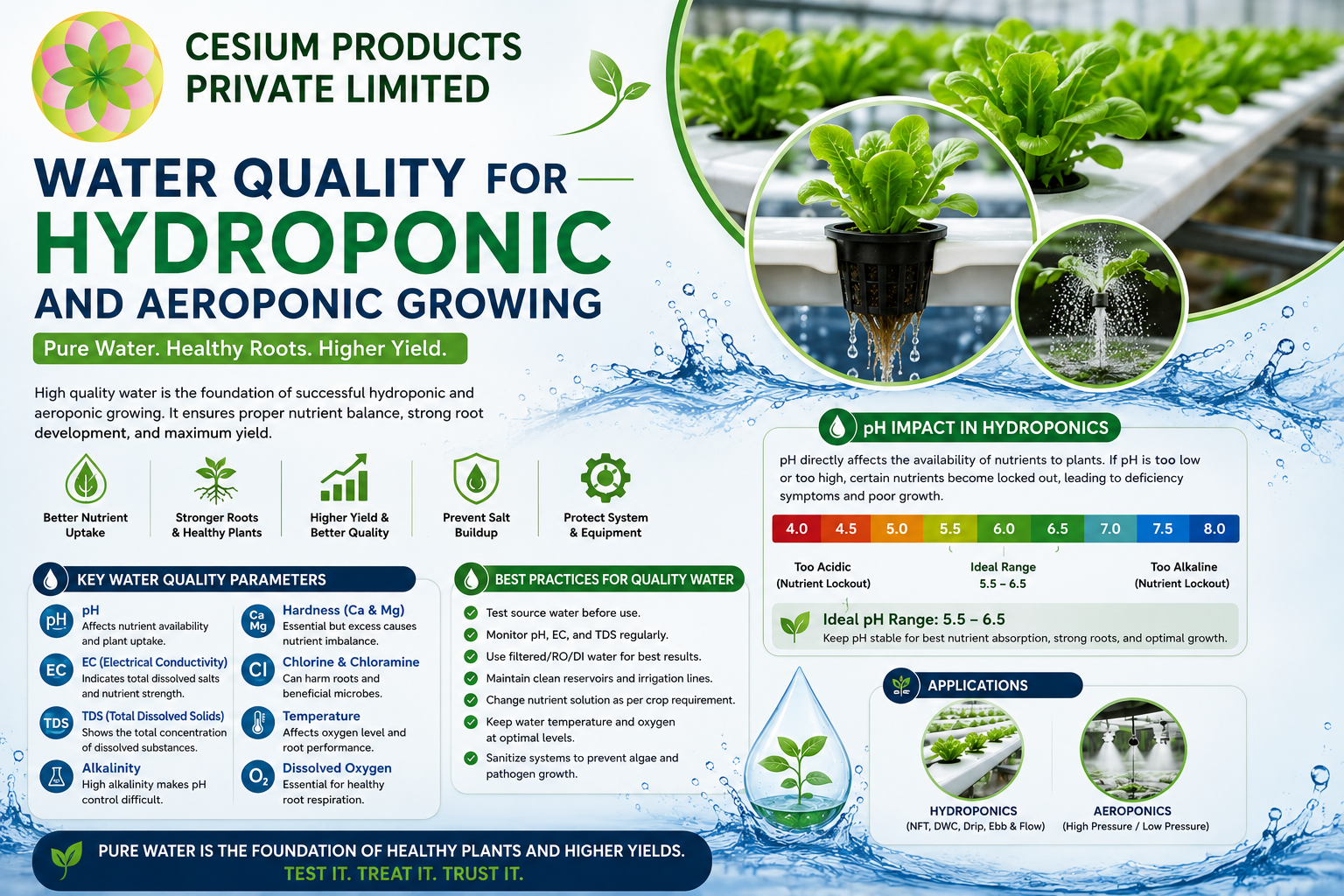
What Makes Good Hydroponic Water?
Good hydroponic water should provide a clean and predictable base for the nutrient solution.
However, “pure” does not always mean “ready to use.”
Very low-mineral water may need calcium, magnesium, and other nutrients added through a balanced hydroponic fertilizer. Therefore, growers should not judge water only by its TDS or conductivity.
A good source-water assessment should consider:
- pH
- Electrical conductivity
- TDS
- Alkalinity
- Calcium
- Magnesium
- Sodium
- Chloride
- Sulfate
- Iron
- Heavy metals
- Chlorine
- Microbial quality
- Water temperature
The exact acceptable range depends on the crop, fertilizer program, and growing system.
For example, lettuce, tomato, cucumber, herbs, and strawberries can have different nutrient requirements. Therefore, growers should follow crop-specific nutrient recommendations instead of using one fixed EC value for every plant.
Hydroponic Water and pH
pH is one of the most important properties of hydroponic water because it affects nutrient availability at the root surface. A nutrient solution that becomes too acidic or too alkaline can reduce the availability of certain nutrients and may cause deficiency symptoms even when those nutrients are present. Many hydroponic programs work around a mildly acidic range, often approximately pH 5.5–6.5, although the ideal value depends on the crop and nutrient program. Oklahoma State University notes that hydroponic nutrient solutions commonly use a slightly acidic pH because nutrient availability is generally favorable in this range.
However, growers should not adjust pH blindly.
First, measure the source water. Next, add the nutrient solution according to the fertilizer manufacturer’s instructions. Then allow the solution to mix properly before taking another reading.
If the pH remains high, a suitable acidifying product may lower it. If the pH becomes too low, an appropriate pH-up product can raise it.
Most importantly, make small adjustments and measure again. Large corrections can cause sudden changes in the root environment.
Electrical Conductivity and Hydroponic Water
Electrical conductivity, commonly called EC, measures how easily electricity passes through water.
Dissolved ions increase conductivity. Therefore, EC gives growers a useful indication of the total concentration of dissolved salts in the nutrient solution.
However, EC does not tell you exactly which nutrients are present.
For example, two solutions can have similar EC values but contain different nutrient ratios. Therefore, EC should support a complete nutrient-management program rather than replace it.
High EC can create osmotic stress. The roots may have more difficulty taking up water. On the other hand, very low EC can indicate that the nutrient solution does not contain enough dissolved nutrients.
Oklahoma State University explains that excessive nutrient concentration can contribute to osmotic stress, ion toxicity, and nutrient imbalance, while low concentrations can contribute to nutrient deficiency and reduced growth.
Therefore, growers should:
- Measure EC regularly
- Follow crop-specific EC recommendations
- Check EC after adding nutrients
- Check EC after adding source water
- Avoid making large changes at once
- Record readings over time
TDS and Hydroponic Water Quality
TDS means Total Dissolved Solids.
A TDS meter estimates the amount of dissolved material in water. However, the reading does not identify individual minerals or contaminants.
This distinction is important.
A low-TDS water source gives growers more control when preparing a nutrient solution. However, plants still need essential nutrients. Therefore, low-TDS source water is not automatically a complete growing solution.
Instead, it provides a cleaner starting point.
Growers should test the source water and then add nutrients according to the crop’s requirements.
Furthermore, TDS meters use conversion factors from conductivity readings. Different meters can therefore display different TDS values for the same water.
For precise nutrient management, EC is generally more useful than relying only on TDS.
Alkalinity and Hydroponic Water
Alkalinity is another important water-quality factor.
It mainly relates to bicarbonates and carbonates in the water. High alkalinity can make the nutrient solution resist pH reduction.
As a result, growers may notice that pH rises again soon after adjustment.
The University of Minnesota Extension identifies alkalinity above approximately 75 ppm as a level that deserves closer monitoring in hydroponic systems.
High-alkalinity water can create several management problems:
- Frequent pH adjustment
- Increased acid consumption
- Nutrient availability changes
- Unstable nutrient solutions
- Greater risk of pH drift
Therefore, alkalinity should be included in a source-water analysis.
If alkalinity is high, growers can consider appropriate water-treatment methods. Depending on the source and application, these may include reverse osmosis or controlled acidification.
Calcium and Magnesium in Hydroponic Water
Calcium and magnesium are essential plant nutrients. However, excessive amounts in the source water can change the nutrient balance.
Hard water often contains significant calcium and magnesium.
If the fertilizer already contains these nutrients, adding more through the source water can push their concentration higher than intended.
Therefore, growers should know the mineral composition of their source water before selecting a fertilizer program.
This approach offers better control because the grower can account for the nutrients already present.
For example, if source water contains substantial calcium, the fertilizer recipe may need adjustment. The exact adjustment should depend on the crop and nutrient formulation.
Sodium and Chloride in Hydroponic Water
Sodium and chloride deserve special attention.
Plants do not need large amounts of sodium for normal hydroponic nutrition. High sodium can accumulate in closed-loop systems.
Chloride can also become problematic at excessive concentrations.
Oklahoma State University lists sodium below 50 ppm and chloride below 140 ppm among example acceptable source-water values in its hydroponic water analysis guidance. These values should not replace crop-specific recommendations or a professional water analysis.
Therefore, growers using hard or saline water should test the source before starting a crop.
Heavy Metals and Unwanted Minerals
Source water can contain trace amounts of metals and other substances.
Depending on the source, these may include:
- Iron
- Copper
- Manganese
- Lead
- Zinc
- Other unwanted ions
Some elements are essential in small quantities. However, excessive concentrations can become toxic.
For this reason, a complete laboratory water analysis can provide more useful information than a basic TDS test.
This is especially important for commercial growers, controlled-environment farms, and systems that recirculate water for long periods.
Chlorine and Chloramine in Hydroponic Water
Municipal water may contain disinfectants such as chlorine or chloramine.
These compounds help control microorganisms in drinking-water systems. However, growers should understand how their water-treatment system interacts with them.
Carbon filtration can help remove chlorine. Chloramine can require a different treatment approach or longer contact time.
Therefore, growers should test the actual source water and choose treatment equipment based on the contaminant profile.
Do not assume that one filter removes every contaminant.
Dissolved Oxygen in Hydroponic Systems
Roots need oxygen for respiration.
This becomes particularly important in hydroponic systems because roots interact directly with water or nutrient mist.
Low dissolved oxygen can slow root activity and create conditions that favor root problems.
Aeroponic systems also require reliable spray or mist delivery. If the system stops operating, the exposed roots can dry quickly.
Therefore, growers should maintain:
- Reliable pumps
- Clean lines
- Correct spray or flow rates
- Adequate aeration where appropriate
- Proper reservoir temperature
- Regular equipment inspections
Water movement also matters. Good circulation helps distribute nutrients and reduces stagnant zones.
Hydroponic Water Temperature
Water temperature affects the root environment.
Very warm water can hold less dissolved oxygen than cooler water. It can also encourage faster microbial activity.
Therefore, growers should monitor reservoir temperature, especially during hot weather.
The goal is not simply to choose one universal temperature. Instead, growers should maintain a stable temperature suitable for their crop and system.
Sudden changes can also stress plants.
For this reason, temperature should become part of the regular monitoring routine.
Water Quality in Aeroponic Growing
Aeroponic systems differ from traditional hydroponic systems because they deliver nutrient solution to exposed roots as a mist or spray.
Consequently, water quality becomes even more important.
Small particles can clog nozzles. Mineral deposits can restrict spray patterns. Microbial growth can create biofilms inside pipes and fittings.
Therefore, aeroponic water management should focus on both chemical and physical quality.
Important checks include:
- pH
- EC
- TDS
- Temperature
- Suspended particles
- Microbial contamination
- Mineral scaling
- Filter condition
- Nozzle performance
In addition, the filtration system should match the nozzle design.
A water source that appears clear may still contain dissolved minerals that later form deposits.
Why Low-Mineral Water Can Help Aeroponics
Low-mineral water gives growers greater control over nutrient formulation.
When source water contains fewer unwanted ions, the fertilizer contributes more predictably to the final nutrient solution.
This can be particularly useful for aeroponic systems with small spray nozzles.
However, extremely pure water still needs a balanced nutrient formulation.
Plants require essential elements such as:
- Nitrogen
- Phosphorus
- Potassium
- Calcium
- Magnesium
- Sulfur
- Iron
- Manganese
- Zinc
- Copper
- Boron
- Molybdenum
Therefore, purified water should serve as the base rather than the complete nutrient solution.
RO Water for Hydroponic Growing
Reverse osmosis, or RO, can reduce many dissolved contaminants from source water.
It can provide a lower-mineral starting point for nutrient preparation.
RO treatment may be useful when source water contains:
- High TDS
- Excess calcium
- Excess magnesium
- High sodium
- High chloride
- High alkalinity
- Other dissolved contaminants
However, RO does not guarantee complete removal of every contaminant.
The University of Minnesota Extension recommends establishing baseline pH and EC for the source water before setting up a hydroponic system.
Therefore, test RO water after treatment rather than assuming its quality.
DM Water and DI Water for Hydroponics
DM water means demineralized water, while DI water means deionized water.
Both processes focus on removing dissolved ions. However, the treatment process and final specifications can vary.
Ion-exchange deionization removes dissolved ionic species. However, DI alone should not be treated as a complete microbial or organic purification method. The treatment system needs to match the intended water quality.
For hydroponic applications, the important question is not simply whether the water is called DM or DI.
Instead, ask:
- What is the conductivity?
- What is the TDS?
- What is the alkalinity?
- What minerals remain?
- Is microbial control required?
- What does the crop require?
- What nutrient formulation will be used?
This approach prevents growers from choosing water based only on its label.
Distilled Water for Hydroponic Growing
Distillation removes many dissolved substances by converting water into vapor and then condensing it.
Distilled water can provide a low-mineral starting point.
However, it can also require nutrient supplementation because plants cannot grow well on pure water alone.
Therefore, distilled water should be combined with a complete nutrient program designed for the crop.
For commercial production, the cost and practicality of producing or purchasing distilled water should also be considered.
Choosing the Right Water for Hydroponics
There is no single water type that works perfectly for every hydroponic farm.
The best choice depends on the source water and crop.
A simple decision process can help.
Step 1: Test the Source Water
Start by measuring:
- pH
- EC
- TDS
- Alkalinity
- Calcium
- Magnesium
- Sodium
- Chloride
For commercial operations, consider a broader laboratory analysis.
Step 2: Identify the Problem
Next, determine whether the source water has:
- High TDS
- High alkalinity
- Excess sodium
- Excess hardness
- Microbial concerns
- Chlorine or chloramine
- Other unwanted contaminants
Step 3: Select Treatment
Depending on the analysis, the treatment may include:
- Sediment filtration
- Activated carbon
- RO
- DI
- UV
- Combination treatment
Step 4: Test Treated Water
Do not stop after installing the treatment system.
Test the treated water again.
This confirms whether the system delivers the expected quality.
Step 5: Prepare the Nutrient Solution
Add nutrients according to the crop and fertilizer manufacturer’s instructions.
Then measure EC.
After that, measure and adjust pH.
How to Monitor Hydroponic Water
Regular monitoring prevents small changes from becoming major crop problems.
A practical routine can include:
- Check pH regularly
- Check EC regularly
- Monitor reservoir temperature
- Check water level
- Inspect filters
- Inspect pumps
- Clean nutrient lines
- Inspect roots
- Check for algae
- Check spray nozzles in aeroponic systems
- Record water-quality readings
- Test source water periodically
The University of Minnesota Extension recommends weekly source-water checks for pH and EC in its NFT guidance and also recommends checking these parameters when adding source water to the reservoir.
For intensive commercial systems, growers may monitor these parameters much more frequently.
Common Hydroponic Water Problems and Solutions
Problem 1: pH Keeps Rising
High alkalinity may cause repeated pH increases.
Solution: Test alkalinity and evaluate the source water. Consider suitable treatment or acidification based on professional guidance.
Problem 2: EC Is Too High
High EC may indicate excessive nutrient concentration or mineral-rich source water.
Solution: Test the source water and nutrient solution separately. Then dilute or reformulate according to the crop’s requirements.
Problem 3: Plants Show Nutrient Deficiency
A deficiency does not always mean that fertilizer is missing.
An incorrect pH can reduce nutrient availability.
Solution: Check pH, EC, source-water chemistry, and nutrient balance before adding more fertilizer.
Problem 4: Nozzles Keep Clogging
Mineral deposits or particles may restrict aeroponic nozzles.
Solution: Improve filtration, inspect water hardness, clean the system, and select suitable filters.
Problem 5: Roots Look Brown
Brown roots can have several causes.
Low oxygen, high temperature, pathogens, and poor sanitation can all contribute.
Solution: Check oxygen, temperature, circulation, sanitation, and water quality.
Problem 6: Nutrient Solution Changes Quickly
Plants continuously remove water and nutrients at different rates.
Therefore, the nutrient ratio can change over time.
Solution: Monitor EC and pH, maintain appropriate water levels, and replace the solution according to the crop and system-management plan.
Best Practices for Hydroponic Water Management
Good water management starts before planting.
Follow these practices:
- Test source water before starting a crop.
- Record pH and EC.
- Test alkalinity when pH control becomes difficult.
- Check calcium and magnesium in hard water.
- Monitor sodium and chloride.
- Use suitable filtration when needed.
- Maintain clean reservoirs.
- Keep irrigation lines clean.
- Calibrate pH and EC meters.
- Use fresh calibration solutions.
- Follow crop-specific nutrient targets.
- Avoid sudden nutrient changes.
- Monitor reservoir temperature.
- Inspect aeroponic nozzles.
- Replace damaged filters.
- Keep accurate water-quality records.
- Test treated water instead of assuming it is pure.
- Clean the system between crop cycles.
These steps make water management more predictable and reduce avoidable growing problems.
How Water Quality Supports Better Nutrient Control
The main advantage of good source water is control.
Suppose two growers use the same nutrient fertilizer. One starts with mineral-rich water. The other starts with low-mineral water.
Their final nutrient solutions may not be chemically identical.
The first grower must account for minerals already present in the source water. The second grower has more freedom to build the nutrient solution from a known starting point.
Therefore, consistent source water can make nutrient management easier.
This is especially valuable in commercial controlled-environment agriculture, where growers aim for repeatable results.
Why Water Testing Is Better Than Guesswork
Clear water is not necessarily high-quality water.
Water can look clean while containing:
- Dissolved salts
- Excess minerals
- High alkalinity
- Sodium
- Chloride
- Metals
- Disinfectants
- Microbial contamination
A TDS meter alone cannot identify all these substances.
Therefore, laboratory analysis is useful when the source water has an unknown composition or when repeated crop problems occur.
After treatment, testing also confirms whether the purification system is working properly.
External Resources for Hydroponic Water Quality
Reliable technical resources can help growers select suitable water-management targets.
The University of Minnesota Extension provides guidance on source-water testing, pH, EC, alkalinity, and nutrient management for hydroponic systems.
Oklahoma State University provides crop-specific information on hydroponic pH and EC management and explains how source-water minerals can affect nutrient solutions.
These resources are useful starting points, but commercial growers should also consider crop-specific recommendations and laboratory water analysis.
Frequently Asked Questions
1. What is the best water for hydroponic growing?
Low-mineral, consistent-quality water is often a good starting point because it gives growers greater control over the final nutrient solution. However, the best choice depends on the source-water analysis, crop, and fertilizer program.
2. What pH should hydroponic water have?
Many hydroponic nutrient programs use a mildly acidic range around 5.5–6.5. However, the ideal value varies by crop and nutrient formulation. Always follow crop-specific guidance rather than using one number for every plant.
3. Is RO water good for hydroponics?
Yes. RO water can provide a low-mineral starting point when source water contains excessive dissolved salts or unwanted minerals. However, RO water still needs testing and usually requires a balanced nutrient solution.
4. Can DM water be used for hydroponics?
DM water can serve as a low-mineral base for nutrient preparation. However, growers must add the essential nutrients required by the crop. The final water quality should be checked through EC, pH, and other relevant tests.
5. Why is water quality important in aeroponics?
Aeroponic systems deliver nutrient solution directly to exposed roots. Therefore, poor water quality can affect nutrient balance, create deposits, and contribute to nozzle blockage. Clean water and reliable filtration help maintain consistent spray delivery.
Conclusion
Hydroponic water directly affects nutrient management, root health, and crop performance. Unlike soil-based growing, hydroponic and aeroponic systems provide little natural buffering against changes in water chemistry.
Therefore, growers should test their source water before preparing a nutrient solution.
The most important parameters include pH, EC, TDS, alkalinity, calcium, magnesium, sodium, chloride, temperature, and microbial quality. Furthermore, aeroponic growers should pay close attention to filtration because particles and mineral deposits can interfere with spray nozzles.
RO, DM, DI, distilled, or filtered water can all have useful applications. However, the right choice depends on the quality of the source water and the needs of the crop.
In short, test first, treat when necessary, formulate nutrients carefully, and monitor the system regularly. Good water quality gives growers better control and creates a more stable environment for healthy plant growth.