


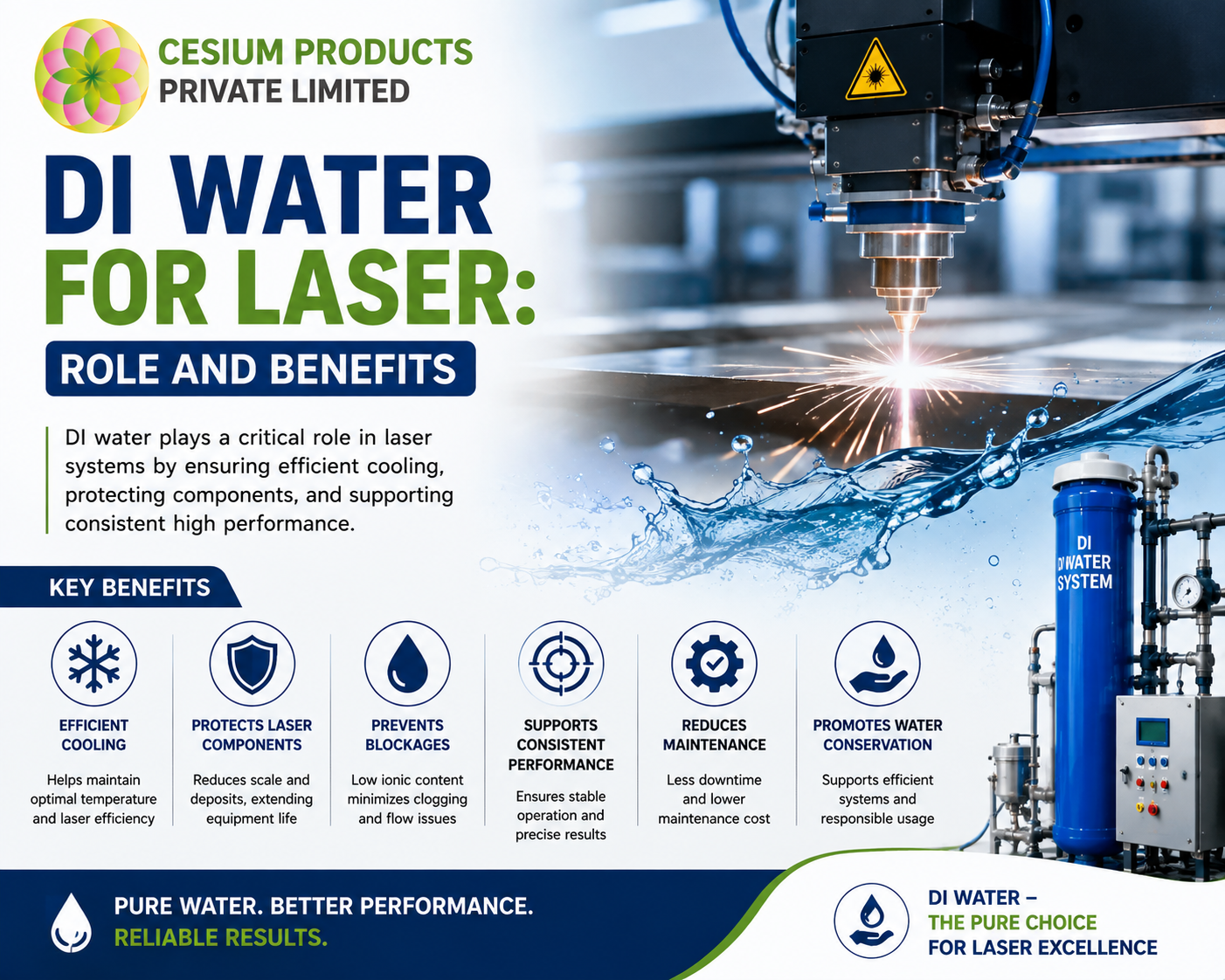
DI Water for Laser systems plays an important role in laser machine cooling and maintenance. Laser machines generate a large amount of heat during operation. A cooling system removes this heat and helps the laser maintain a stable working temperature. Therefore, the quality of cooling water can directly affect machine performance.
Ordinary water may contain minerals such as calcium, magnesium, chloride, and sulfate. These dissolved substances can create deposits inside cooling channels, pipes, heat exchangers, and other components. Over time, these deposits can reduce cooling efficiency.
DI Water for Laser applications use deionized water with a very low level of dissolved ionic impurities. As a result, DI water can help reduce mineral deposits and support efficient heat transfer. However, the correct water specification depends on the laser manufacturer’s requirements. Always follow the machine manual before selecting or replacing cooling water.
What Is DI Water?
Deionized water, also called DI water, is water from which many dissolved ions have been removed. A deionization system usually uses ion-exchange technology to reduce positively and negatively charged ions.
Common ions removed during the process include:
- Calcium
- Magnesium
- Sodium
- Potassium
- Chloride
- Sulfate
- Bicarbonate
- Nitrate
As a result, DI water contains fewer dissolved ionic contaminants than ordinary tap water.
However, DI water is not automatically the same as distilled water or ultrapure water. Each type has different production methods and purity levels. Therefore, users should select water according to the laser equipment specification rather than choosing water based only on its name.
Why Does a Laser Machine Need Cooling Water?
A laser system converts electrical energy into laser energy. During this process, some energy becomes heat. High-power laser systems can generate considerable heat during continuous operation.
The cooling system removes this heat from important components. Depending on the machine design, the cooling circuit may support:
- Laser source cooling
- Laser tube cooling
- Optical component cooling
- Power supply cooling
- Heat exchanger cooling
- Chiller operation
- Industrial cutting head cooling
- Welding laser cooling
Stable cooling helps the machine maintain its operating temperature. In addition, it can help reduce thermal stress on sensitive components.
Therefore, water quality becomes an important part of the cooling system.
DI Water for Laser Cooling Systems
DI Water for Laser cooling systems helps reduce the concentration of dissolved ions in the cooling circuit. This matters because mineral-rich water can leave deposits when it circulates through a machine.
For example, hard water may contain calcium and magnesium. When the water moves through a heated cooling circuit, these minerals can contribute to scale formation.
DI water reduces this mineral load. Therefore, it can help maintain cleaner cooling passages and heat-transfer surfaces.
However, users should not assume that higher purity always means better performance. Some laser cooling systems require specific conductivity, resistivity, pH, corrosion protection, or additive levels. Consequently, the machine manufacturer’s water specification should remain the primary reference.
How DI Water Helps Heat Transfer
Laser machines need efficient heat removal. The cooling system transfers heat away from the laser source and sends it toward a radiator, heat exchanger, or chiller.
Clean cooling water helps the system maintain efficient circulation. When scale accumulates inside a cooling passage, the deposit can reduce the effective flow area. It can also create an additional barrier between the water and the heat-transfer surface.
By reducing dissolved mineral content, DI Water for Laser applications can help limit scale formation. Therefore, the cooling system can maintain cleaner internal surfaces when the water quality and operating conditions are suitable.
Good water quality does not replace proper chiller maintenance. Instead, it supports the complete cooling system.
DI Water for Laser and Scale Control
Scale is one of the common concerns in water-based cooling systems. Hard water can carry calcium and magnesium ions. These ions may contribute to mineral deposits under suitable operating conditions.
Scale can cause several problems:
- Reduced cooling efficiency
- Restricted water flow
- Increased pressure across cooling passages
- Poor heat transfer
- More frequent cleaning
- Higher maintenance requirements
- Unstable operating temperature
For this reason, many industrial users consider low-mineral water for cooling applications.
DI Water for Laser can reduce the ionic content that contributes to many mineral deposits. However, it cannot prevent every type of contamination. Dust, biological growth, corrosion products, and other contaminants can still affect the cooling circuit.
Therefore, users should combine suitable water quality with proper filtration, circulation, cleaning, and maintenance.
DI Water for Laser and Corrosion Control
Water quality can also affect corrosion inside a cooling system. Dissolved ions and contaminants may influence the chemical environment inside pipes, fittings, heat exchangers, and other components.
However, extremely low-ion water does not automatically guarantee corrosion-free operation. In some systems, very high-purity water can interact with metals and contribute to corrosion if the system design and water chemistry do not match.
For this reason, do not select DI water only because it has low conductivity.
Instead, check the complete specification. The manufacturer may define acceptable limits for conductivity, resistivity, pH, temperature, hardness, chloride, and other parameters.
If the cooling circuit requires a specific corrosion inhibitor or additive, use only the recommended product and concentration.
pH Impact of DI Water in Laser Machines
pH has an important impact on DI Water for Laser cooling systems because it affects corrosion, material compatibility, water stability, and the overall condition of the cooling circuit. The pH scale indicates whether water is acidic, neutral, or alkaline. However, laser cooling systems do not all require the same pH range. For example, some laser equipment specifies a pH range of 5–8, while some chiller systems recommend a narrower range such as 7.2–8.1. Therefore, the laser and chiller manufacturer’s specification should always be followed instead of using one universal pH value.
How pH Affects Laser Cooling Water
The pH of cooling water can influence the chemical condition of the entire cooling loop. If the water becomes too acidic, it can increase the risk of corrosion in compatible metal components. Corrosion may release metal ions into the water, which can then increase contamination and affect other parts of the cooling circuit.
On the other hand, excessively alkaline water can also create material-compatibility problems. Therefore, maintaining the recommended pH range helps keep the water chemistry more stable.
This is especially important because laser cooling systems may contain different materials, such as stainless steel, aluminum, copper, nickel, plastics, seals, and other components. Each material can respond differently to changes in water chemistry.
Why DI Water Can Show pH Changes
Fresh DI water contains very few dissolved ions. Because of this low ionic content, measuring its pH can be less straightforward than measuring ordinary water.
DI water can also interact with the surrounding environment. For example, carbon dioxide from air can dissolve into the water and form carbonic acid. This can lower the measured pH. Eaton notes that highly deionized water can initially be close to neutral but may become more acidic after exposure to air.
Therefore, a lower pH reading does not always mean that the laser cooling system has a serious acid contamination problem. The result should be interpreted together with conductivity, water temperature, system materials, and the manufacturer’s limits.
DI Water for Laser and Conductivity
Conductivity indicates how easily water can carry electrical current. Dissolved ions strongly influence conductivity.
When ion concentration decreases, water generally shows lower conductivity. Therefore, conductivity can provide a useful indication of water quality in many industrial cooling applications.
However, conductivity alone does not identify every contaminant. For example, some non-ionic contaminants may not cause the same conductivity response.
Therefore, laser machine operators should use conductivity as one part of a broader water-quality monitoring program.
DI Water for Laser and Chiller Performance
A chiller removes heat from the cooling water and maintains the required temperature. The chiller and laser therefore work as a connected system.
Poor water quality can affect this relationship. For example, deposits can reduce heat-transfer efficiency. Restricted passages can also affect circulation.
With suitable water quality, the cooling circuit can operate with cleaner internal surfaces. Consequently, the chiller can support more stable temperature control when other operating conditions remain within specification.
Still, water quality represents only one part of chiller performance. Ambient temperature, airflow, refrigerant condition, pump performance, filters, and heat-exchanger cleanliness also matter.
Applications of DI Water in Laser Machines
DI Water for Laser systems can support several industrial laser applications when the equipment manufacturer permits its use.
1. Laser Cutting Machines
Laser cutting machines use high-energy laser sources to cut metals and other materials. The laser source generates heat during operation.
A suitable cooling system removes this heat. DI water can help reduce mineral deposits within the approved cooling circuit.
2. Laser Welding Machines
Laser welding systems require controlled thermal conditions for stable operation. Cooling systems help protect the laser source and related components.
Clean cooling water can support reliable circulation and heat removal.
3. Laser Marking Systems
Some industrial laser marking systems use dedicated cooling systems. The exact requirement depends on the laser source and machine design.
Where the manufacturer specifies deionized water, users should maintain the recommended water quality.
4. Fiber Laser Systems
Fiber laser systems can require dedicated cooling arrangements. High-power systems produce significant heat, so temperature control becomes important.
DI water may help reduce scale and mineral contamination in suitable closed-loop systems.
5. CO₂ Laser Systems
CO₂ laser systems often use water-based cooling arrangements, depending on the equipment design.
The cooling water removes heat from the laser tube and related components. Therefore, water quality can influence cooling performance and maintenance requirements.
How Poor Water Quality Can Affect a Laser Machine
Poor cooling-water quality can create several operational problems. However, the exact effect depends on the machine design and water chemistry.
Common issues include:
- Scale formation
- Blocked cooling passages
- Reduced heat transfer
- Corrosion
- Water contamination
- Pump stress
- Flow reduction
- Temperature instability
- Frequent maintenance
- Shorter component life
For example, mineral deposits can build up slowly. The machine may continue to operate at first. Later, the cooling system may struggle to remove heat efficiently.
Therefore, preventive water-quality monitoring can help identify problems before they become serious.
DI Water vs Tap Water for Laser Cooling
Tap water contains naturally occurring minerals and dissolved ions. Its composition also varies by location and water source.
DI water contains far fewer dissolved ions. Therefore, it can provide better control over mineral content in systems that require low-ion cooling water.
However, tap water may still suit some equipment if the manufacturer specifically permits it. Similarly, DI water may not suit every laser system without additional treatment.
The correct choice depends on the equipment specification.
Do not replace the manufacturer’s recommended coolant with DI water without checking compatibility. This step is especially important for systems that use corrosion inhibitors, biocides, or proprietary coolants.
How to Maintain DI Water for Laser Systems
Using DI water once does not guarantee long-term water quality. The water can pick up contaminants from the cooling circuit, storage container, air, pipes, seals, and surrounding environment.
A basic maintenance approach should include:
- Check the manufacturer’s water specification.
- Use a suitable DI water source.
- Store water in a clean compatible container.
- Keep the cooling circuit closed when possible.
- Monitor conductivity regularly.
- Check pH when the manufacturer specifies it.
- Inspect the water for visible contamination.
- Maintain the recommended water level.
- Clean filters according to the machine schedule.
- Inspect hoses and fittings for leakage.
- Follow the recommended replacement interval.
- Record water-quality measurements.
Regular monitoring helps identify changes early. As a result, operators can take corrective action before cooling performance declines.
What Happens When DI Water Becomes Contaminated?
DI water can lose its purity during use. The water may absorb ions from metal surfaces, pipes, fittings, and other components.
Contamination can also enter through improper handling or an open cooling reservoir.
As contamination increases, conductivity may rise. In addition, deposits or biological growth may develop under unsuitable operating conditions.
Therefore, operators should not assume that water remains deionized simply because it started as DI water.
Monitor the cooling loop based on the manufacturer’s recommended parameters. Replace or treat the water when the specified limits require action.
Choosing the Right DI Water for a Laser Machine
Not all DI water products have the same specification. Before purchasing water, check the machine manual.
Important parameters may include:
- Conductivity
- Resistivity
- pH
- Hardness
- Chloride concentration
- Total dissolved solids
- Microbial quality
- Required additives
- Operating temperature
The required purity level can vary between laser brands and models. Therefore, avoid choosing a product only because its label says “DI water.”
For industrial applications, ask the supplier for a suitable specification or certificate of analysis when required.
Common Mistakes When Using DI Water
Several simple mistakes can reduce the benefits of DI water.
Using Any DI Water Without Checking the Manual
Different laser systems have different cooling requirements. Always verify compatibility first.
Mixing DI Water With Unknown Chemicals
Unapproved additives can change water chemistry and may damage system components.
Ignoring Conductivity
DI water can become contaminated during operation. Regular monitoring can help detect this change.
Using Dirty Containers
A clean water source can become contaminated through an unclean storage container.
Neglecting the Cooling System
DI water cannot compensate for blocked filters, damaged pumps, poor airflow, or a dirty heat exchanger.
Benefits of DI Water for Laser Cooling
When the equipment manufacturer approves its use, DI water can offer several advantages:
- Low mineral content
- Reduced risk of scale
- Cleaner cooling passages
- Better control of water quality
- Support for efficient heat transfer
- Reduced mineral-related maintenance
- More consistent cooling conditions
- Better control of the cooling loop
These benefits depend on correct water quality, equipment compatibility, and regular maintenance.
How DI Water Supports Laser Machine Reliability
A laser machine needs stable thermal conditions for reliable operation. The cooling system plays a major role in maintaining those conditions.
When cooling water contains excessive minerals or contaminants, deposits and other problems can develop. These problems may gradually affect circulation and heat transfer.
By using suitable DI water and monitoring the cooling circuit, operators can better control water quality.
Moreover, regular maintenance helps keep pumps, filters, heat exchangers, and cooling passages in good condition.
Therefore, DI Water for Laser should form part of a complete cooling-management strategy rather than acting as a standalone solution.
Frequently Asked Questions About DI Water for Laser
1. Why is DI water used in laser machines?
DI water contains fewer dissolved ions than ordinary tap water. Therefore, it can help reduce mineral deposits in compatible laser cooling systems and support cleaner heat-transfer surfaces.
2. Can I use tap water instead of DI water in a laser machine?
Do not make the change without checking the machine manual. Some laser systems allow treated tap water, while others require DI water or a specific coolant.
3. Is DI water the same as distilled water?
No. Both have reduced impurities, but they use different purification methods. Their final water quality can also differ. Always select water according to the laser manufacturer’s specification.
4. What pH should DI water have for a laser machine?
There is no single pH value that applies to every laser machine. The correct range depends on the cooling-loop materials and manufacturer requirements. Follow the equipment specification rather than using a general target.
5. How often should DI water be replaced in a laser cooling system?
The replacement interval depends on the machine, cooling design, water quality, and operating conditions. Monitor the parameters specified by the manufacturer and replace the water when it reaches the recommended limits.
Conclusion
DI Water for Laser applications can play an important role in maintaining suitable cooling conditions for industrial laser equipment. Low-ion water can help reduce mineral deposits and support clean cooling passages in compatible systems.
However, water purity alone does not guarantee reliable laser performance. Operators should also monitor conductivity, pH where required, temperature, flow, contamination, and other specified parameters.
Most importantly, always follow the laser manufacturer’s water-quality requirements. The correct DI water specification can vary between machines.