


What Is Distilled Water?
Distilled water is produced through distillation. The process heats water to create steam and then condenses that steam into liquid water. Many dissolved minerals and non-volatile contaminants remain behind during the process.
However, distillation does not automatically make water suitable for every application. The final quality depends on the feed water, equipment, storage container, cleaning practices, and handling method.
For example, a laboratory may require water that meets a defined laboratory grade. A battery may only require water that meets the battery manufacturer’s requirements. Therefore, users should check the required specification before selecting the product.
What Is Lab Distilled Water?
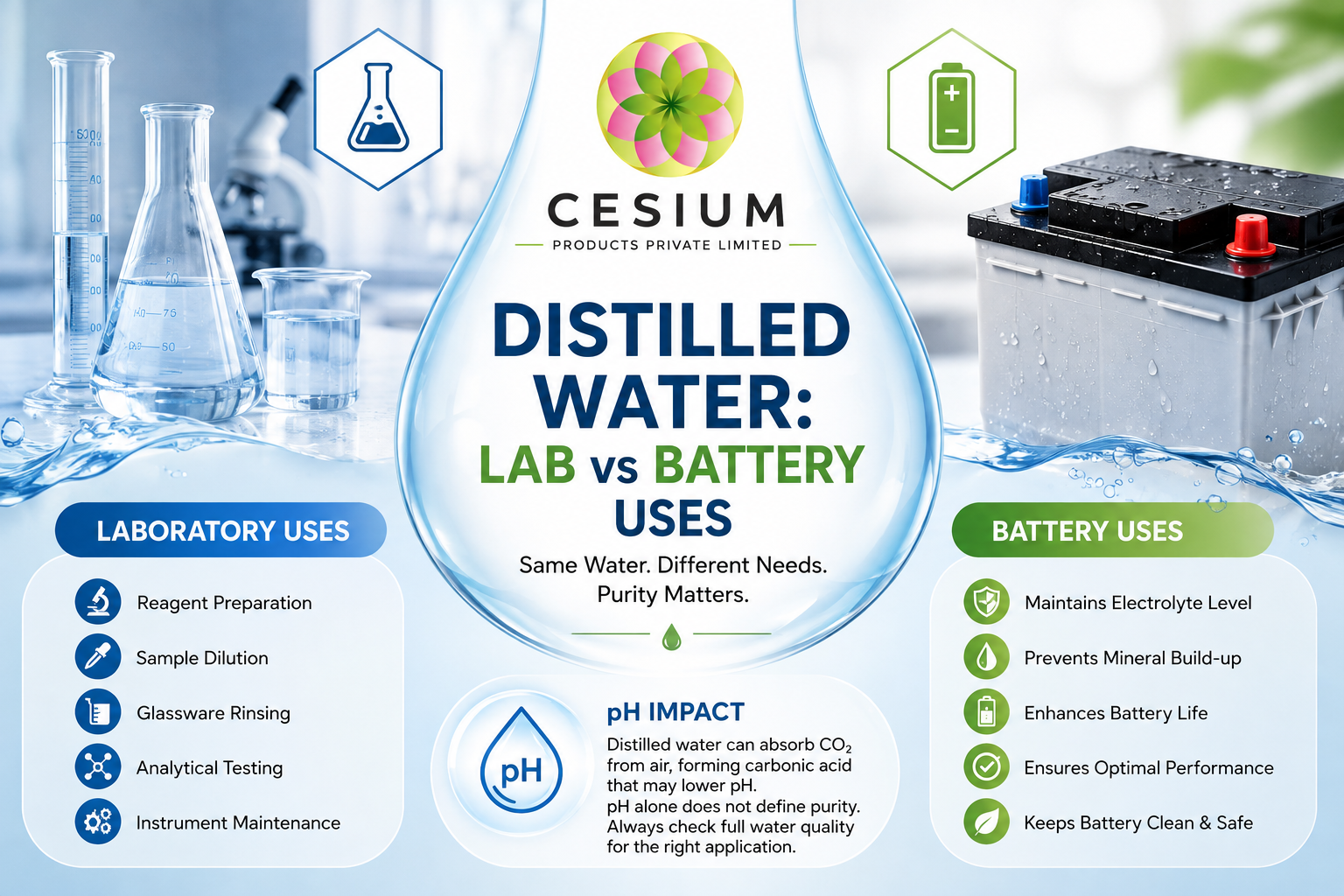
Lab distilled water refers to distilled water prepared or supplied for laboratory use. Laboratories use purified water in many routine processes. These include glassware rinsing, reagent preparation, sample preparation, buffer preparation, and other laboratory procedures.
However, the term “lab distilled water” does not always define one fixed purity level. Different laboratory applications need different water grades.
According to laboratory water guidance, Type 1 water is used for highly sensitive applications, while Type 2 water supports many general laboratory tasks. Type 3 water is commonly used for basic tasks such as rinsing and heating baths.
This distinction is important because a laboratory may require more than simple distillation. For sensitive analysis, laboratories often use additional purification steps such as reverse osmosis, ion exchange, filtration, ultraviolet treatment, or electrodeionization.
What Is Battery Distilled Water?
Battery distilled water is water intended for use in batteries that require water addition, especially flooded lead-acid batteries.
During battery operation, water can be lost from the electrolyte. When the manufacturer allows or requires water addition, users should add the recommended water without adding unnecessary chemicals or minerals.
Trojan Battery, for example, recommends distilled water for its flooded lead-acid battery maintenance and advises users not to add acid during routine watering.
The purpose of using distilled water in this application is simple: reduce the introduction of unwanted dissolved substances into the battery electrolyte.
Why Is Lab Distilled Water Different From Battery Distilled Water?
At first glance, both products may appear identical. Both can come from a distillation process, and both may have low mineral content. However, their intended use and quality control can differ.
The most important differences include:
- Application: Lab water supports scientific and analytical work, while battery water supports battery maintenance.
- Purity requirement: Laboratory applications can require highly controlled purity levels.
- Testing: Laboratory water may require testing for conductivity, resistivity, organic carbon, particles, bacteria, or other contaminants.
- Packaging: Lab water may use containers selected to reduce contamination during storage.
- Specifications: Battery water should follow the battery manufacturer’s recommendations.
- Criticality: A small contaminant level may affect a sensitive laboratory test, while battery water mainly needs to avoid substances that can interfere with battery operation.
- Additional purification: Laboratories may combine several purification technologies to achieve the required grade.
Therefore, the two products should not be considered interchangeable in every situation.
Lab Distilled Water Purity Requirements
Laboratory water quality depends strongly on the test or process. A basic washing process does not need the same water quality as HPLC, ICP-MS, LC-MS, PCR, or trace-element analysis.
Laboratory water systems commonly classify water into different grades. Merck’s laboratory water guidance describes Type 1 as ultrapure water for critical analytical and life-science applications, Type 2 as pure water for general laboratory work, and Type 3 as lower-grade water for basic applications.
For example, Type 1 water can have a resistivity of about 18.2 MΩ·cm at 25°C and very low total organic carbon when produced under suitable conditions. Such specifications show why simply calling water “distilled” may not provide enough information for a sensitive experiment.
Laboratory Applications of Distilled Water
Laboratory distilled or purified water can support many processes, including:
- Glassware rinsing
- Reagent preparation
- Buffer preparation
- Sample dilution
- Cleaning laboratory equipment
- Preparation of certain test solutions
- Microbiological work, when the required grade is suitable
- General analytical work
- Instrument support
- Feed water for higher-purity purification systems
The correct grade depends on the method. Therefore, laboratories should follow the test method, instrument instructions, and applicable water-quality standard.
Battery Distilled Water Requirements
Battery water has a different purpose. It enters the battery electrolyte, so unwanted dissolved minerals can create problems over time.
Tap water may contain calcium, magnesium, chloride, sulfate, iron, and other dissolved substances. These substances can enter the battery when users add untreated water. For this reason, manufacturers commonly recommend distilled water for batteries that require watering.
Users should also remember that not every modern battery needs water. Many sealed or maintenance-free battery designs do not require routine water addition. Therefore, users should first check the battery manual.
For flooded lead-acid batteries, correct watering practices also matter. Trojan recommends adding water according to the battery’s condition and level instructions and warns against overwatering.
pH Impact of Distilled Water
The pH of distilled water can create confusion because pure water does not always show a stable pH reading after exposure to air. Freshly produced water contains very few dissolved ions. Therefore, it has a very low buffering capacity. When the water comes into contact with atmospheric carbon dioxide, CO₂ dissolves into the water and forms carbonic acid and related carbonate species. As a result, the measured pH can move below neutral even though the water has not received a mineral contaminant.
This is why users should not assume that distilled water must always show exactly pH 7.00. Temperature, dissolved gases, storage conditions, measurement technique, and contamination can all affect the reading. ASTM methods also recognize the importance of dissolved carbon dioxide in high-purity water and provide methods for measuring CO₂ in water.
Why Distilled Water Does Not Always Have a pH of 7
People often describe pure water as neutral and therefore expect a pH of exactly 7. However, this value applies to pure water under a specific temperature and equilibrium condition.
Once distilled water leaves the distillation system, its environment changes. The water can absorb gases from the atmosphere. Carbon dioxide is especially important because it reacts with water and forms carbonic acid:
CO₂ + H₂O ⇌ H₂CO₃
Carbonic acid can then participate in further reactions that produce hydrogen ions. More hydrogen ions can lower the measured pH.
Therefore, freshly produced distilled water may show a reading close to neutral, while the same water may show a lower pH after storage in an open container.
The change does not automatically mean that the water has become highly contaminated. Instead, it can indicate interaction with atmospheric CO₂.
Can Battery Distilled Water Be Used in a Laboratory?
Sometimes it may appear suitable, but users should not assume that it meets laboratory requirements.
A battery water product may have low mineral content, yet a sensitive laboratory method may require controlled levels of ions, organic compounds, particles, bacteria, or other contaminants.
For simple non-critical tasks, a laboratory may use lower-grade purified water. However, analytical methods require water that meets the method’s specification.
For example, advanced techniques such as HPLC, LC-MS, ICP-MS, and molecular biology procedures can require Type 1 or another specified high-purity water grade.
Therefore, always match the water grade with the laboratory method.
Can Lab Distilled Water Be Used for Batteries?
If the water meets the battery manufacturer’s requirements and contains no harmful additives or contaminants, it may be suitable for a battery that requires distilled water.
However, the label alone should not determine suitability. Users should check the product specification and the battery manual.
A laboratory-grade product may provide a higher level of purity than necessary for routine battery watering. That does not automatically make it a better battery product in every situation. It may simply cost more because the manufacturer controls additional quality parameters.
The practical approach is to select water that meets the battery manufacturer’s requirements without adding unnecessary substances.
Key Contaminants That Matter
Different applications are sensitive to different contaminants.
Dissolved Minerals
Calcium and magnesium can affect processes that require very low ionic contamination. Battery users also want to avoid introducing unnecessary mineral content into the electrolyte.
Chloride and Sulfate
Chloride and sulfate can be undesirable contaminants in sensitive laboratory work. Battery users should also avoid introducing unnecessary ions into the electrolyte.
Silica
Silica can matter in sensitive analytical and industrial applications. Laboratory water specifications can therefore include silica limits.
Organic Contaminants
Organic compounds can interfere with sensitive analytical measurements. High-purity laboratory systems therefore control total organic carbon and other impurities.
Microorganisms
Microbiological contamination can affect certain laboratory applications. Sensitive laboratory processes may require additional purification and filtration.
Distilled Water vs Deionized Water
Distilled water and deionized water use different purification principles.
Distillation uses evaporation and condensation. Deionization uses ion-exchange technology to remove charged ions.
Neither name alone guarantees that the water is suitable for every application.
For laboratory work, the final specification matters more than the purification method. A laboratory may use distillation, deionization, reverse osmosis, filtration, electrodeionization, or a combination of technologies.
For battery maintenance, users should follow the battery manufacturer’s recommendation. If the manufacturer specifies distilled water, use a suitable distilled-water product rather than assuming that every type of purified water is automatically acceptable.
Why Storage Matters
Water quality can change after purification if users store it incorrectly.
Open containers can allow airborne particles and gases to enter the water. Containers can also release substances into stored water if they are unsuitable or poorly cleaned.
Laboratories should use clean, appropriate containers and follow their water-handling procedures. Sensitive applications may require freshly produced water or controlled distribution systems.
Battery water should also remain sealed and clean until use. Avoid transferring it into dirty bottles or containers.
How to Choose Lab Distilled Water
Before purchasing water for laboratory work, check:
- Required laboratory water grade
- Conductivity or resistivity
- Total organic carbon, if relevant
- Microbial requirements
- Particle requirements
- Silica or ion limits, when relevant
- Packaging and storage conditions
- Certificate of analysis or quality documentation
- Compatibility with the laboratory method
For highly sensitive work, follow the method or instrument manufacturer’s specification rather than relying on a generic “distilled water” label.
How to Choose Battery Distilled Water
Before purchasing water for battery maintenance, check:
- Battery type
- Manufacturer’s maintenance instructions
- Whether the battery requires water
- Water purity specification
- Additives or chemicals listed on the label
- Packaging quality
- Storage condition
- Product quality documentation
Most importantly, never add battery water to a battery that the manufacturer identifies as sealed or maintenance-free unless the manufacturer specifically provides instructions for doing so.
Common Mistakes to Avoid
Several mistakes can reduce the benefits of purified water.
Using Tap Water in a Flooded Battery
Tap water contains dissolved substances that can enter the battery. Use the water recommended by the manufacturer.
Using Battery Water for Sensitive Laboratory Testing
Battery water may not meet the purity requirements of a sensitive laboratory method. Check the required laboratory grade first.
Assuming Distilled Means Ultrapure
Distillation is a purification method, not a universal purity grade. Sensitive laboratory work may require additional purification.
Judging Purity Only by pH
pH does not provide a complete picture of water quality. Other parameters can matter much more for a specific application.
Storing Purified Water in Dirty Containers
Even high-quality water can become contaminated during storage. Always use suitable, clean containers.
Adding Chemicals to Battery Water
Do not add chemicals simply because they are marketed as battery additives. Follow the battery manufacturer’s instructions. Trojan specifically advises against adding substances other than distilled water to its batteries.
Why Water Quality Matters in Manufacturing
Water quality also affects many manufacturing processes. Manufacturers use purified water in metal finishing, electronics, pharmaceutical production, cosmetics, chemical processing, cleaning, and other operations.
For example, ionic contamination can interfere with plating processes, while impurities can affect surface cleaning or product consistency. Therefore, manufacturers should define water quality according to the process rather than using the same water specification everywhere.
This approach helps reduce contamination, improve process consistency, and control operating costs.
Lab Water and Battery Water: Which One Should You Buy?
The answer depends on the application.
Choose laboratory-grade water when you need controlled purity for experiments, analytical testing, reagent preparation, or sensitive instruments.
Choose suitable battery distilled water when you need to maintain a battery that requires water and the manufacturer recommends distilled water.
If you are unsure, check the specification rather than relying only on the product name. The words “distilled water” describe the purification method, but they do not always describe every quality parameter.
Frequently Asked Questions
1. Is lab distilled water the same as battery distilled water?
Not necessarily. Both may use distillation, but their quality controls and intended applications can differ. Laboratory work may require a defined water grade, while battery water should meet the battery manufacturer’s requirements.
2. Can distilled water be used in a car battery?
For a battery that requires water, distilled water is commonly recommended. However, always check the battery manufacturer’s instructions before adding water.
3. Is battery distilled water pure enough for laboratory use?
Not automatically. Sensitive laboratory methods can require specific limits for ions, organic carbon, particles, bacteria, and other contaminants. A battery-water label does not prove compliance with a laboratory water standard.
4. Does distilled water have a fixed pH?
No. Distilled water can absorb carbon dioxide from the air, which can change its measured pH. Therefore, pH should not be used as the only indicator of purity.
5. What is more important than the word distilled?
The required specification is more important. For laboratory work, check the required water grade and quality parameters. For batteries, follow the battery manufacturer’s water requirements and maintenance instructions.
Conclusion
Lab distilled water and battery distilled water can have a similar basic purification method, but their intended uses are different. Laboratory applications may require carefully controlled water grades, while battery maintenance mainly requires suitable water with very low unwanted mineral contamination.
Therefore, users should not select water only because the label says “distilled.” Instead, check the application, purity specification, storage requirements, and manufacturer’s instructions. For sensitive laboratory processes, use water that meets the required laboratory standard. For batteries, use the water recommended by the battery manufacturer.
Choosing the correct distilled water helps protect equipment, reduce contamination, and support consistent performance.