


Introduction
The DM Water Salt Spray Test plays a vital role in evaluating the corrosion resistance of metals, coatings, fasteners, automotive parts, and industrial components. Manufacturers use this test to understand how their products perform in harsh, salt-rich environments before they reach customers. As industries demand higher quality and longer-lasting products, accurate corrosion testing has become more important than ever.
One of the biggest factors that affects the reliability of a salt spray test is the quality of the water used to prepare the salt solution. Ordinary tap water contains dissolved minerals such as calcium, magnesium, silica, iron, and chlorides. These impurities can interfere with the corrosion process and produce misleading results. Therefore, laboratories use DM water, also known as demineralized water, to eliminate unwanted minerals and maintain a controlled testing environment.
The DM Water Salt Spray Test helps manufacturers achieve consistent, repeatable, and internationally accepted corrosion testing results. Moreover, it supports compliance with standards such as ASTM B117 and ISO 9227. As a result, industries can confidently evaluate coatings, paints, plating, and metal treatments before commercial production.
In this detailed guide, you will learn what the DM Water Salt Spray Test is, why DM water is essential, how the testing process works, its industrial applications, major benefits, common mistakes to avoid, and best practices for obtaining reliable corrosion testing results.
What Is a DM Water Salt Spray Test?
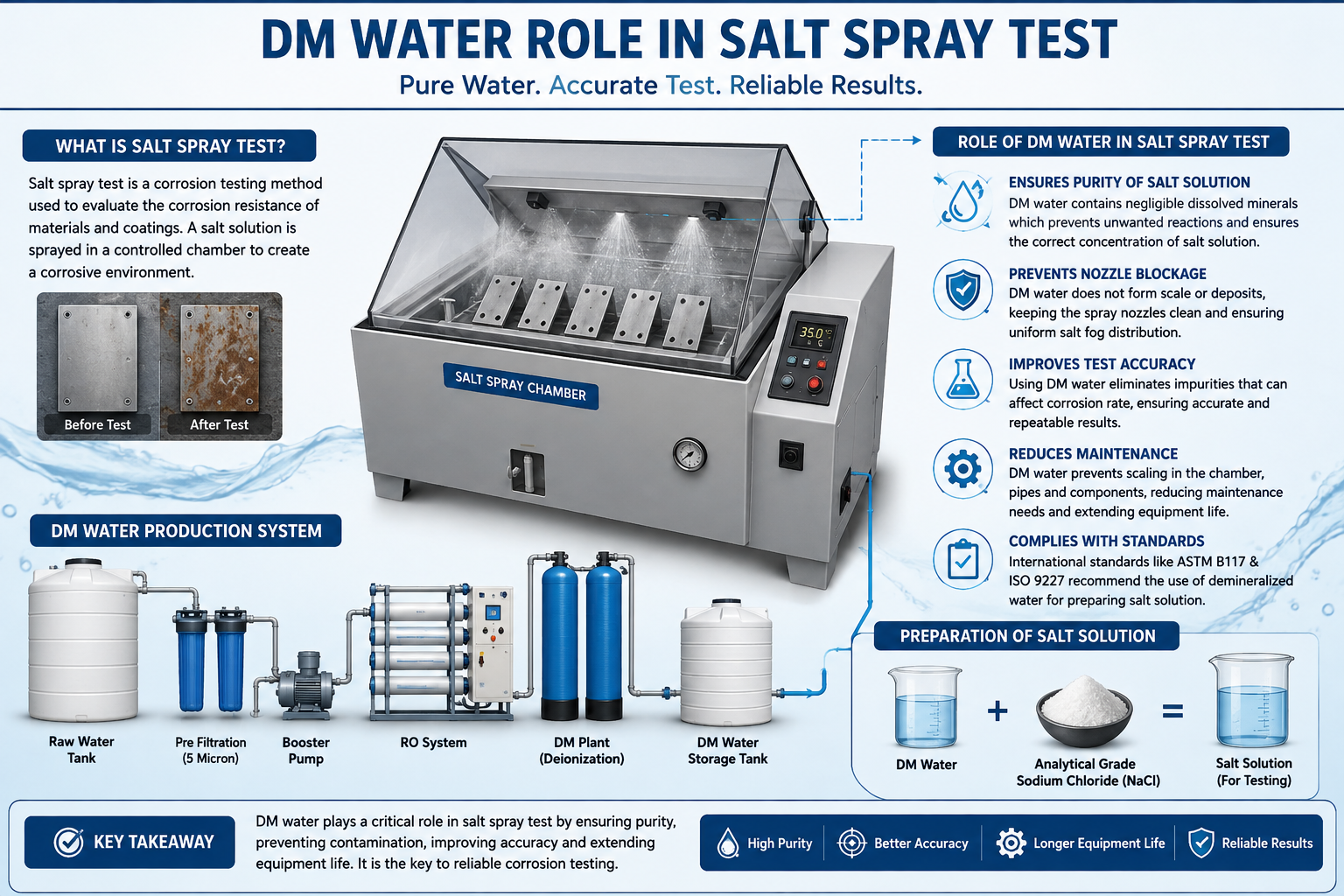
The DM Water Salt Spray Test is a laboratory corrosion test that uses demineralized water to prepare a controlled sodium chloride solution. This solution is converted into a fine mist inside a salt spray chamber, where metal samples are continuously exposed to a corrosive environment.
The purpose of the test is simple. It measures how effectively a material or protective coating resists corrosion over a specific period. Engineers can compare different materials under identical conditions and identify which products provide better durability.
Unlike natural outdoor corrosion, which depends on changing weather conditions, the salt spray chamber creates a controlled environment. Temperature, humidity, pH, spray pressure, and salt concentration remain within specified limits. Consequently, manufacturers receive reliable and repeatable results in a much shorter time.
The quality of water used during solution preparation directly affects the entire testing process. If impurities are present, the corrosion pattern may change unexpectedly. Therefore, laboratories use DM water instead of ordinary water.
What Is DM Water?
DM water, or demineralized water, is water that has almost all dissolved minerals removed through specialized purification processes. These minerals include:
Calcium
Magnesium
Sodium
Potassium
Iron
Silica
Sulfates
Carbonates
Chlorides
Heavy metal ions
The removal of these dissolved ions produces highly purified water with very low electrical conductivity.
Because DM water contains almost no dissolved minerals, it becomes an ideal choice for laboratory testing, pharmaceutical manufacturing, electronics production, battery manufacturing, chemical processing, and corrosion testing.
How DM Water Is Produced
Several purification technologies produce DM water. The selected method depends on the required purity level and industrial application.
Ion Exchange Process
Ion exchange is one of the most common methods.
The water first passes through a cation resin that removes positively charged ions such as calcium and magnesium. Next, it flows through an anion resin that removes negatively charged ions like chloride and sulfate.
Finally, the treated water contains very few dissolved salts.
Reverse Osmosis with Demineralization
Many industries first use reverse osmosis (RO) to remove most dissolved solids.
Afterward, ion exchange polishing removes the remaining ions.
This combination produces high-quality DM water suitable for laboratory testing.
Mixed Bed Resin System
Mixed bed resin combines cation and anion exchange resins inside one vessel.
As water flows through the mixed resin, it undergoes final polishing.
Consequently, conductivity becomes extremely low, making the water suitable for sensitive laboratory applications such as the DM Water Salt Spray Test.
Why Water Quality Matters in Corrosion Testing
Many people assume that any clean-looking water can prepare a salt solution. However, appearance does not indicate purity.
Even crystal-clear tap water may contain hundreds of dissolved substances.
These impurities influence corrosion in several ways.
For example, calcium can form deposits on metal surfaces. Iron contamination may accelerate rust formation. Silica can leave residues inside spray nozzles. Chlorides beyond the specified concentration may increase corrosion unexpectedly.
Therefore, laboratories cannot depend on ordinary water for standardized testing.
Instead, they use DM water to remove these unwanted variables.
As a result, every corrosion test follows nearly identical conditions.
Why the DM Water Salt Spray Test Is Important
Ensures Accurate Corrosion Evaluation
Accurate corrosion testing helps manufacturers understand the actual durability of their products.
For example, an automotive manufacturer may compare two protective coatings before selecting one for commercial production.
If contaminated water affects the test, engineers may choose the wrong coating.
However, DM water eliminates unwanted mineral interference.
Therefore, the results reflect the true corrosion resistance of the material rather than impurities in the water.
Supports Consistent Test Results
Repeatability is one of the most important requirements in laboratory testing.
Imagine performing the same corrosion test today and repeating it next month.
If different water quality is used each time, the corrosion results may differ.
Consequently, quality engineers cannot compare product performance accurately.
The DM Water Salt Spray Test solves this problem by providing a consistent foundation for every test.
Protects Laboratory Equipment
Salt spray chambers contain precision spray nozzles, pumps, tubing, and reservoirs.
Ordinary water gradually forms mineral scale inside these components.
Scale blocks spray nozzles and reduces fog uniformity.
As a result, the chamber no longer produces equal salt distribution.
DM water prevents mineral deposits from forming.
Therefore, laboratory equipment remains cleaner and requires less maintenance.
Helps Meet International Standards
Most industrial customers require products to comply with recognized corrosion testing standards.
Organizations such as ASTM and ISO specify water quality requirements because impurities influence testing accuracy.
Using DM water helps laboratories maintain compliance with these international standards.
Consequently, manufacturers gain greater confidence when supplying products to global markets.
DM Water Salt Spray Test and International Standards
Many industries follow internationally recognized corrosion testing procedures.
Two of the most widely accepted standards are:
ASTM B117
ISO 9227
These standards describe how to prepare the salt solution, maintain chamber conditions, monitor pH, control temperature, and evaluate corrosion.
Although each standard includes detailed technical requirements, both emphasize the importance of using purified water to avoid contamination.
By following these standards, laboratories can compare results across different countries and manufacturers.
Therefore, the DM Water Salt Spray Test has become a trusted quality control method worldwide.
Industries That Depend on the DM Water Salt Spray Test
Corrosion affects nearly every industrial sector. Consequently, many industries use the DM Water Salt Spray Test to verify product quality before commercial use.
Some major industries include:
Automotive manufacturing
Aerospace engineering
Marine equipment production
Electronics manufacturing
Fastener manufacturing
Metal fabrication
Steel processing
Construction hardware
Powder coating industries
Electroplating companies
Paint and coating manufacturers
Railway equipment manufacturers
Defense manufacturing
Industrial machinery production
Renewable energy equipment manufacturing
Each of these industries relies on accurate corrosion testing to improve product reliability, reduce warranty claims, and increase customer satisfaction.
Why This Test Is Becoming More Important
Modern industries face increasing pressure to manufacture products that last longer in demanding environments. Customers expect vehicles, machinery, electronics, and industrial equipment to resist corrosion for many years. At the same time, international quality standards have become stricter, making reliable testing more important than ever.
The DM Water Salt Spray Test provides manufacturers with a dependable method for evaluating corrosion resistance before products reach the market. Because DM water eliminates mineral contamination, laboratories can trust their results and make informed decisions about coatings, materials, and manufacturing processes. As industries continue to focus on durability and quality, the importance of this test will only continue to grow.
How the DM Water Salt Spray Test Works
The DM Water Salt Spray Test follows a carefully controlled process to evaluate the corrosion resistance of metals and protective coatings. Every stage of the process is important because even a small variation can affect the final results. Therefore, laboratories follow international testing standards and use high-purity DM water to maintain consistency.
Below is a step-by-step explanation of how the test works.
Step 1: Production of High-Purity DM Water
The first step is to produce high-quality demineralized water. The water usually passes through a reverse osmosis (RO) system followed by ion exchange resins or a mixed-bed demineralization unit.
During this process, dissolved minerals such as calcium, magnesium, sodium, chloride, sulfate, silica, and iron are removed. As a result, the water reaches very low conductivity and becomes suitable for laboratory applications.
Laboratories also monitor water quality regularly. If the conductivity increases beyond the recommended limit, technicians replace or regenerate the resin before preparing the salt solution.
Using high-quality DM water at this stage creates a strong foundation for accurate corrosion testing.
Step 2: Preparation of the Salt Solution
The next step is preparing the salt solution used inside the chamber.
Laboratory technicians dissolve analytical-grade sodium chloride in DM water according to the requirements of ASTM B117 or ISO 9227. The concentration is carefully measured because even a small deviation may change the corrosion rate.
Technicians also check the pH of the solution before using it. Maintaining the correct pH ensures that the corrosion process remains stable throughout the test.
Because DM water contains almost no dissolved minerals, only the sodium chloride influences the corrosion reaction. Therefore, laboratories obtain more reliable and repeatable results.
Step 3: Filling the Salt Spray Chamber
After preparing the solution, technicians transfer it to the reservoir of the salt spray chamber.
The chamber includes several important components, such as:
Salt solution reservoir
Spray nozzle
Air pressure regulator
Humidifier
Heating system
Sample holder
Collection funnel
Control panel
Each component works together to create a controlled salt fog environment.
Since the solution contains DM water, the chamber remains cleaner and experiences less mineral scaling.
Step 4: Generation of Salt Fog
The chamber uses compressed air to atomize the salt solution into a fine mist.
This mist spreads evenly throughout the testing chamber and settles on the metal samples.
Uniform fog distribution is extremely important because uneven spraying may produce inaccurate corrosion results.
DM water plays an important role here because it prevents mineral particles from blocking the spray nozzle. Consequently, the chamber produces a consistent fog pattern during the entire test.
Step 5: Continuous Exposure of Test Samples
The prepared metal samples remain inside the chamber for several hours, days, or even weeks, depending on the testing requirement.
Some common exposure durations include:
24 hours
48 hours
72 hours
96 hours
240 hours
500 hours
1,000 hours or more
During this period, technicians continuously monitor:
Chamber temperature
Spray rate
Salt concentration
pH level
Air pressure
Water quality
Careful monitoring helps maintain identical testing conditions from beginning to end.
Step 6: Inspection and Evaluation
Once the required exposure time is complete, technicians remove the samples from the chamber.
They carefully inspect each sample for visible signs of corrosion.
Common observations include:
Red rust
White rust
Blister formation
Paint peeling
Surface staining
Pitting corrosion
Cracks
Coating delamination
Finally, engineers compare the results with product specifications or customer requirements.
The Role of DM Water at Every Stage of the Salt Spray Test
Many people think DM water is only used for preparing the salt solution. However, its role is much broader.
It supports the entire testing process from beginning to end.
DM Water Maintains Solution Purity
The salt solution should contain only sodium chloride and purified water.
If ordinary water introduces additional minerals, unwanted chemical reactions may occur.
DM water eliminates this risk.
As a result, the solution remains chemically stable throughout the testing period.
DM Water Prevents Mineral Deposits
Hard water contains calcium and magnesium salts.
These minerals gradually form scale inside pipes, tanks, and spray nozzles.
Scale blocks the nozzle opening and changes the spray pattern.
Consequently, some test samples receive more salt fog than others.
DM water prevents scale formation and keeps the chamber operating efficiently.
DM Water Improves Repeatability
Manufacturers often compare products over several months or even years.
For example, an automotive company may compare corrosion resistance between two production batches.
If water quality changes each time, engineers cannot compare results accurately.
DM water provides stable quality every time.
Therefore, repeatability improves significantly.
DM Water Reduces Equipment Maintenance
Mineral deposits increase cleaning frequency and maintenance costs.
Blocked nozzles reduce testing efficiency and interrupt laboratory schedules.
Using DM water keeps internal components cleaner.
Consequently, maintenance becomes easier and equipment life increases.
DM Water Supports Reliable Product Certification
Many customers require corrosion testing reports before approving products.
These reports must be accurate and repeatable.
Since DM water minimizes contamination, laboratories can confidently certify product performance.
Therefore, manufacturers gain greater customer trust.
Benefits of Using DM Water in Salt Spray Testing
Using DM water offers several important advantages beyond simple water purification.
Each benefit contributes to more reliable corrosion testing.
Higher Testing Accuracy
DM water removes unwanted variables from the testing process.
As a result, corrosion occurs because of the test conditions rather than impurities.
This produces more accurate results.
Better Product Quality
Reliable testing helps manufacturers identify weak coatings before products reach customers.
Therefore, companies can improve product quality and reduce warranty claims.
Improved Laboratory Efficiency
Clean equipment requires less maintenance.
Consequently, technicians spend less time cleaning spray chambers and more time performing tests.
Longer Equipment Life
Mineral scale damages pumps, nozzles, and piping.
DM water prevents this damage.
Therefore, expensive laboratory equipment lasts much longer.
Lower Operating Costs
Frequent maintenance increases operating expenses.
Because DM water reduces scaling, laboratories save money on repairs, spare parts, and downtime.
Greater Customer Confidence
Accurate corrosion reports improve customer trust.
Manufacturers can demonstrate that their products meet international quality standards.
Easier Compliance with Global Standards
International buyers expect reliable corrosion testing.
Using DM water helps laboratories satisfy ASTM and ISO requirements.
As a result, product approvals become smoother.
Industrial Applications of the DM Water Salt Spray Test
The DM Water Salt Spray Test supports quality assurance across many industries. Below are some of the most common applications.
Automotive Industry
Automotive manufacturers test:
Car body panels
Chassis components
Brake systems
Nuts and bolts
Door hinges
Suspension parts
Fuel system components
Exhaust parts
These components regularly face rain, humidity, road salt, and coastal environments.
Therefore, corrosion testing helps improve vehicle durability and safety.
Aerospace Industry
Aircraft operate under harsh environmental conditions.
Metal components experience moisture, salt, and temperature changes.
Manufacturers perform the DM Water Salt Spray Test to evaluate:
Aircraft fasteners
Landing gear components
Structural brackets
Aluminum alloys
Protective coatings
Reliable testing helps improve aircraft safety and service life.
Marine Industry
Marine equipment remains exposed to seawater almost continuously.
As a result, corrosion protection becomes essential.
Manufacturers test:
Ship hardware
Marine fasteners
Offshore equipment
Dock structures
Propeller components
Navigation equipment housings
Using DM water ensures reliable corrosion evaluation for these demanding environments.
Electronics Industry
Electronic products contain numerous metal components that require corrosion protection.
Manufacturers test:
Connectors
Switches
Electrical terminals
Control panels
Battery contacts
Printed circuit hardware
Enclosures
Accurate corrosion testing helps maintain long-term electrical performance and reliability.
Construction Industry
Construction hardware must withstand outdoor weather for many years.
Common test samples include:
Steel brackets
Roofing hardware
Structural fasteners
Window fittings
Door hardware
Fencing components
Industrial supports
Manufacturers use the DM Water Salt Spray Test to verify coating durability before installation.
Fastener Manufacturing Industry
Fasteners play a critical role in almost every industrial product.
Manufacturers test:
Bolts
Nuts
Screws
Washers
Anchors
Threaded rods
DM Water Salt Spray Test: Water Quality Parameters
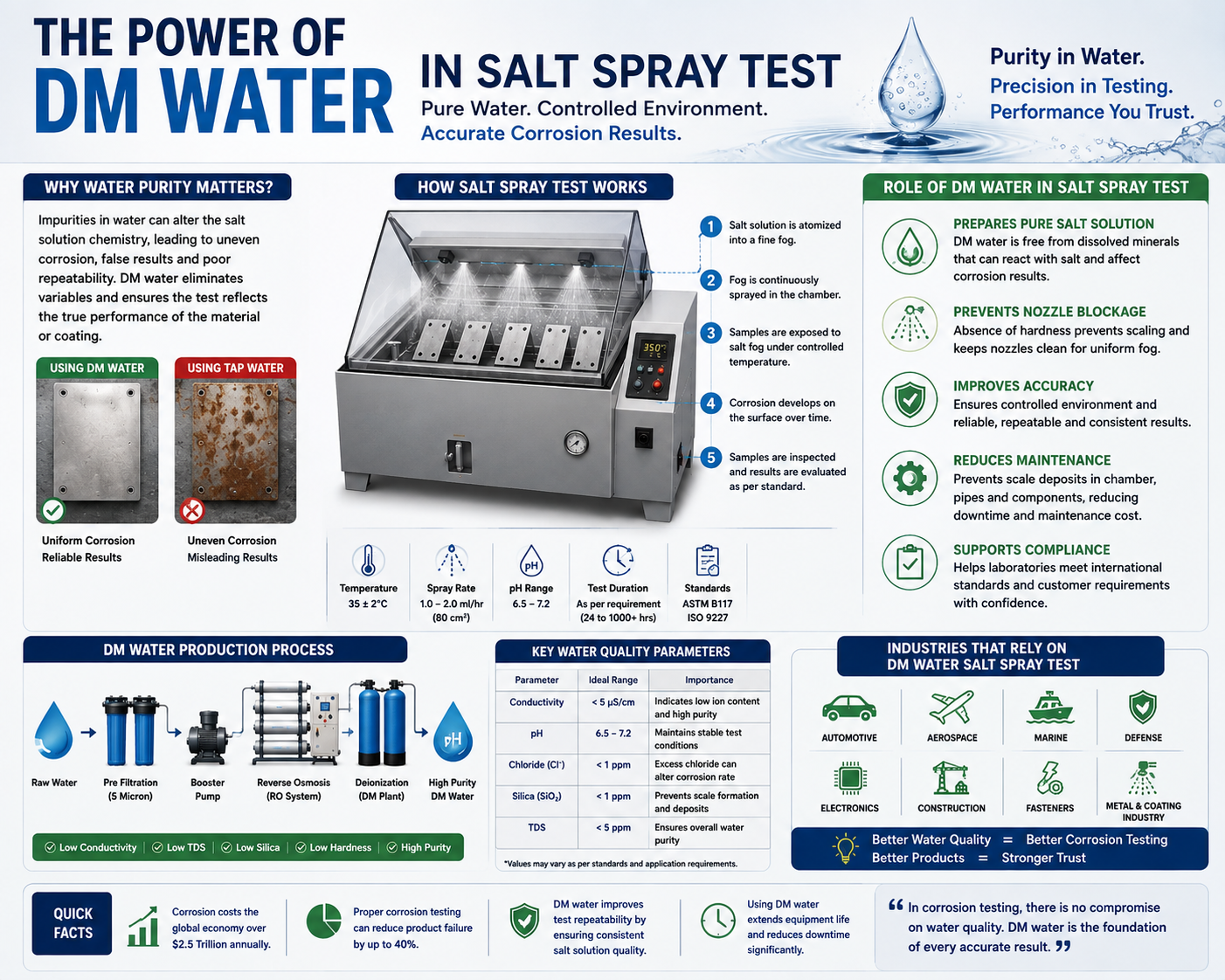
Water quality is the foundation of a successful DM Water Salt Spray Test. Even if the salt concentration, chamber temperature, and spray pressure are correct, poor-quality water can still affect the results. Therefore, laboratories regularly monitor key water quality parameters before preparing the salt solution.
Maintaining these parameters helps ensure that every corrosion test is accurate, repeatable, and compliant with international standards.
Conductivity in the DM Water Salt Spray Test
Conductivity measures the ability of water to conduct electricity. It also indicates the amount of dissolved ions present in the water.
Pure DM water has very low conductivity because it contains very few dissolved minerals. As conductivity increases, the concentration of unwanted ions also increases.
If conductivity becomes too high, contaminants may influence the corrosion process. Consequently, the test may produce misleading results.
For this reason, laboratories measure conductivity before every DM Water Salt Spray Test. Regular monitoring also helps identify when the demineralization system requires maintenance or resin replacement.
Why Low Conductivity Matters
Low-conductivity DM water offers several advantages:
Reduces contamination risks
Improves test consistency
Prevents unexpected corrosion reactions
Supports compliance with ASTM and ISO standards
Increases confidence in laboratory results
Because conductivity directly affects water purity, it remains one of the most important quality indicators.
pH Control in the DM Water Salt Spray Test
The pH value of the salt solution also plays an important role in corrosion testing.
If the pH is too high or too low, corrosion may occur differently from the expected standard conditions. Therefore, laboratories carefully adjust and monitor the pH before beginning the test.
A stable pH helps create uniform corrosion across all samples. As a result, engineers can compare different products under identical conditions.
Technicians usually check the pH:
Before preparing the solution
After mixing the salt
During long-duration testing
Before replacing the solution
Regular pH monitoring improves testing reliability and reduces unexpected variations.
Salt Purity in the DM Water Salt Spray Test
The quality of sodium chloride is just as important as the quality of DM water.
Laboratories use analytical-grade sodium chloride because it contains very few impurities.
Low-grade industrial salt may contain calcium, magnesium, iron, copper, or other contaminants. These impurities can change the corrosion rate and affect the final results.
Therefore, technicians always select high-purity chemicals when preparing the salt solution.
Benefits of High-Purity Salt
Using high-quality salt helps laboratories:
Maintain consistent corrosion rates
Reduce unwanted chemical reactions
Improve repeatability
Produce reliable test reports
Meet international testing requirements
When high-purity salt is combined with DM water, the testing environment remains controlled and predictable.
Temperature Control During the DM Water Salt Spray Test
Temperature has a significant influence on corrosion.
Higher temperatures generally increase the corrosion rate, while lower temperatures may slow it down. Therefore, laboratories maintain the chamber at the temperature specified by the testing standard.
Modern salt spray chambers include automatic temperature control systems. These systems continuously monitor the chamber and make small adjustments whenever necessary.
Stable temperature provides several benefits:
Uniform corrosion
Better repeatability
Accurate comparison between products
Improved compliance with testing standards
Although temperature control is important, it works best when combined with high-quality DM water.
Spray Pattern and Fog Distribution
Uniform salt fog is essential for reliable corrosion testing.
If one area of the chamber receives more salt fog than another, different samples may corrode at different rates.
Therefore, technicians regularly inspect spray nozzles, air pressure, and fog distribution.
DM water helps maintain a clean spray system because it contains almost no dissolved minerals. As a result, spray nozzles remain free from scale deposits for a longer period.
Signs of Poor Spray Distribution
Watch for the following signs:
Uneven corrosion on samples
Blocked spray nozzles
Dry areas inside the chamber
Excessive salt accumulation
Irregular fog density
Routine inspection helps prevent these problems before they affect test quality.
Common Mistakes in the DM Water Salt Spray Test
Even experienced laboratories can make mistakes if testing procedures are not followed carefully.
Understanding these common errors helps improve testing accuracy.
Using Tap Water Instead of DM Water
This is one of the most common mistakes.
Tap water contains dissolved minerals that interfere with corrosion testing. Consequently, the results become inconsistent.
Always use high-quality DM water when preparing the salt solution.
Ignoring Water Quality Checks
Some laboratories only test water quality occasionally.
However, water quality can change over time.
Therefore, technicians should monitor conductivity and water purity regularly.
Using Contaminated Storage Containers
Clean DM water can become contaminated if it is stored in dirty containers.
Dust, chemicals, and metal particles may enter the water and reduce its purity.
Always use clean, dedicated storage tanks.
Incorrect Salt Concentration
Adding too much or too little salt changes the corrosion rate.
Therefore, technicians should measure chemicals accurately using calibrated laboratory equipment.
Poor Chamber Maintenance
A dirty chamber affects fog distribution and testing performance.
Regular cleaning prevents contamination and improves consistency.
Maintenance should include:
Cleaning spray nozzles
Inspecting air lines
Removing salt deposits
Checking sensors
Verifying spray pressure
Best Practices for the DM Water Salt Spray Test
Following best practices helps laboratories achieve reliable and repeatable results.
Consider these recommendations:
Use freshly produced DM water.
Measure conductivity before every test.
Use analytical-grade sodium chloride.
Prepare a fresh salt solution for each testing cycle.
Store DM water in clean containers.
Calibrate measuring instruments regularly.
Monitor pH throughout long-duration tests.
Maintain proper chamber temperature.
Clean spray nozzles frequently.
Replace worn components immediately.
Record all testing parameters.
Follow ASTM B117 or ISO 9227 procedures.
Train laboratory personnel regularly.
Schedule preventive maintenance.
Validate results before issuing reports.
These practices reduce errors and improve laboratory performance.
How to Choose the Right DM Water System
Selecting the correct DM water system is important for laboratories that perform corrosion testing regularly.
Before purchasing a system, evaluate the following factors:
Water Purity Requirements
Determine the required conductivity level based on your testing applications.
Higher purity generally produces more reliable results.
Daily Water Demand
Estimate the amount of DM water needed each day.
An undersized system may interrupt laboratory operations.
An oversized system may increase operating costs unnecessarily.
Maintenance Requirements
Choose equipment that offers easy maintenance and readily available replacement parts.
Regular maintenance keeps water quality stable.
Automation Features
Modern systems include:
Automatic conductivity monitoring
Resin regeneration alerts
Digital displays
Remote monitoring
Automatic shutdown during faults
These features improve operational efficiency.
Service and Technical Support
Reliable after-sales support is essential.
Choose a supplier that provides:
Installation assistance
Routine servicing
Spare parts availability
Technical guidance
Emergency support
Strong technical support helps maintain uninterrupted laboratory operations.
Why Regular Maintenance of the DM Water System Matters
A high-quality DM water system cannot maintain excellent performance without proper maintenance.
Over time, ion exchange resins lose their capacity, filters become clogged, and membranes may foul due to contaminants. If these components are not serviced on time, water purity gradually decreases. As a result, the DM Water Salt Spray Test may no longer produce reliable or repeatable results.
Regular maintenance helps laboratories:
Maintain consistent water purity
Extend equipment lifespan
Reduce unexpected breakdowns
Lower long-term operating costs
Ensure compliance with testing standards
Improve laboratory productivity
Deliver accurate corrosion reports
Industry Statistics on Corrosion and Water Quality
Corrosion causes significant financial losses across industries every year. It also affects product safety, equipment performance, and maintenance costs. Therefore, manufacturers invest heavily in corrosion testing methods such as the DM Water Salt Spray Test to improve product durability and quality.
Several recent studies highlight the importance of proper corrosion testing and high-purity water.
According to the World Corrosion Organization, corrosion costs the global economy more than US$2.5 trillion annually, which is about 3–4% of global GDP.
The National Association of Corrosion Engineers (AMPP, formerly NACE) reports that effective corrosion prevention programs can reduce corrosion-related costs by 15–35%.
Industry reports show that the global corrosion protection coatings market continues to grow because manufacturers increasingly focus on longer product life and improved durability.
The automotive industry performs thousands of salt spray tests every year to validate paint systems, galvanized components, and protective coatings before commercial production.
Aerospace manufacturers conduct corrosion testing throughout product development to improve aircraft safety and reduce maintenance requirements.
Electronics manufacturers use salt spray testing to verify connector reliability, especially for products used in humid and coastal environments.
These figures demonstrate why reliable water quality is essential. Even a small amount of mineral contamination can influence corrosion behaviour and reduce confidence in laboratory results.
Expert Insights on the DM Water Salt Spray Test
Industry experts consistently emphasize the importance of purified water in corrosion testing.
“The accuracy of a corrosion test depends on controlling every variable, and water purity is one of the most critical factors.” — ASTM International, guidance on corrosion testing
This highlights that laboratories cannot rely on ordinary water if they want consistent and repeatable results.
“Standardized laboratory testing allows manufacturers to compare coating performance under controlled conditions.” — ISO 9227 Corrosion Testing Guidance
Using DM water helps laboratories maintain those controlled conditions.
“Preventing contamination is just as important as selecting the correct testing procedure.” — AMPP (Association for Materials Protection and Performance)
This reinforces the need for proper water purification before every salt spray test.
Future Trends in the DM Water Salt Spray Test
Corrosion testing continues to evolve as industries demand higher product quality and greater reliability. At the same time, environmental regulations and customer expectations are becoming more stringent. Therefore, laboratories are adopting advanced technologies to improve testing accuracy and efficiency.
Several important trends are shaping the future of the DM Water Salt Spray Test.
Smart Laboratory Monitoring
Modern salt spray chambers now include digital monitoring systems that continuously track:
Temperature
Humidity
Conductivity
Spray rate
Air pressure
Solution level
These systems reduce manual errors and improve testing consistency.
Automated Water Quality Monitoring
Many new DM water systems include real-time conductivity sensors and automatic alarms.
If water quality drops below the required standard, the system immediately alerts laboratory personnel.
As a result, contaminated water is less likely to enter the testing process.
Sustainable Water Management
Industries are also focusing on water conservation.
Many facilities now recycle RO reject water for non-critical applications while reserving high-purity DM water for laboratory testing.
This approach reduces water consumption without affecting testing quality.
Improved Corrosion Simulation
Researchers continue to develop corrosion chambers that better simulate real environmental conditions.
Future systems may combine:
Salt spray
Humidity cycling
UV exposure
Temperature variation
Condensation testing
These improvements will help manufacturers predict real-world product performance more accurately.
Why Manufacturers Should Invest in High-Quality DM Water
Investing in a reliable DM water system provides long-term benefits for any organization that performs corrosion testing.
A high-quality system helps manufacturers:
Improve corrosion testing accuracy
Reduce laboratory errors
Increase repeatability
Protect expensive testing equipment
Lower maintenance costs
Meet international standards
Improve product quality
Build customer confidence
Reduce warranty claims
Support continuous quality improvement
Although the initial investment may seem significant, the long-term savings and improved testing reliability often outweigh the installation cost.
Frequently Asked Questions
What is the purpose of the DM Water Salt Spray Test?
The DM Water Salt Spray Test evaluates how well metals and protective coatings resist corrosion under controlled laboratory conditions. It helps manufacturers assess product durability before commercial use.
Why is DM water used instead of tap water in a salt spray test?
DM water contains very few dissolved minerals. Therefore, it prevents contamination and ensures that corrosion occurs only because of the controlled salt solution. This improves testing accuracy and repeatability.
Which international standards support the DM Water Salt Spray Test?
The two most widely used standards are:
ASTM B117
ISO 9227
These standards define the procedures for preparing the salt solution, maintaining chamber conditions, and evaluating corrosion resistance.
How does DM water improve corrosion testing?
DM water removes dissolved minerals that could interfere with the corrosion process. As a result, laboratories obtain consistent, repeatable, and accurate results. It also protects spray nozzles from mineral deposits and reduces equipment maintenance.
Conclusion
The DM Water Salt Spray Test is an essential method for evaluating the corrosion resistance of metals, coatings, and industrial components. The quality of the water used during testing directly affects the accuracy of the results. For this reason, laboratories rely on DM water instead of ordinary water to prepare the salt solution.
DM water removes dissolved minerals that can interfere with corrosion reactions, contaminate the solution, and reduce testing reliability. As a result, manufacturers obtain accurate, repeatable, and standards-compliant results that support better product development and quality control.
Moreover, using DM water helps protect laboratory equipment by preventing scale formation in spray nozzles and piping. This reduces maintenance requirements, extends equipment life, and lowers operating costs over time. Whether the application involves automotive components, aerospace parts, marine equipment, electronic connectors, or construction hardware, the DM Water Salt Spray Test provides valuable insights into long-term corrosion performance.
As industries continue to demand stronger, safer, and more durable products, the importance of high-quality corrosion testing will only increase. Investing in a reliable DM water system and following recognized standards such as ASTM B117 and ISO 9227 enables laboratories to maintain consistent testing conditions and deliver dependable results. Ultimately, the DM Water Salt Spray Test remains one of the most effective tools for improving product quality, ensuring customer satisfaction, and supporting global manufacturing standards.