


Water purity plays a major role in laboratories, pharmaceutical manufacturing, electronics, cosmetics, food processing, and industrial production. However, many people confuse distilled water with deionized water because both are highly purified. Although they appear similar, they differ in their purification methods, mineral content, purity level, and industrial applications. Understanding the distilled vs deionized water differences helps businesses choose the right water quality for their operations. Moreover, selecting the correct type improves product quality, reduces equipment damage, and supports regulatory compliance.
In this guide, you will learn how distilled and deionized water are produced, their major differences, advantages, limitations, and the industries where each performs best.
What Is Distilled Water?
Distilled water is purified through a process called distillation. During this process, water is heated until it becomes steam. The steam then cools and condenses into liquid water in a separate container. As a result, most dissolved salts, minerals, heavy metals, bacteria, and many contaminants remain behind.
Therefore, distilled water offers a very high level of purity.
How Distillation Works
The distillation process follows these simple steps:
- Raw water enters the distillation unit.
- The water boils and turns into steam.
- The steam separates from impurities.
- The steam cools inside a condenser.
- Pure distilled water collects in a storage tank.
Because impurities do not evaporate with the steam, the final water becomes highly purified.
What Is Deionized Water?
Deionized water, commonly known as DI water, is purified using ion exchange technology. Instead of boiling water, this process removes charged minerals through special resin beds.
The resins replace positive and negative ions with hydrogen and hydroxide ions. These ions combine to form pure water.
As a result, deionized water contains very low levels of dissolved minerals.
How Deionization Works
The purification process includes several steps:
- Raw water enters the ion exchange system.
- Cation resin removes positively charged minerals.
- Anion resin removes negatively charged minerals.
- Hydrogen and hydroxide ions combine.
- Highly purified water leaves the system.
Unlike distillation, deionization mainly removes dissolved ions rather than microorganisms or organic compounds.
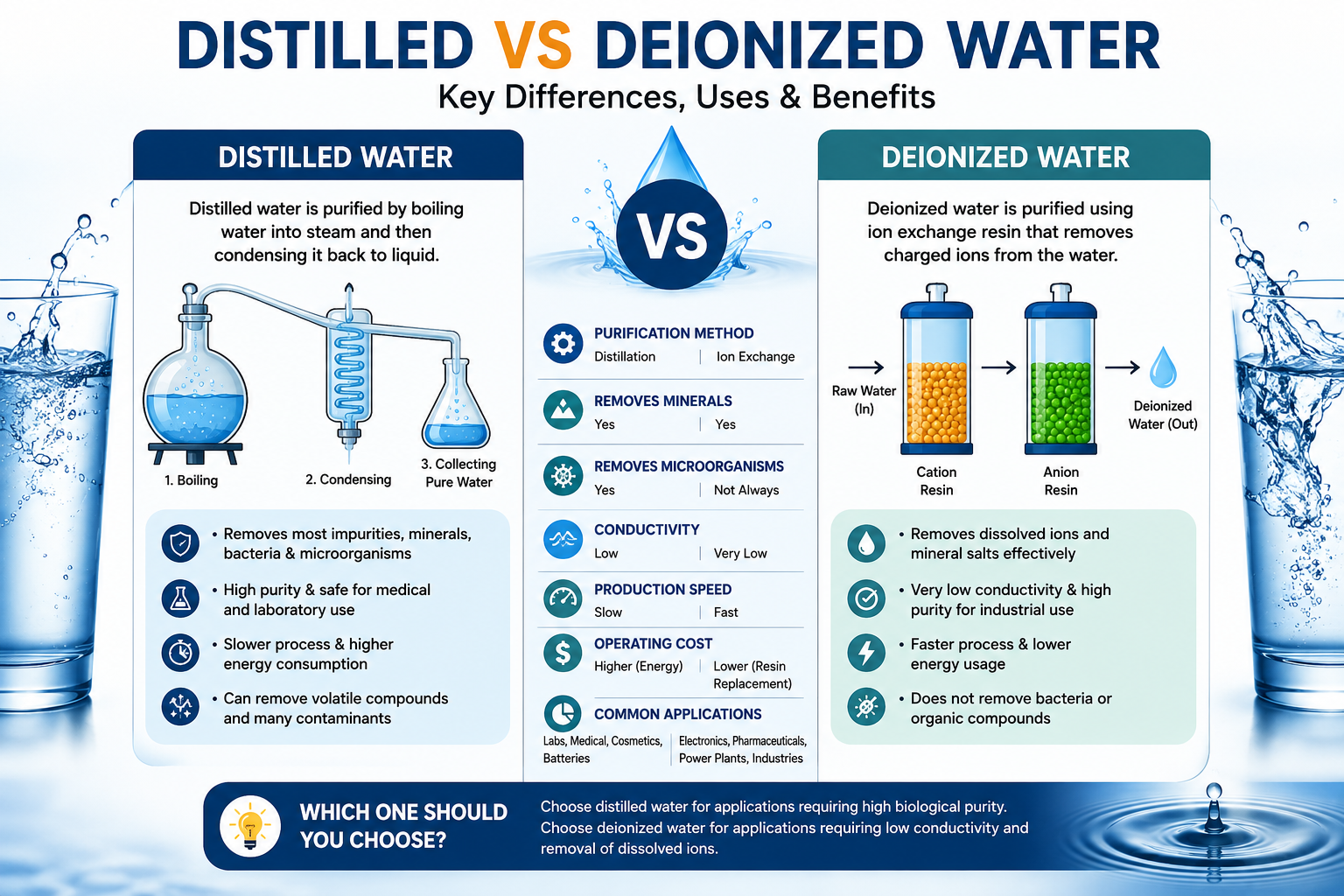
Distilled vs Deionized Water Differences
Although both water types are highly purified, several important differences exist.
Purification Method
The biggest difference lies in the purification process.
Distilled water uses heat and condensation.
In contrast, deionized water uses ion exchange resins.
Therefore, the technologies are completely different.
Mineral Removal
Distillation removes minerals by separating water from dissolved solids.
Meanwhile, deionization removes electrically charged minerals directly from the water.
Both methods produce mineral-free water. However, they achieve this in different ways.
Removal of Microorganisms
Distillation effectively removes bacteria, viruses, and many microorganisms because high temperatures destroy them.
On the other hand, deionization does not always remove bacteria unless additional filtration systems are installed.
Therefore, distilled water generally offers better biological purity.
Removal of Organic Contaminants
Distillation removes many organic contaminants, although some volatile compounds may require additional treatment.
Meanwhile, deionization mainly targets dissolved ions instead of organic impurities.
As a result, many DI systems include activated carbon filters or reverse osmosis before ion exchange.
Water Conductivity
Deionized water usually has lower electrical conductivity because almost all dissolved ions are removed.
Distilled water also has low conductivity, but it may contain tiny traces of minerals.
Therefore, DI water is often preferred where electrical resistance matters.
Production Speed
Distillation requires heating and cooling, which takes time.
By comparison, deionization works continuously and produces water much faster.
Consequently, industries with high water demand often prefer DI systems.
Operating Cost
Distillation consumes more electricity because it relies on heating.
Meanwhile, deionization uses less energy but requires regular resin replacement.
Therefore, operating costs depend on water usage and maintenance schedules.
Typical Purity Level
Both methods produce high-purity water.
However, combining reverse osmosis, deionization, and ultraviolet treatment often achieves even higher purity than distillation alone.
Many pharmaceutical and semiconductor industries use multiple purification technologies together.
Advantages of Distilled Water
Distilled water offers several important benefits.
- Removes most dissolved minerals
- Eliminates bacteria and viruses
- Produces consistent water quality
- Prevents mineral scaling
- Supports laboratory testing
- Suitable for medical applications
- Increases equipment life
- Reduces contamination risks
Therefore, many industries trust distilled water for critical applications.
Advantages of Deionized Water
Deionized water also provides many valuable advantages.
- Removes dissolved ions effectively
- Produces extremely low conductivity
- Operates continuously
- Uses less energy than distillation
- Ideal for electronics manufacturing
- Supports pharmaceutical production
- Prevents mineral deposits
- Delivers high-purity rinse water
As a result, DI water remains one of the most widely used industrial water types.
Industrial Applications of Distilled Water
Many industries depend on distilled water every day.
Laboratories
Scientists use distilled water for experiments, chemical preparation, and equipment cleaning.
Pharmaceutical Manufacturing
Manufacturers use distilled water during medicine production to maintain product quality.
Medical Equipment
Hospitals use distilled water in sterilizers, autoclaves, and diagnostic instruments.
Cosmetic Manufacturing
Cosmetic companies prepare creams, lotions, shampoos, and skincare products with distilled water.
Battery Maintenance
Distilled water helps maintain lead-acid batteries by preventing mineral buildup.
Industrial Applications of Deionized Water
Deionized water serves many industries that require extremely low mineral content.
Electronics Manufacturing
Manufacturers clean electronic components without leaving mineral residues.
Semiconductor Industry
Chip manufacturers use DI water during wafer cleaning and production.
Pharmaceutical Industry
Many pharmaceutical plants use deionized water during manufacturing and equipment cleaning.
Power Plants
Boilers require high-purity water to reduce corrosion and scale formation.
Automotive Industry
Vehicle manufacturers use DI water during painting, cooling systems, and component cleaning.
How to Choose Between Distilled and Deionized Water
Choosing the right water depends on your application.
Consider these factors before making a decision.
- Required purity level
- Production volume
- Budget
- Equipment sensitivity
- Industry regulations
- Maintenance requirements
- Energy consumption
- Water quality standards
Therefore, understanding your process requirements helps you select the best purification method.
Which Water Type Is Better?
There is no universal answer because every industry has different requirements.
Choose distilled water if you need:
- High biological purity
- Laboratory testing
- Medical equipment
- Cosmetic production
- Small-scale purification
Choose deionized water if you need:
- Low conductivity
- Continuous production
- Electronics cleaning
- Large industrial systems
- Semiconductor manufacturing
Many modern industries combine reverse osmosis, deionization, UV sterilization, and filtration to achieve the highest water purity.
Common Mistakes When Choosing Purified Water
Many businesses make avoidable mistakes when selecting purified water.
Avoid these common errors.
- Assuming both water types are identical
- Ignoring conductivity requirements
- Overlooking maintenance costs
- Choosing only based on price
- Forgetting industry regulations
- Skipping regular water quality testing
- Using the wrong water for sensitive equipment
- Neglecting system maintenance
Making the correct choice improves efficiency, reduces downtime, and protects expensive equipment.
Why Water Purity Matters in Industry
High-quality purified water delivers several long-term benefits.
- Improves product consistency
- Extends equipment lifespan
- Reduces maintenance costs
- Prevents contamination
- Supports regulatory compliance
- Improves manufacturing efficiency
- Protects sensitive machinery
- Enhances customer satisfaction
Therefore, investing in the right purification system supports reliable production and long-term business growth.
Frequently Asked Questions (FAQs)
1. What is the main difference between distilled and deionized water?
Distilled water is produced through boiling and condensation. In contrast, deionized water is purified using ion exchange resins that remove dissolved ions.
2. Is distilled water purer than deionized water?
Both are highly pure. However, distilled water removes microorganisms more effectively, while deionized water removes dissolved minerals more efficiently.
3. Can distilled water replace deionized water?
It depends on the application. Some industries require very low conductivity, making deionized water the better choice. Others need biological purity, where distilled water performs well.
4. Which industries commonly use deionized water?
Electronics, semiconductor manufacturing, pharmaceuticals, automotive production, laboratories, and power plants frequently use deionized water.
5. Which water type is better for laboratory use?
Many laboratories use both types. Distilled water works well for general laboratory applications, while deionized water is preferred when extremely low mineral content is required.
Conclusion
Understanding the distilled vs deionized water differences helps industries choose the right purification method for their specific needs. Although both water types offer excellent purity, they differ in production methods, conductivity, biological purity, operating costs, and industrial applications.
Distilled water remains an excellent choice for laboratories, healthcare, cosmetics, and battery maintenance. Meanwhile, deionized water is ideal for electronics, pharmaceuticals, power generation, and semiconductor manufacturing because it removes dissolved ions very effectively.
Before selecting a purification system, evaluate your industry’s water quality requirements, production volume, maintenance needs, and operating costs. Choosing the right purified water improves product quality, protects equipment, reduces downtime, and supports long-term operational success.