


Distilled Water Uses in cosmetic manufacturing are essential for product quality, safety, and consistency. Water is one of the main ingredients in many cosmetic products. Therefore, manufacturers must use highly purified water to achieve the best results. Distilled water helps create stable formulations and reduces the risk of contamination. Moreover, it supports the performance of active ingredients and improves the shelf life of cosmetic products.
Today, consumers expect safe and high-quality beauty products. As a result, cosmetic companies pay close attention to water quality during production. Distilled water has become a preferred choice because it contains very low levels of minerals, salts, and impurities. Consequently, it helps manufacturers maintain consistent product standards.
What Is Distilled Water?
Distilled water is purified water produced through a distillation process. During this process, water is heated until it becomes steam. The steam then cools and returns to liquid form. As a result, many impurities remain behind.
Unlike regular water, distilled water contains very few dissolved minerals. Furthermore, it has lower levels of contaminants that may affect cosmetic formulations. Because of its purity, it is widely used in cosmetic manufacturing.
Key characteristics of distilled water include:
- High purity
- Low mineral content
- Reduced contaminants
- Consistent quality
- Better formulation compatibility
Why Water Quality Matters in Cosmetics
Water often makes up a large portion of cosmetic products. In some formulations, water can account for more than 70% of the total product. Therefore, poor-quality water can negatively affect product performance.
Impurities in water may cause several issues, including:
- Product instability
- Unwanted chemical reactions
- Microbial growth
- Changes in texture
- Reduced shelf life
For this reason, manufacturers choose distilled water to ensure reliable product quality. In addition, purified water helps maintain consumer trust.
Distilled Water Uses in Cosmetic Manufacturing
Skincare Product Manufacturing
Distilled water is a key ingredient in skincare products. It serves as a clean and stable base for many formulations.
Common skincare products include:
- Face creams
- Moisturizers
- Serums
- Cleansers
- Face masks
Because distilled water contains very few impurities, it helps maintain product stability. Moreover, it allows active ingredients to perform more effectively. As a result, manufacturers can create products with consistent quality.
Hair Care Product Manufacturing
Hair care products also rely on purified water. Distilled water helps manufacturers achieve uniform formulations and improved performance.
It is commonly used in:
- Shampoos
- Conditioners
- Hair serums
- Hair masks
- Hair sprays
Furthermore, distilled water prevents unwanted interactions between minerals and cosmetic ingredients. Consequently, the final product remains stable throughout its shelf life.
Makeup Product Formulation
Many makeup products contain water-based ingredients. Therefore, the quality of water directly affects the final formulation.
Distilled water is commonly used in:
- Liquid foundations
- BB creams
- CC creams
- Setting sprays
- Liquid concealers
In addition, distilled water helps create smooth textures. It also improves product consistency and application performance.
Personal Care Product Manufacturing
Personal care products require high-quality ingredients. Distilled water helps meet this requirement.
Manufacturers use it in:
- Body lotions
- Hand creams
- Body washes
- Shower gels
- Deodorants
As a result, these products achieve better stability and improved consumer safety.
Raw Material Preparation
Before production begins, manufacturers often prepare ingredients using distilled water. This step is important because ingredient quality affects the final product.
Distilled water is used for:
- Ingredient dilution
- Solution preparation
- Botanical extract processing
- Formula development
Therefore, manufacturers can maintain greater accuracy during production.
Equipment Cleaning and Rinsing
Distilled water is not only used in formulations. It is also used for cleaning manufacturing equipment.
Benefits include:
- Reduced mineral deposits
- Cleaner surfaces
- Better sanitation
- Lower contamination risk
Consequently, production facilities can maintain high hygiene standards.
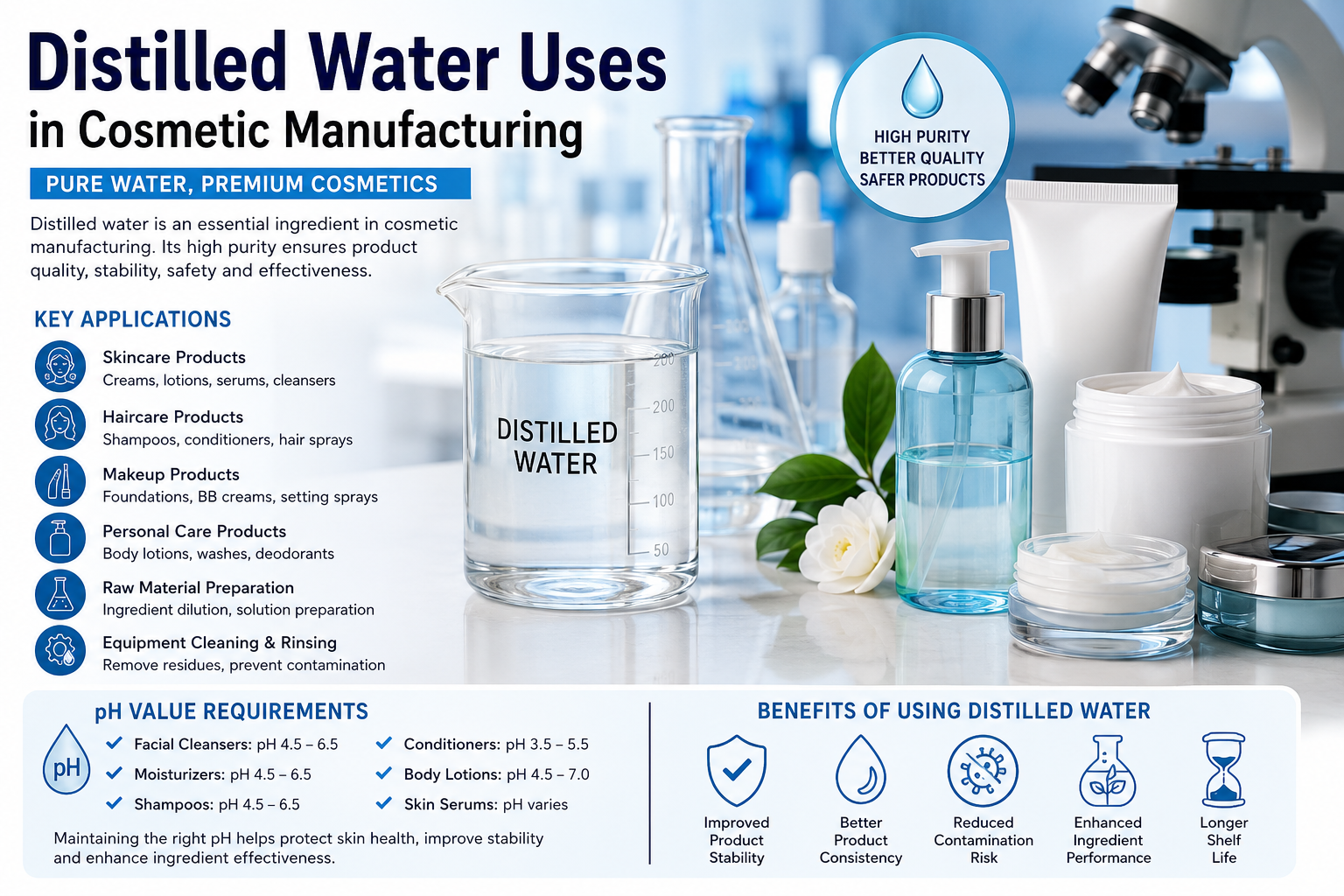
pH Value Requirements in Cosmetic Manufacturing
The pH value of water plays an important role in cosmetic production. Fresh distilled water generally has a pH close to 7. However, the final pH depends on the cosmetic formulation.
Different products require different pH levels.
Common pH ranges include:
- Facial cleansers: pH 4.5–6.5
- Moisturizers: pH 4.5–6.5
- Shampoos: pH 4.5–6.5
- Conditioners: pH 3.5–5.5
- Body lotions: pH 4.5–7.0
- Serums: Depends on active ingredients
Maintaining the correct pH is important because it helps:
- Improve product stability
- Support ingredient performance
- Protect skin health
- Extend shelf life
- Reduce irritation risks
Therefore, cosmetic manufacturers carefully monitor pH during production.
Benefits of Using Distilled Water in Cosmetics
Improved Product Stability
Distilled water contains very few impurities. As a result, it reduces unwanted chemical reactions and improves formulation stability.
Better Product Consistency
Manufacturers need consistent results across production batches. Therefore, distilled water helps maintain uniform quality.
Reduced Contamination Risk
Purified water lowers the possibility of contamination. Consequently, cosmetic products become safer for consumers.
Enhanced Ingredient Performance
Active ingredients work more effectively in a clean environment. Moreover, fewer minerals mean fewer formulation challenges.
Longer Shelf Life
Stable formulations often last longer. Therefore, distilled water helps support product longevity.
Better Manufacturing Efficiency
Clean water reduces production issues. In addition, it helps maintain smooth manufacturing operations.
Quality Parameters for Distilled Water
Manufacturers regularly test distilled water to ensure quality.
Important parameters include:
- pH level
- Conductivity
- Total dissolved solids (TDS)
- Microbial count
- Purity level
- Storage conditions
Regular monitoring helps maintain product quality and compliance standards.
Future of Distilled Water in Cosmetic Manufacturing
The cosmetic industry continues to grow every year. At the same time, consumers are becoming more aware of product quality and safety.
Therefore, the demand for purified water systems is increasing. Distilled water will continue to play an important role in cosmetic manufacturing. Furthermore, manufacturers will rely on it to maintain quality, consistency, and regulatory compliance.
Frequently Asked Questions
1. Why is distilled water used in cosmetic manufacturing?
Distilled water provides high purity and helps improve product quality, stability, and safety.
2. What is the typical pH of distilled water?
Fresh distilled water usually has a pH close to 7, although exposure to air may slightly change the value.
3. Which cosmetic products use distilled water?
Distilled water is used in creams, lotions, shampoos, conditioners, serums, cleansers, and makeup products.
4. Does distilled water improve product shelf life?
Yes. Distilled water reduces contamination risks and helps maintain formulation stability.
5. Can distilled water affect cosmetic product quality?
Yes. High-purity water supports better product consistency, ingredient performance, and consumer safety.
Conclusion
Distilled Water Uses in cosmetic manufacturing go far beyond simple formulation support. Distilled water helps improve product stability, maintain quality, reduce contamination risks, and support proper pH control. Moreover, it enhances ingredient performance and contributes to longer shelf life. As the cosmetic industry continues to evolve, distilled water will remain a critical component in producing safe, effective, and high-quality beauty products.