


Introduction
Water treatment plays an important role in industrial, commercial, and residential applications. However, different water treatment methods produce different types of water. Two common examples are Demineralized (DM) Water and Soft Water.
Many people use these terms interchangeably. However, they are not the same. While both undergo treatment processes, they differ in mineral content, purity level, production method, and application.
Understanding the major differences between DM water and soft water helps businesses and homeowners choose the right water for their specific needs. In this guide, we will explore both water types in detail and explain where each one works best.
What Is DM Water?
DM water, or Demineralized Water, is water that contains very low levels of dissolved minerals and salts. Manufacturers produce it through processes such as ion exchange, reverse osmosis, and electrodeionization.
These treatment methods remove minerals like:
- Calcium
- Magnesium
- Sodium
- Potassium
- Chlorides
- Sulfates
As a result, DM water achieves a very high level of purity.
Key Characteristics of DM Water
- Almost mineral-free
- Very low conductivity
- High purity level
- Suitable for industrial use
- Prevents scaling and corrosion
- Supports critical manufacturing processes
What Is Soft Water?
Soft water is water that has undergone a softening process to remove hardness-causing minerals, mainly calcium and magnesium.
A water softener replaces these minerals with sodium or potassium ions. Therefore, the water becomes softer and less likely to form scale deposits.
However, soft water still contains dissolved salts. As a result, it does not achieve the same purity level as DM water.
Key Characteristics of Soft Water
- Removes hardness minerals
- Contains sodium or potassium
- Reduces scale formation
- Improves cleaning efficiency
- Suitable for domestic use
- Supports commercial washing applications
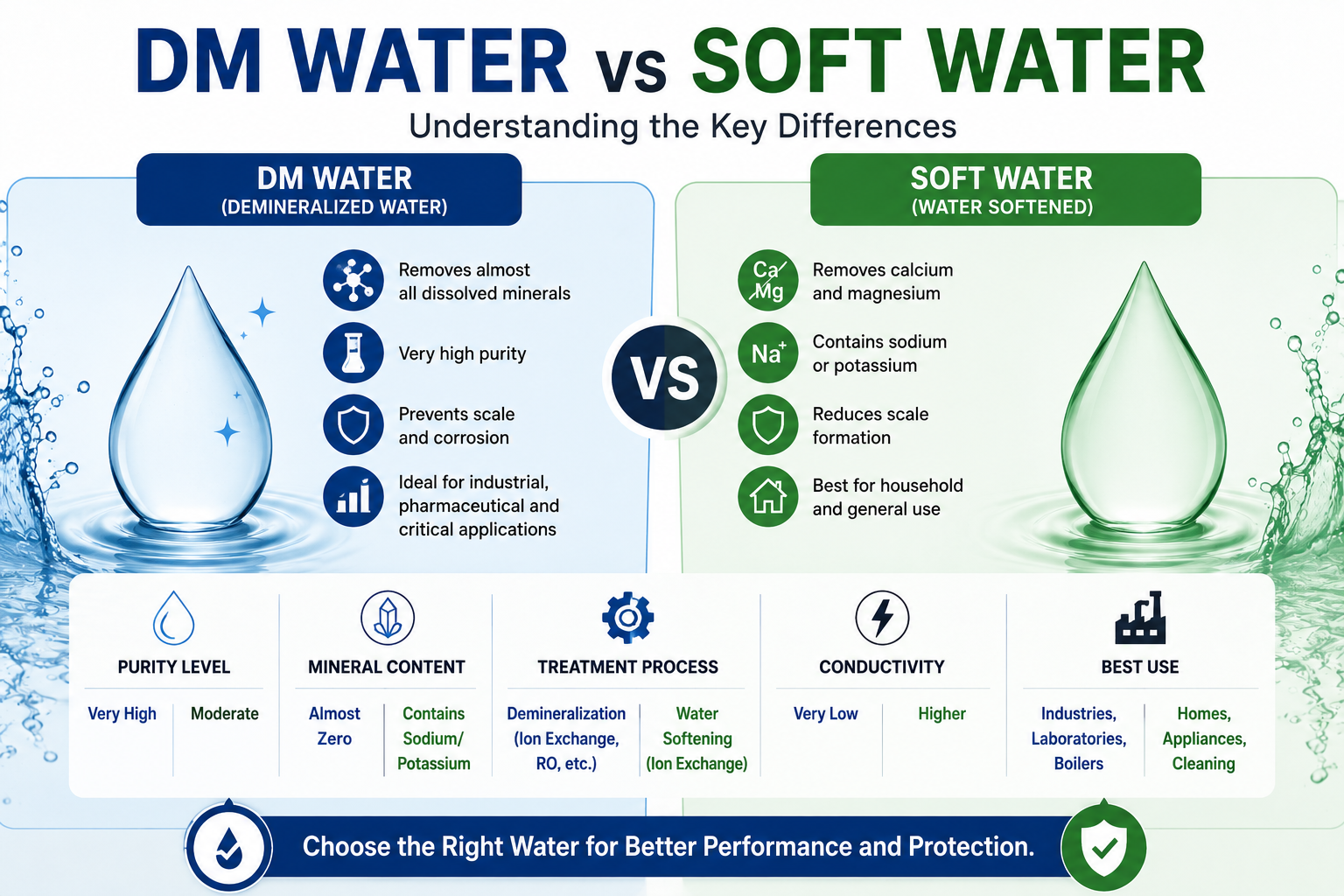
Major Differences Between DM Water and Soft Water
The following differences clearly explain why these two water types serve different purposes.
1. Purity Level
DM Water
DM water offers extremely high purity because treatment systems remove most dissolved minerals and salts.
Industries often require this level of purity for sensitive operations.
Soft Water
Soft water only removes hardness minerals. Therefore, it still contains dissolved ions.
Highlighted Difference
✅ DM Water = Very High Purity
✅ Soft Water = Moderate Purity
2. Mineral Content
DM Water
DM water contains almost no dissolved minerals. Consequently, it leaves very little residue behind.
Soft Water
Soft water removes calcium and magnesium. However, it replaces them with sodium or potassium ions.
Highlighted Difference
✅ DM Water = Near-Zero Minerals
✅ Soft Water = Contains Sodium or Potassium
3. Water Treatment Process
DM Water
Manufacturers use advanced purification technologies such as:
- Ion Exchange
- Reverse Osmosis (RO)
- Electrodeionization (EDI)
These systems remove most dissolved impurities.
Soft Water
Water softeners use ion exchange resin to replace hardness minerals.
The process focuses on hardness reduction rather than complete purification.
Highlighted Difference
✅ DM Water = Complete Mineral Removal
✅ Soft Water = Hardness Removal Only
4. Conductivity
Conductivity measures the ability of water to conduct electricity.
DM Water
Because DM water contains very few ions, it has very low conductivity.
Soft Water
Soft water contains dissolved sodium or potassium ions. Therefore, conductivity remains higher.
Highlighted Difference
✅ DM Water = Very Low Conductivity
✅ Soft Water = Higher Conductivity
5. Scale Formation
Scale can damage pipes, boilers, and industrial equipment.
DM Water
DM water virtually eliminates scale formation because it contains very few dissolved minerals.
Soft Water
Soft water significantly reduces scale. However, it cannot completely eliminate it.
Highlighted Difference
✅ DM Water = Excellent Scale Prevention
✅ Soft Water = Good Scale Prevention
6. Industrial Applications
DM Water
Many industries depend on DM water because impurities can affect product quality.
Common industries include:
- Pharmaceutical manufacturing
- Power generation
- Chemical processing
- Electronics manufacturing
- Automotive production
- Laboratories
Soft Water
Industries rarely use soft water for critical production processes.
Highlighted Difference
✅ DM Water = Industrial Grade
✅ Soft Water = Limited Industrial Use
7. Boiler Feed Water Applications
Boilers require high-purity water to prevent scaling.
DM Water
DM water works exceptionally well in boiler systems because it minimizes deposits.
Soft Water
Soft water reduces hardness but may still contain impurities that affect boiler performance.
Highlighted Difference
✅ DM Water = Preferred for Boilers
✅ Soft Water = Less Suitable
8. Household Applications
DM Water
DM water has limited household applications because producing it costs more.
Soft Water
Soft water is ideal for daily use.
It helps with:
- Bathing
- Laundry
- Dishwashing
- Cleaning
- Water heating systems
Highlighted Difference
✅ DM Water = Specialized Use
✅ Soft Water = Everyday Use
Which Water Type Should You Choose?
The right choice depends on your application.
Choose DM water if you need:
- Pharmaceutical production
- Boiler feed systems
- Electronics manufacturing
- Laboratory operations
- Chemical processing
- High-purity industrial water
Choose soft water if you need:
- Household water treatment
- Commercial cleaning
- Laundry facilities
- Hotels and restaurants
- Appliance protection
Therefore, understanding your operational requirements is essential before selecting a water treatment solution.
Frequently Asked Questions
Is DM water better than soft water?
DM water offers higher purity. However, soft water is often better for household use.
Can soft water replace DM water?
No. Industries that require high-purity water should use DM water.
Why is DM water used in industries?
DM water helps prevent contamination, scaling, and corrosion in critical processes.
Is soft water safe for daily use?
Yes. Soft water is commonly used in homes and commercial buildings.
Does DM water contain minerals?
No. DM water contains very low levels of dissolved minerals.
Which water is best for boilers?
DM water is the preferred choice because it minimizes scale formation.
Conclusion
Although DM water and soft water both undergo treatment, they serve different purposes. DM water removes nearly all dissolved minerals and provides exceptional purity for industrial applications. In contrast, soft water focuses on hardness removal and works well for homes and commercial facilities.
By understanding these major differences, businesses and consumers can select the right water type for their specific requirements. Ultimately, choosing the correct water treatment solution improves efficiency, protects equipment, and delivers better long-term results.