


Full Form of DM Water: Meaning, Uses, Benefits, and Applications
Introduction
Many industries use purified water to maintain product quality and equipment performance. One common type of purified water is DM water. However, many people still ask about the full form of DM water and its purpose.
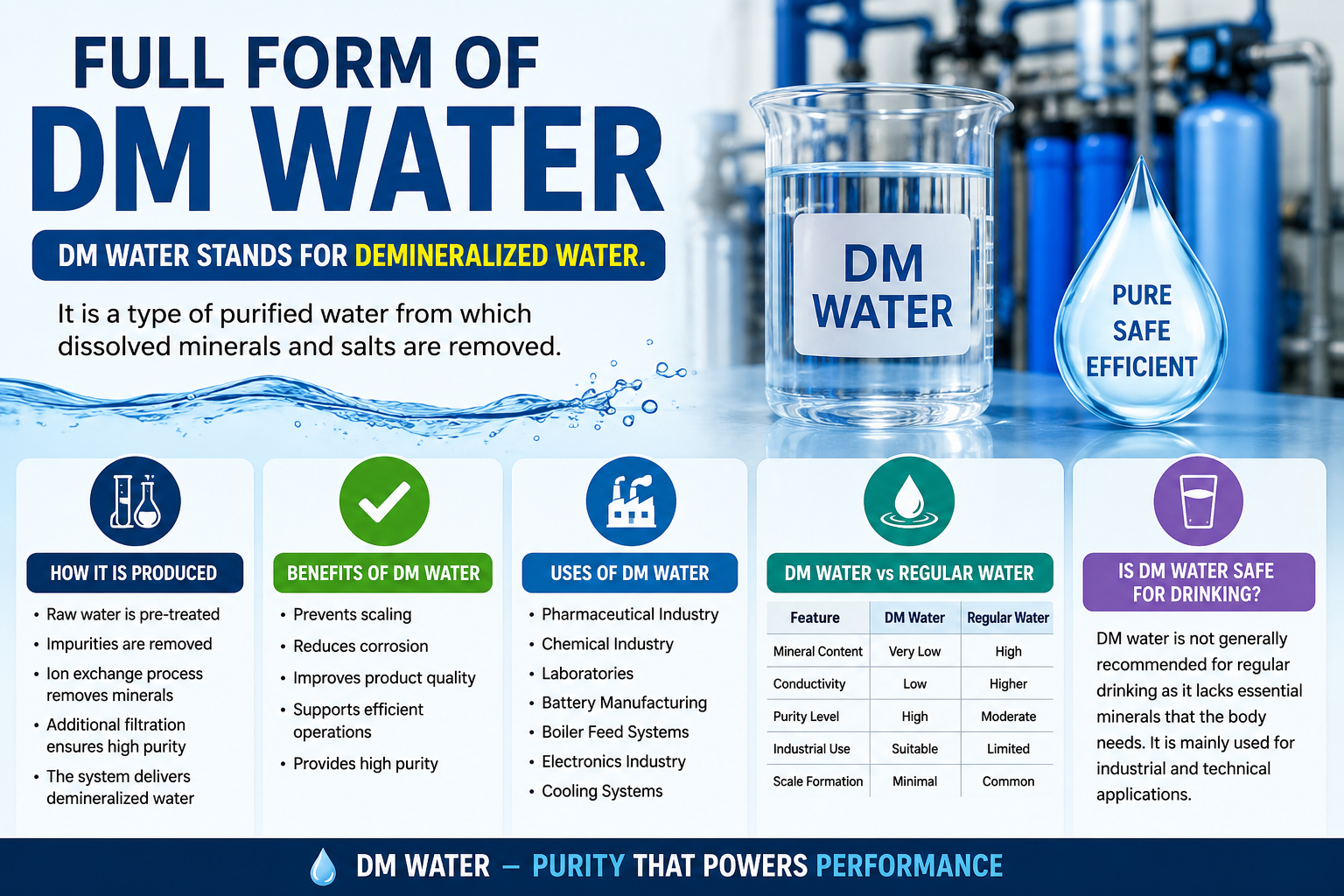
The full form of DM water is Demineralized Water. Manufacturers remove dissolved minerals and salts from this water through a purification process. As a result, DM water becomes highly pure and suitable for industrial and technical applications.
In this article, you will learn the full form of DM water, how it is produced, its benefits, and its common uses.
What Is the Full Form of DM Water?
The full form of DM water is Demineralized Water. This type of water contains very low levels of dissolved minerals and ions.
During the purification process, treatment systems remove minerals such as:
- Calcium
- Magnesium
- Sodium
- Chloride
- Sulfate
The removal of these minerals increases water purity and reduces conductivity. Therefore, industries prefer DM water when they need mineral-free water.
How Is DM Water Produced?
Manufacturers usually produce it through an ion exchange process. In this process, special resins remove positive and negative ions from the water.
The purification process follows these steps:
- Raw water enters the treatment system.
- The system removes suspended particles and impurities.
- Ion exchange resins remove dissolved minerals.
- The treated water passes through additional filtration if required.
- The system delivers highly purified DM water.
Many modern plants combine reverse osmosis and ion exchange technologies to achieve better results.
Why Is DM Water Important?
DM water plays an important role in many industries. Minerals present in ordinary water can cause scaling, corrosion, and contamination. These problems reduce equipment efficiency and increase maintenance costs.
It helps prevent these issues. It improves operational efficiency and protects sensitive equipment.
Therefore, industries rely on it for critical processes.
Benefits of DM Water
1. Prevents Scaling
Minerals in regular water often form deposits inside pipes and equipment. It contains very few minerals, so it reduces scale formation.
2. Reduces Corrosion
Pure water helps protect industrial systems from corrosion. This increases equipment life and lowers repair costs.
3. Improves Product Quality
Many manufacturing processes require pure water. It helps maintain product consistency and quality.
4. Supports Efficient Operations
Industries use DM water to improve equipment performance and reduce downtime.
5. Provides High Purity
It offers a high level of purity. Therefore, it works well in applications that require mineral-free water.
Common Uses of DM Water
Pharmaceutical Industry
Pharmaceutical companies use it to manufacture medicines and healthcare products. Pure water helps maintain quality standards and product safety.
Chemical Industry
Chemical manufacturers use it during production processes. Mineral-free water helps prevent unwanted chemical reactions.
Laboratories
Laboratories need highly purified water for testing and research. Scientists use DM water to prepare solutions and clean instruments.
Battery Manufacturing
Battery manufacturers use it in lead-acid batteries. Pure water improves battery performance and extends battery life.
Boiler Feed Systems
Industries use it in boilers to reduce scaling and improve efficiency. This helps lower maintenance costs.
Electronics Industry
Electronics manufacturers use it to clean circuit boards and sensitive components. The water leaves no mineral residue behind.
Cooling Systems
Cooling towers and industrial cooling systems often use it. It helps reduce corrosion and keeps systems running efficiently.
DM Water vs Regular Water
DM water differs significantly from regular water.
| Feature | DM Water | Regular Water |
|---|---|---|
| Mineral Content | Very Low | High |
| Conductivity | Low | Higher |
| Purity Level | High | Moderate |
| Industrial Use | Suitable | Limited |
| Scale Formation | Minimal | Common |
This comparison shows why industries choose DM water over ordinary water for technical applications.
Is DM Water Safe for Drinking?
It is generally not the preferred choice for regular drinking. The purification process removes almost all minerals from the water.
The human body needs certain minerals for normal functioning. Therefore, most people choose drinking water that contains essential minerals.
Industries mainly use it for technical and manufacturing purposes rather than daily consumption.
Conclusion
The full form of DM water is Demineralized Water. Manufacturers remove dissolved minerals and salts from the water to achieve a high level of purity. This process creates water that works well in industrial, laboratory, pharmaceutical, and technical applications.
DM water helps prevent scaling, reduces corrosion, and improves equipment performance. As a result, many industries depend on it for smooth operations. Understanding the full form of DM water and its uses can help businesses choose the right water treatment solution for their requirements.