


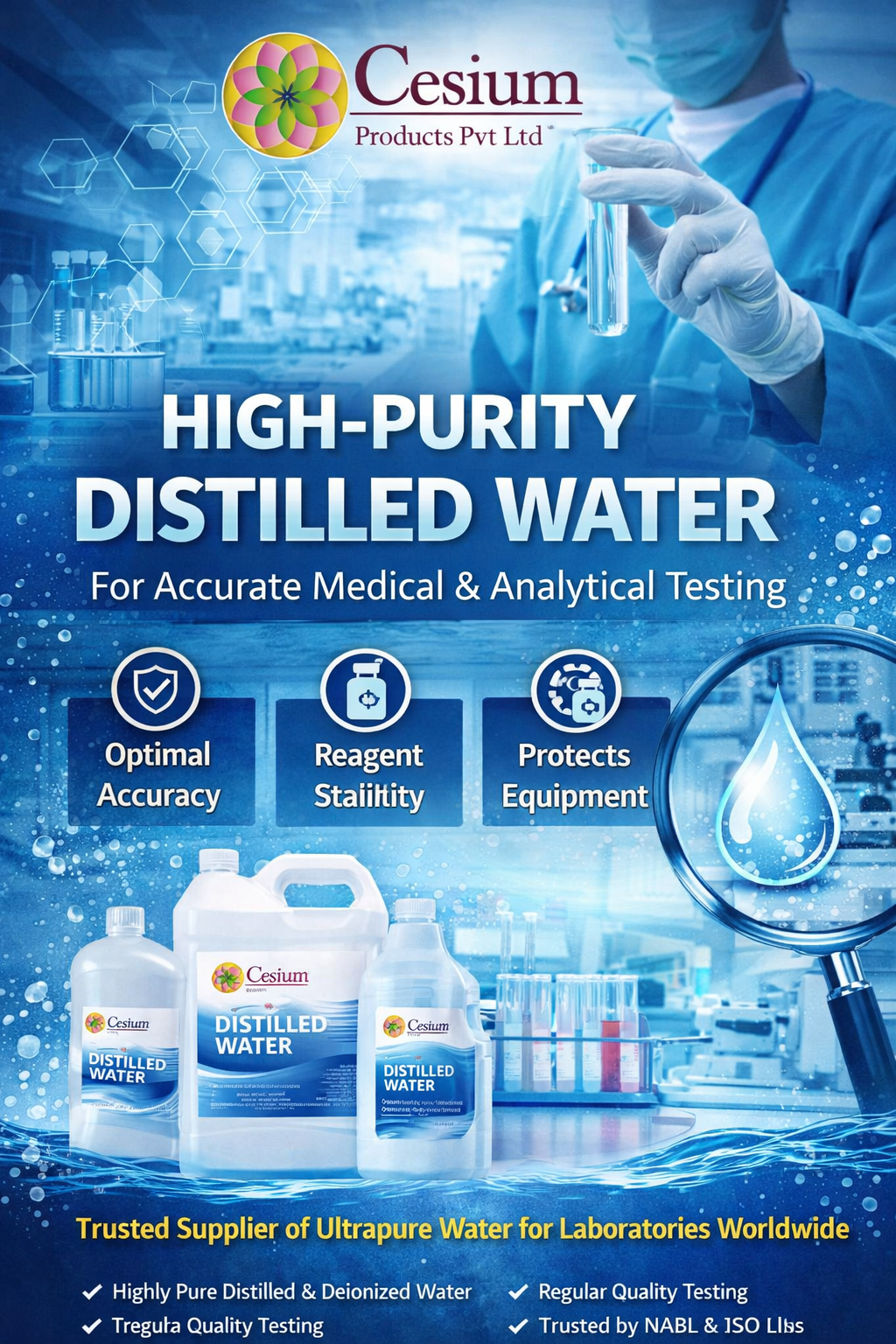
Distilled water is one of the most critical components in any medical laboratory. It is not just “clean water”—it acts as a baseline medium in testing, cleaning, reagent preparation, and instrument functioning.
Even small impurities can lead to serious diagnostic errors, making water quality a high-risk factor that should never be ignored.
- Importance of Distilled Water in Medical Labs
- a) Reagent Preparation
- Used to prepare chemicals, buffers, and solutions
- Impure water can react with reagents → false readings
- b) Sample Dilution
- Blood, urine, and tissue samples are diluted using distilled water
- Contaminants can alter concentration and composition
- c) Equipment Cleaning & Sterilization
- Used in washing glassware, analyzers, and instruments
- Prevents residue and cross-contamination
- d) Instrument Functioning
- Used in analyzers like:
- Biochemistry analyzers
- Hematology analyzers
- HPLC systems
- Poor-quality water leads to blockages and calibration errors
- What Defines Good Quality Distilled Water?
| Parameter | Ideal Range |
| Conductivity | < 1–2 µS/cm |
| pH | 5.5 – 7 |
| Total Dissolved Solids (TDS) | Near zero |
| Microbial Load | Nil |
| Organic Content | Very low |
- Impact of Poor Water Quality on Lab Results
❌ a) False Positive / False Negative Results
- Impurities interfere with chemical reactions
- Can lead to wrong diagnosis
❌ b) Reagent Degradation
- Minerals and ions react with reagents
- Reduces shelf life and accuracy
❌ c) Instrument Damage
- Scale formation (Ca, Mg) → clogged tubes & sensors
- Corrosion → equipment failure
❌ d) Microbial Contamination
- Bacteria growth affects:
- Culture tests
- Molecular biology work
- Leads to unreliable results
- e) Calibration Errors
- Instruments rely on pure water for baseline
- Impure water = wrong calibration = wrong data
- Real-World Risk Example
- A lab using poor-quality distilled water may report:
- Incorrect glucose levels
- Wrong pH values
- False infection indicators
This can lead to:
- Wrong treatment
- Patient risk
- Legal and compliance issues
- How Important is Water Quality? (Severity Level)
| Area | Impact Level |
| Diagnostic Accuracy | 🔴 Critical |
| Instrument Life | 🔴 High |
| Reagent Stability | 🔴 High |
| Compliance (NABL, ISO) | 🔴 Mandatory |
In simple terms:
Bad water = Bad results = High risk to patients
- Best Practices for Laboratories
✔ Use high-quality distilled or deionized water
✔ Regularly check conductivity & pH
✔ Use fresh water (avoid storage contamination)
✔ Maintain water purification systems
✔ Prefer trusted suppliers like Cesium Products Pvt Ltd
- Conclusion
Distilled water is not just a utility—it is a core component of laboratory accuracy and reliability.
Even minor contamination can:
- Distort results
- Damage instruments
- Risk patient safety
Using high-purity distilled water ensures:
- Accurate diagnostics
- Longer equipment life
- Compliance with lab standards
FAQs
Can slightly impure water affect lab results?
Yes, even trace impurities can alter chemical reactions and give incorrect results.
❓ Is distilled water enough for all lab applications?
For basic labs yes, but advanced labs may require DI, RO, or HPLC grade water.
❓ How often should water quality be tested?
Ideally daily or weekly, depending on lab workload.