


How Tap Water Can Damage Your Powder Coating Process
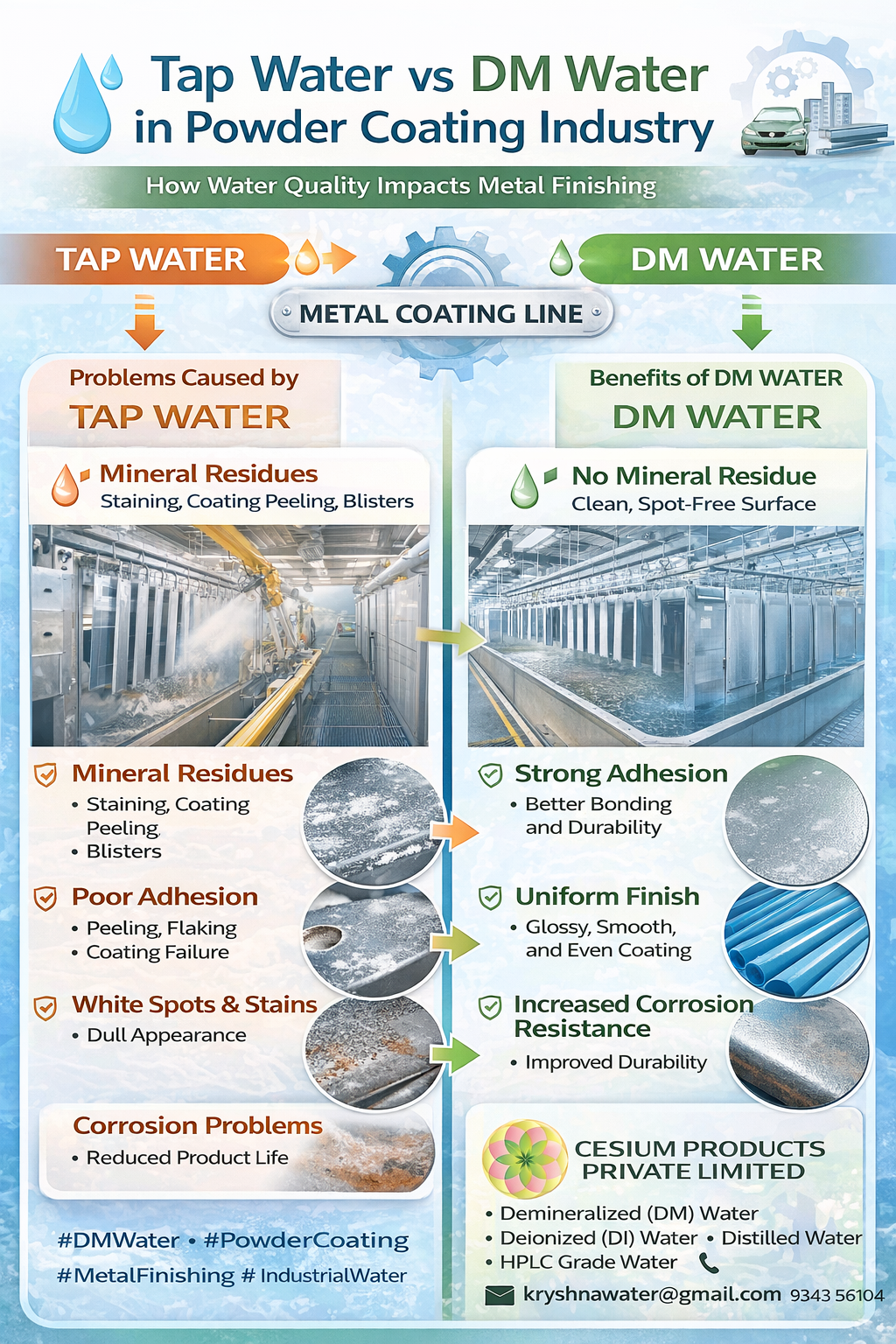
Why DM Water Is Critical for Metal Finishing and Surface Treatment


Introduction
Powder coating is widely used in industries such as automotive, appliances, electrical panels, furniture, and construction because it provides durable, corrosion-resistant, and attractive finishes.
However, many industries unknowingly face coating failure, surface defects, poor adhesion, and corrosion problems due to one hidden factor — poor water quality in the pretreatment stage.
Most metal finishing processes involve multiple washing and rinsing steps before powder coating. If tap water is used, it contains dissolved salts, minerals, silica, and other contaminants that remain on the metal surface.
These contaminants can seriously affect coating quality.
Using Demineralized (DM) water instead of tap water can completely transform coating performance, surface quality, and long-term durability.
What Is DM Water?
DM (Demineralized) water is water that has had nearly all dissolved minerals removed through ion exchange processes.
Common contaminants removed include:
- Calcium
- Magnesium
- Sodium
- Chlorides
- Sulfates
- Silica
- Heavy metals
DM water is widely used in metal finishing, electroplating, powder coating, automotive manufacturing, and high-precision cleaning processes.
Where Water Is Used in Powder Coating
Water is mainly used in the pretreatment stage, which includes:
- Degreasing / cleaning
- Rinsing
- Pickling or etching
- Phosphating or conversion coating
- Final rinse
The final rinse quality is extremely important because whatever remains on the metal surface will remain under the coating layer.
Problems Caused by Tap Water in Powder Coating
1. Mineral Deposits on Metal Surface
Tap water contains minerals such as calcium and magnesium.
When the metal dries:
- minerals remain as deposits
- surface becomes uneven
- coating adhesion reduces
This can lead to coating peeling or blistering.
2. White Spots and Staining
Tap water often contains dissolved salts and silica.
After drying, these may create:
- white stains
- spotting marks
- dull appearance
This reduces the aesthetic quality of powder coated products.
3. Poor Coating Adhesion
Mineral residues prevent proper bonding between:
- metal surface
- phosphate coating
- powder coating layer
Result:
- peeling
- flaking
- coating failure
4. Increased Corrosion Risk
Tap water may contain:
- chlorides
- sulfates
- dissolved oxygen
These contaminants may remain trapped under coating layers and later cause rust formation and corrosion.
5. Reduced Life of Powder Coated Products
Poor surface preparation leads to:
- shorter coating life
- increased product failure
- warranty complaints
Industries may face major quality issues and customer dissatisfaction.
How DM Water Changes the Whole Process
Using DM water in the final rinse stage dramatically improves powder coating quality.
1. No Mineral Residue
DM water contains almost zero dissolved salts, so it leaves no deposits on the metal surface.
This ensures a perfectly clean surface before coating.
2. Better Coating Adhesion
A clean surface allows:
- stronger chemical bonding
- better phosphate layer formation
- stronger powder coating adhesion
This results in durable coatings with excellent performance.
3. Improved Surface Finish
Using DM water eliminates:
- water spots
- stains
- uneven surfaces
The result is a smooth, uniform, and glossy coating finish.
4. Increased Corrosion Resistance
Because DM water removes corrosive ions like chlorides and sulfates, it helps prevent corrosion beneath the coating.
This significantly improves product life and environmental resistance.
5. Consistent Production Quality
Tap water quality may change daily depending on:
- municipal supply
- seasonal variations
- mineral levels
DM water provides consistent and controlled water quality, ensuring stable production results.
Importance of DM Water in Metal Finishing Industry
DM water is essential for many metal finishing processes:
Applications
- Powder coating pretreatment
- Electroplating
- Phosphating lines
- Anodizing
- Passivation
- Precision cleaning
- Automotive component manufacturing
Industries that rely heavily on DM water include:
- Automotive
- Aerospace
- Electrical panel manufacturing
- Appliance manufacturing
- Steel fabrication
Recommended Water Quality for Final Rinse
| Parameter | Recommended Level |
|---|---|
| Conductivity | < 10 µS/cm |
| Hardness | Near zero |
| Chlorides | Very low |
| Silica | Minimal |
| TDS | < 10 ppm |
These specifications are typically achieved using RO + DM water systems.
How Cesium Products Private Limited Supports Industry
Cesium Products Private Limited supplies high-quality purified water solutions for industrial and laboratory applications.
Our products include:
✔ Demineralized (DM) Water
✔ Deionized (DI) Water
✔ Distilled Water
✔ HPLC Grade Water
✔ Laboratory Grade Water
Our purified water solutions are widely used in:
- metal finishing industries
- powder coating plants
- pharmaceutical laboratories
- biotechnology research
- analytical laboratories
Contact Details
CESIUM PRODUCTS PRIVATE LIMITED
Supplier of High Purity Water Solutions
📧 Email: [email protected]
📞 Contact: 9343561104
Frequently Asked Questions (Q&A)
1. Why is tap water not suitable for powder coating pretreatment?
Tap water contains minerals, salts, and impurities that remain on metal surfaces and cause coating defects such as peeling, staining, and corrosion.
2. What is the role of DM water in powder coating?
DM water is used in the final rinse stage to remove contaminants and ensure a clean metal surface before coating.
3. Can DM water improve coating quality?
Yes. DM water improves adhesion, prevents mineral deposits, enhances surface finish, and increases corrosion resistance.
4. What happens if mineral residues remain on metal surfaces?
Mineral residues can cause poor coating adhesion, blistering, and early coating failure.
5. Is DM water required in all metal finishing plants?
Most modern powder coating and metal finishing plants use DM water in the final rinse stage to maintain consistent product quality.
Conclusion
The success of powder coating depends heavily on surface preparation and water quality. While many industries focus on coating materials and equipment, they often overlook the importance of high-purity rinse water.
Using tap water during pretreatment can introduce minerals, salts, and corrosive ions that remain on metal surfaces and cause serious coating defects.
Switching to Demineralized (DM) water eliminates these contaminants, improves coating adhesion, enhances finish quality, and significantly increases corrosion resistance.
For industries aiming for high-quality, durable, and reliable powder coated products, using DM water is not just an improvement — it is a critical requirement for modern metal finishing processes.
SEO Hashtags
#DMWater
#PowderCoating
#MetalFinishing
#SurfaceTreatment
#IndustrialWater
#DemineralizedWater
#CoatingTechnology
#ManufacturingQuality
#CorrosionProtection
#IndustrialCleaning
#CesiumProducts
#WaterTreatment
#PowderCoatingProcess
#IndustrialManufacturing
#EngineeringIndustry