


What Are the Key Applications of DM Water in Manufacturing?
DM water Bangalore has become an important resource for many manufacturing industries. Manufacturers use demineralized water when ordinary water may introduce minerals, salts, or other dissolved ions into a process. These impurities can cause scale, deposits, corrosion, and process variation. Therefore, companies often choose DM water when they need better control over water quality.
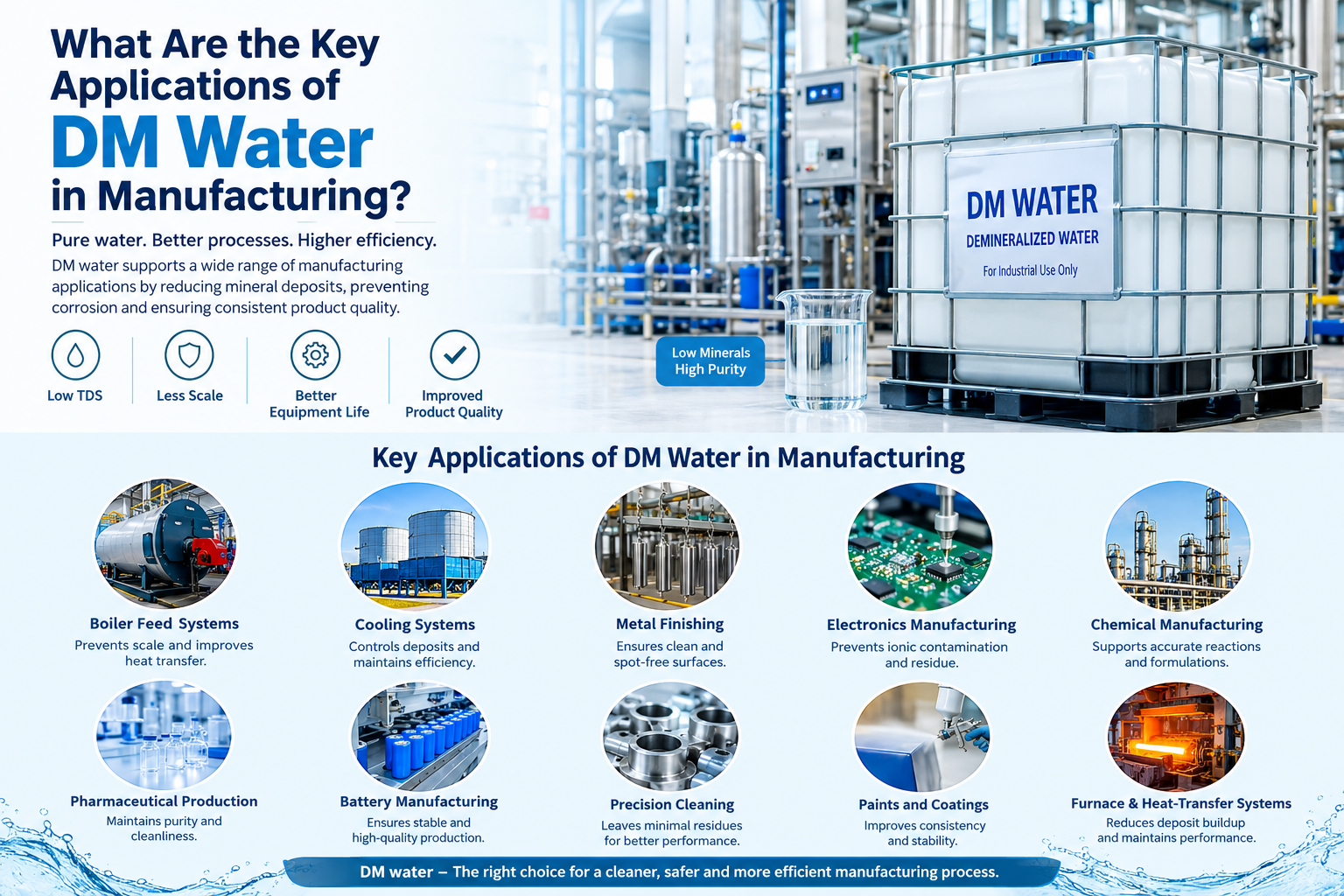
Manufacturing plants use DM water in many areas. These include boilers, cooling systems, metal finishing, electronics, chemical production, pharmaceuticals, batteries, and precision cleaning. However, the required water quality can differ from one application to another. For this reason, businesses should select water based on conductivity, TDS, hardness, silica, and other required specifications.
In Bangalore, companies looking for DM water near me may consider suppliers that provide suitable quantities and consistent quality. Bulk supply can also help manufacturing plants maintain a steady production schedule.
What Is DM Water?
DM water stands for demineralized water. It is water from which many dissolved mineral ions have been removed through a purification process.
Normal water may contain calcium, magnesium, sodium, chloride, sulfate, bicarbonate, iron, and other dissolved substances. The exact composition depends on the original water source.
DM water treatment can use technologies such as ion exchange, reverse osmosis, or a combination of purification methods. The selected process depends on the required water quality and application.
As a result, DM water contains much lower levels of dissolved minerals than ordinary water. This makes it useful in manufacturing processes where mineral deposits or ionic contamination can create problems.
However, DM water does not automatically mean that every contaminant has been removed. Therefore, manufacturers should check the actual water specifications before using it in a critical process.
Why Manufacturing Industries Use DM Water
Manufacturing equipment often works under controlled conditions. Water quality can directly affect equipment performance, cleaning, cooling, and product quality.
For example, minerals in ordinary water can form deposits on heat-transfer surfaces. Over time, these deposits may reduce heat transfer and increase maintenance requirements. Similarly, dissolved ions can interfere with some chemical processes and surface-finishing operations.
DM water reduces many of these mineral-related problems.
Moreover, controlled water quality can help manufacturers maintain more consistent production conditions. This is particularly important when a process requires low mineral content or low conductivity.
Key benefits include:
- Reduced mineral deposits
- Lower risk of scale formation
- Better process consistency
- Improved equipment protection
- Reduced ionic contamination
- Cleaner rinsing
- Better control of sensitive processes
- Support for high-purity manufacturing
Therefore, DM water can serve as an important process input rather than simply being an alternative to tap water.
Key Applications of DM Water in Manufacturing
1. DM Water for Boiler Feed Systems
Boilers need suitable feedwater to operate efficiently. Ordinary water can contain calcium, magnesium, silica, and other dissolved substances. When these substances accumulate inside a boiler, they can contribute to scale and deposits.
Manufacturers therefore use appropriately treated water as boiler feedwater. DM water can help reduce the mineral load entering the system.
In addition, lower mineral content can support better heat-transfer performance. It can also reduce cleaning and maintenance needs when the water quality matches the boiler’s operating requirements.
However, boiler systems require more than simply choosing water labelled “DM.” The plant should monitor parameters such as conductivity, hardness, silica, alkalinity, and other values based on the system design.
2. DM Water in Cooling Systems
Cooling systems remove heat from industrial equipment and production processes. They may operate continuously for long periods.
When ordinary water contains high levels of dissolved minerals, those minerals can contribute to deposits on heat-exchange surfaces. Consequently, heat transfer may become less efficient.
Using appropriately treated water can help control mineral deposition. DM water can therefore support cooling applications where low mineral content is required.
For example, manufacturing plants may use purified water in certain cooling loops, heat exchangers, and equipment cooling systems.
Nevertheless, the correct water specification depends on the materials, temperature, circulation system, and manufacturer’s recommendations.
3. DM Water for Metal Finishing
Metal finishing processes often include cleaning, rinsing, pretreatment, plating, phosphating, anodizing, or passivation.
Water quality matters because the final rinse can affect the surface of the finished component. If water contains unwanted minerals, it may leave deposits after drying.
Therefore, manufacturers may use DM or DI water for selected rinsing stages.
This application is especially important when the manufacturer needs a clean surface before coating or further processing. Lower ionic contamination can help reduce residues that could affect surface appearance or subsequent treatment.
For example, DM water can support applications involving automotive components, electrical panels, metal parts, and precision-engineered products.
4. DM Water in Electronics Manufacturing
Electronics manufacturing requires careful contamination control. Small amounts of ionic residue can create problems on sensitive components.
Manufacturers may use high-purity water for cleaning and rinsing printed circuit boards, electronic components, and production equipment.
In particular, DI water is widely used for PCB cleaning because it contains very low levels of dissolved ions. The required specification, however, depends on the cleaning process and equipment.
Therefore, manufacturers should not select water only because it is called DM or DI. They should check conductivity, resistivity, particle levels, organic contamination, and other relevant parameters.
For related information, you can also read about DI Water in PCB Cleaning.
5. DM Water for Chemical Manufacturing
Chemical manufacturing often requires controlled raw materials and process conditions. Water can become an important part of a formulation or chemical reaction.
If untreated water contains unwanted ions, those ions may interact with chemicals in the process. As a result, they can change reaction conditions or introduce unwanted impurities.
DM water can reduce many dissolved mineral ions. Therefore, manufacturers may use it for selected formulations, dilution, cleaning, and process applications.
However, the required purity depends on the chemical process. Some applications may require additional purification beyond standard demineralization.
6. DM Water in Pharmaceutical Manufacturing
Pharmaceutical manufacturing requires strict control over raw materials, equipment, and water quality.
Purified water can be used for different purposes, including equipment cleaning, preparation processes, and other applications where the required water grade permits it.
However, pharmaceutical water requirements depend on the intended use and applicable standards. DM water should not automatically be treated as pharmaceutical-grade water.
Manufacturers should therefore identify the required specification before purchasing or using the water.
7. DM Water for Battery Manufacturing
Battery production requires controlled manufacturing conditions. Water quality can become important during selected production and maintenance processes.
Dissolved minerals can introduce unwanted ions into a process. Therefore, manufacturers may use purified or demineralized water where the process specification requires low mineral content.
The exact water quality depends on the battery chemistry and manufacturing process. Consequently, manufacturers should follow the equipment and process requirements instead of using one specification for every battery application.
8. DM Water for Precision Cleaning
Precision cleaning requires careful control of residues. This is common in industries that manufacture sensitive components.
After cleaning, the final rinse can leave behind minerals if the water contains dissolved salts. These residues may become visible after drying or may remain on the surface.
DM water can reduce mineral residues during suitable cleaning processes. As a result, it can support cleaner surfaces and more consistent production.
This makes purified water useful for components used in electronics, engineering, automotive, optical, and other precision applications.
9. DM Water in Paints and Coatings
Water-based paints, coatings, and chemical formulations may require controlled water quality.
Minerals in untreated water can interact with ingredients and may influence product stability, appearance, or consistency. Therefore, manufacturers may use demineralized water as a controlled process ingredient.
The exact specification depends on the formulation. For example, some coating products may require specific conductivity or hardness limits.
Thus, manufacturers should test the finished formulation and establish a suitable water specification.
10. DM Water for Furnace and Heat-Transfer Systems
Industrial furnaces can generate significant heat. Some systems use water for cooling components, heat exchangers, or related equipment.
Mineral deposits can reduce heat transfer and increase cleaning requirements. Therefore, suitable purified water can help control mineral buildup in these systems.
DM water can support furnace cooling applications when the equipment manufacturer approves its use.
For example, DM water may have applications in steel, glass, chemical, and other manufacturing environments.
You can also explore DM Water for Furnace: Uses, Benefits & Working Process.
How DM Water Helps Reduce Scale and Deposits
Scale is one of the common concerns associated with mineral-rich water. Calcium and magnesium are examples of minerals that can contribute to deposits under suitable conditions.
These deposits can build up on equipment surfaces. Consequently, heat transfer may decrease, and maintenance may increase.
DM water contains much lower levels of many dissolved mineral ions. Therefore, it can help reduce the mineral load entering a process.
However, DM water should not be considered a complete solution for every type of corrosion or contamination. Equipment materials, temperature, flow rate, dissolved gases, and process chemistry can also affect system performance.
For this reason, manufacturers should evaluate the complete water-treatment and equipment system.
DM Water and pH: Why It Matters in Manufacturing
pH can affect manufacturing processes because it influences chemical reactions, corrosion behavior, cleaning performance, and formulation stability. However, very low-mineral water can show unstable pH readings because it has little buffering capacity and can absorb carbon dioxide from the surrounding air. As a result, the measured pH of freshly produced DM water may change after exposure to air, and pH alone should not determine water quality. Manufacturers should instead evaluate pH together with conductivity, TDS, hardness, silica, and other process-specific parameters. Most importantly, the required pH range depends on the application, so companies should follow the specifications of their process, equipment, and applicable standards rather than assuming that DM water must always have a pH of exactly 7.
For more information, you can read pH Value of DM Water.
DM Water vs DI Water in Manufacturing
The terms DM water and DI water often appear together. However, manufacturers should understand that the terms describe water treatment approaches and may not guarantee the same final specification.
DM water generally refers to demineralized water with many dissolved mineral ions removed.
DI water generally refers to deionized water produced through ion-exchange or related deionization processes.
In practice, suppliers and industries may use the terms differently. Therefore, buyers should focus on measurable specifications instead of relying only on the product name.
Before ordering, ask the supplier for relevant information such as:
- TDS
- Conductivity
- Resistivity, when applicable
- Hardness
- Silica
- Chloride
- Sodium
- pH
- Required quality grade
- Batch or delivery specifications
This approach helps manufacturers select water that matches the actual production requirement.
You can also read Distilled vs Deionized Water: Key Differences Explained.
How to Choose a DM Water Supplier in Bangalore
Businesses searching for DM water Bangalore should evaluate more than price. A reliable supplier should understand the intended application and provide water that matches the required specifications.
Consider these factors before placing an order:
- Required quantity
- Required TDS
- Conductivity requirement
- Application-specific purity
- Packaging options
- Bulk or tanker supply
- Delivery schedule
- Quality documentation
- Batch consistency
- Storage requirements
- Technical support
Furthermore, discuss your application with the supplier before ordering large quantities. This step can prevent a mismatch between the water supplied and the water required by your process.
For manufacturing plants, bulk supply may be useful when daily consumption is high. Smaller containers may work better for laboratories, maintenance teams, or low-volume applications.
Why Local DM Water Supply Can Help Manufacturers
Manufacturers often need regular water deliveries. A nearby supplier can make logistics easier and may reduce delays caused by long-distance transportation.
For businesses searching for DM water near me, local supply can provide practical benefits such as easier communication, faster coordination, and more flexible delivery planning.
However, location should not be the only selection factor. Water quality and consistency remain important.
A supplier should be able to explain the water specification and recommend a suitable grade for the intended application.
Bulk DM Water Supply for Manufacturing Plants
Large manufacturing facilities may need DM water in significant quantities. In such cases, businesses can discuss bulk supply options with the supplier.
Bulk supply can support:
- Boiler operations
- Cooling systems
- Metal finishing
- Electronics manufacturing
- Chemical processing
- Equipment cleaning
- Furnace cooling
- Battery manufacturing
- Other industrial processes
Before arranging bulk delivery, calculate average daily consumption and storage capacity. Also, confirm the required water specification and delivery schedule.
This planning helps reduce the risk of production interruptions.
Quality Checks Before Using DM Water
Manufacturers should establish quality checks that match their process.
Common parameters may include:
- TDS
- Conductivity
- Hardness
- pH
- Silica
- Chloride
- Sodium
- Resistivity
- Microbiological parameters, when applicable
Not every application needs every test. Instead, select the parameters that matter for your process.
Moreover, store DM water in suitable containers and protect it from contamination. High-purity water can pick up contaminants from its storage environment. Therefore, clean handling and appropriate storage are important.
Frequently Asked Questions About DM Water Bangalore
1. What is DM water used for in manufacturing?
DM water is used in many manufacturing processes where low mineral content is important. Common applications include boilers, cooling systems, metal finishing, electronics, chemical processing, precision cleaning, batteries, and selected pharmaceutical processes.
2. Is DM water the same as DI water?
DM water and DI water both involve the removal of dissolved ions, but the treatment process and final specifications can differ. Therefore, manufacturers should check measurable parameters such as conductivity, TDS, hardness, and resistivity rather than relying only on the name.
3. Can I buy bulk DM water in Bangalore?
Yes, industrial suppliers may provide DM water in different quantities, depending on their supply and delivery options. Businesses should discuss their required quantity, water specifications, packaging, and delivery schedule before placing a bulk order.
4. Why is DM water useful for cooling systems?
DM water contains fewer dissolved mineral ions than ordinary water. Therefore, it can help reduce mineral deposits in suitable cooling and heat-transfer applications. However, the correct water specification depends on the equipment and operating conditions.
5. How should I choose DM water for my manufacturing process?
Start by identifying the exact application. Then determine the required conductivity, TDS, hardness, silica, pH, and other relevant parameters. Finally, discuss these requirements with the supplier and confirm that the supplied water meets your process specification.
Conclusion
DM water Bangalore can support many manufacturing applications where controlled water quality matters. From boiler feed systems and cooling equipment to electronics, metal finishing, chemical processing, batteries, and precision cleaning, demineralized water can help reduce unwanted mineral contamination.
However, every manufacturing process has different requirements. Therefore, businesses should not choose water only by the terms “DM water,” “DI water,” or “zero TDS.” Instead, they should check the actual quality parameters required by their equipment and process.
For companies looking for DM water near me or a reliable industrial water supplier in Bangalore, comparing quality specifications, supply capacity, delivery options, and application requirements can help create a more suitable purchasing decision.