


DM water in pharma plays an important role in pharmaceutical manufacturing, equipment cleaning, and the preparation of certain process solutions. Pharmaceutical companies need water with controlled levels of dissolved salts, minerals, and other impurities. Even small amounts of unwanted substances can affect product quality, equipment performance, and manufacturing processes.
Demineralized (DM) water passes through a treatment process that removes many dissolved mineral ions. As a result, it contains much less calcium, magnesium, chloride, and other dissolved ions than ordinary water. However, DM water is not automatically suitable for every pharmaceutical application. The required water quality depends on the product, manufacturing process, and applicable pharmacopoeial standards.
Therefore, pharmaceutical manufacturers must select the correct water grade, validate their water treatment systems, and monitor water quality regularly.
What Is DM Water in Pharma?
DM water stands for demineralized water. Manufacturers produce it by removing dissolved mineral ions from the feed water. These ions can include calcium, magnesium, sodium, chloride, and sulphate.
Ordinary water may contain minerals, salts, and other substances that affect its suitability for pharmaceutical production. DM water reduces the mineral content and helps manufacturers control these impurities.
How Is DM Water Produced?
Water treatment plants use different methods to reduce dissolved ions. The process depends on the quality of the incoming water and the required final specification.
Common treatment methods include:
- Reverse osmosis (RO): A membrane reduces dissolved salts and many other impurities.
- Ion exchange: Special resins remove positively and negatively charged ions.
- Electrodeionization (EDI): Electricity and ion-exchange media help remove remaining ions.
- Pretreatment and filtration: These steps reduce suspended particles and protect downstream equipment.
A plant may combine several of these methods to achieve the required water quality. In addition, it may use ultraviolet treatment, suitable sanitization methods, and other controls to manage microbial growth.
Importantly, removing minerals does not guarantee that the water is free from microorganisms, endotoxins, or organic contaminants. Manufacturers must control these risks separately.
Why Do Pharmaceutical Companies Need Highly Pure Water?
Pharmaceutical products must meet strict quality requirements. Water can come into direct contact with ingredients, equipment, containers, and finished products. Therefore, its quality can affect the safety, stability, and consistency of medicines.
- To protect product quality
Water containing unwanted minerals or other impurities can interfere with certain ingredients. For example, some dissolved ions can react with formulation components or change their behaviour. Using water that meets the required specification helps reduce this risk.
- To support safe manufacturing
Pharmaceutical companies use water in many production steps. They must control chemical impurities and microbial contamination to protect the manufacturing process. Consequently, they select a suitable water grade for each application.
- To reduce mineral deposits
Hard water can leave mineral deposits on pipes, tanks, heaters, and other equipment. These deposits may reduce heat transfer and increase cleaning needs. DM water can help limit mineral scaling when the treatment system and water specification are suitable.
- To maintain consistent batches
Variations in water quality may affect product formulations and manufacturing results. Regular testing helps identify changes early. As a result, manufacturers can maintain better control over batch-to-batch consistency.
- To support equipment cleaning
Pharmaceutical facilities use water to rinse equipment after cleaning. The final rinse water must meet the requirements of the equipment, product, and validated cleaning process. Suitable low-mineral water can help prevent deposits and reduce the risk of mineral residues.
Key Applications of DM Water in Pharma
DM water can support several pharmaceutical operations. However, manufacturers must confirm the required water grade before using it in any specific process.
- Equipment and tank cleaning
Pharmaceutical production uses tanks, mixing vessels, pipes, filling lines, and other equipment. Water helps remove cleaning agents and residues during validated cleaning procedures.
DM water may be suitable for certain equipment-cleaning stages. However, the final rinse may require compendial Purified Water or Water for Injection (WFI), depending on the product and process.
- Preparation of process solutions
Manufacturers sometimes use treated water to prepare cleaning solutions, buffers, and other process solutions. Water quality matters because dissolved ions can affect chemical reactions, pH, and solution stability.
The manufacturer must confirm that the water meets the requirements of the specific formulation or process.
- Pharmaceutical manufacturing support
Some manufacturing operations require low-mineral water for rinsing, dilution, or other supporting activities. The required quality depends on whether the water contacts the product directly or indirectly.
For this reason, DM water should not replace a specified pharmaceutical water grade without documented approval.
- Laboratory use and testing
Pharmaceutical laboratories use water for preparing certain reagents, rinsing laboratory equipment, and carrying out analytical procedures. Different tests require different water qualities.
Therefore, laboratory staff should follow the relevant analytical method and use the specified water grade rather than assuming that all DM water is suitable.
- Boiler and utility systems
Pharmaceutical facilities may use treated water in boilers and other utility systems. Low-mineral water can help reduce scale formation and support equipment performance.
However, boiler feed water requires its own specifications and treatment controls. The appropriate quality depends on boiler design, operating pressure, and the manufacturer’s requirements.
- Preparation of pharmaceutical products
Water used as an ingredient needs particular attention. Oral liquids, topical preparations, and other medicines may require Purified Water, while certain parenteral products and other specified applications require WFI.
DM water alone does not automatically meet these standards. Manufacturers must verify the applicable pharmacopoeia, product requirements, and regulatory expectations before using it as an ingredient.
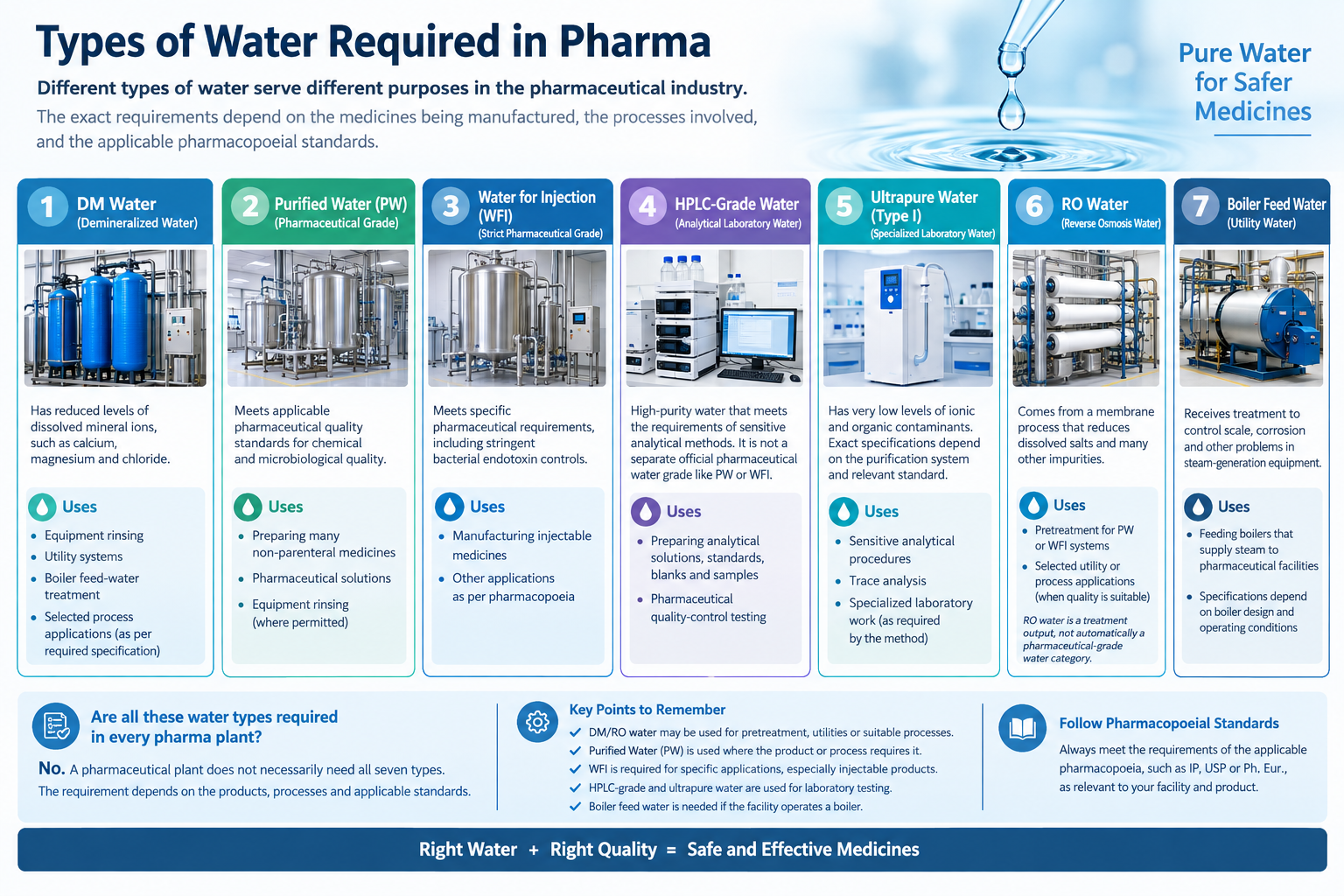
DM Water vs Purified Water vs Water for Injection
These terms describe different aspects of water quality and intended use.
- DM water: Water treated to remove dissolved mineral ions. Its quality depends on the treatment system and final specification.
- Purified Water (PW): Pharmaceutical-grade water that meets the applicable pharmacopoeial requirements. It requires suitable production, storage, distribution, and monitoring controls.
- Water for Injection (WFI): A pharmaceutical water grade with additional requirements, including stringent endotoxin controls. It is used where the applicable standards require it, particularly for specified parenteral applications.
Although a DM system can form part of a pharmaceutical water treatment plant, the label “DM water” does not establish compliance with the requirements for PW or WFI.
What Are the Quality Requirements for DM Water in Pharma?
Pharmaceutical manufacturers should assess water quality against the intended use and the applicable specifications. Common quality considerations include:
- Conductivity: Helps assess the level of ionic impurities in water.
- Total organic carbon (TOC): Helps measure organic carbon contamination.
- Microbial count: Helps monitor the number of viable microorganisms.
- Bacterial endotoxins: Must meet the applicable limits for relevant uses, particularly WFI.
- Chemical impurities: Testing may be necessary for specific contaminants based on the source water and process.
- Visual appearance: Water should meet the applicable requirements for clarity and visible contamination.
No single test can confirm every aspect of water purity. Therefore, manufacturers use a combination of testing, process controls, and documented procedures.
Why Is Regular Water Testing Important?
Water quality can change because of variations in feed water, exhausted treatment media, membrane problems, poor sanitization, or microbial growth in storage tanks and distribution loops.
Regular monitoring helps manufacturers detect these changes before they affect production. In addition, preventive maintenance and documented corrective actions help keep the system under control.
How Does pH Affect DM Water in Pharma?
The pH of DM water can influence chemical processes, cleaning performance, and the stability of certain solutions. However, highly demineralized water has very low buffering capacity, so its pH can change easily when it comes into contact with air, absorbs carbon dioxide, or encounters traces of other substances. As a result, a pH reading alone does not prove that water is pure or suitable for pharmaceutical use. Manufacturers should assess conductivity, TOC, microbial quality, and other required parameters alongside pH. They should also follow the applicable testing method and product specifications rather than relying on one universal pH target for all pharmaceutical water.
Important water management practices
- Test the feed water: Check the source water to identify the treatment requirements.
- Choose the right treatment system: Select RO, ion exchange, EDI, or a suitable combination based on the required quality.
- Validate the system: Document evidence that the system consistently produces water that meets its specifications.
- Monitor key parameters: Check conductivity, TOC, microbial quality, and other required attributes at defined intervals.
- Maintain storage tanks and pipelines: Use suitable designs and maintenance procedures to reduce contamination risks.
- Control microbial growth: Apply validated sanitization and appropriate operating practices.
- Keep accurate records: Document test results, maintenance, deviations, and corrective actions.
- Review water quality trends: Look for changes that may indicate a developing system problem.
These practices help maintain consistent water quality and support pharmaceutical quality management.
Benefits of Using Suitable High-Purity Water
When manufacturers use the correct water grade and maintain proper controls, they can gain several operational benefits.
- Better control over unwanted mineral impurities.
- Lower risk of mineral scale in suitable applications.
- More consistent manufacturing conditions.
- Reduced risk of residues from unsuitable water.
- Better control over equipment cleaning and rinsing.
- Improved monitoring and documentation of water quality.
- Support for pharmaceutical quality and regulatory compliance.
These benefits depend on correct system design, maintenance, and testing. High-purity water alone cannot guarantee product safety or regulatory compliance.
Why Choose a Reliable DM Water Supplier?
A reliable supplier can help a pharmaceutical facility select a water treatment solution that matches its feed water, required capacity, and quality targets.
Before choosing a supplier, a company should consider:
- Water treatment technology and system design.
- Required water quality and intended application.
- Plant capacity and expected daily demand.
- Material compatibility and hygienic design.
- Maintenance and technical support.
- Testing, documentation, and validation support.
- Operating costs and water recovery.
- Ability to meet applicable pharmaceutical requirements.
For pharmaceutical applications, the supplier should understand the difference between demineralized water and compendial pharmaceutical water. The buyer should also verify the final system’s performance rather than relying only on the supplier’s general claims.
HPLC-Grade Water in the Pharmaceutical Industry
HPLC-grade water is highly purified water designed to meet the strict purity requirements of sensitive laboratory applications. In the pharmaceutical industry, water quality plays an important role in maintaining product quality and obtaining reliable analytical results. HPLC-grade water contains very low levels of impurities that could interfere with sensitive tests.
Why Is HPLC-Grade Water Important in Pharma?
Pharmaceutical companies need water with controlled impurity levels for laboratory testing and quality control. HPLC-grade water helps laboratories prepare analytical solutions and test pharmaceutical ingredients and finished products.
Its key applications include:
- Quality control testing: Laboratories use HPLC-grade water to prepare samples and solutions for pharmaceutical analysis.
- Drug purity analysis: It helps analysts detect impurities in drug substances and formulations without unwanted interference from the water.
- Preparation of analytical solutions: Laboratories use it to prepare standards, blanks, and other solutions required by validated test methods.
- Reliable laboratory results: Low levels of interfering contaminants help improve the reliability and consistency of analytical measurements.
- Pharmaceutical research and development: Researchers use high-purity water during drug formulation studies and analytical method development.
How Does HPLC-Grade Water Differ from DM Water?
DM water undergoes demineralization to remove dissolved mineral ions. However, this process alone does not ensure the low levels of organic compounds and other contaminants that sensitive analytical methods may require.
HPLC-grade water meets specific analytical purity requirements. Therefore, pharmaceutical laboratories should select water based on the intended test method and its specifications rather than assuming that all DM water is suitable.
Frequently Asked Questions (FAQs)
- Why is highly pure water important in pharmaceutical manufacturing?
Highly pure water helps control unwanted minerals, chemical impurities, and microbial contamination. It supports product quality, equipment cleaning, and consistent manufacturing. However, the water grade must match the intended use.
- Is DM water suitable for pharmaceutical production?
DM water may suit certain utility, cleaning, and process applications. However, manufacturers must confirm its quality before use. Product ingredients and other applications may require Purified Water or WFI that meets the relevant pharmacopoeial standards.
- What is the difference between DM water and Purified Water?
DM water describes water that has undergone demineralization to remove dissolved ions. Purified Water is a defined pharmaceutical water grade that must meet applicable quality standards. Therefore, DM water does not automatically qualify as Purified Water.
- Which tests are important for pharmaceutical water?
Common tests include conductivity, TOC, and microbial monitoring. Depending on the intended use, manufacturers may also need to test bacterial endotoxins and specific chemical impurities. They should follow the relevant specifications and validated procedures.
- Does the pH of DM water determine its purity?
No. pH measures how acidic or alkaline water is, but it does not measure every impurity. Manufacturers must also assess other relevant quality parameters, such as conductivity, TOC, and microbial contamination.
Conclusion
DM water in pharma supports pharmaceutical manufacturing by reducing dissolved mineral ions and helping control water quality in suitable applications. It can assist with equipment cleaning, laboratory work, utility systems, and selected manufacturing processes.
However, pharmaceutical companies must understand that demineralization alone does not guarantee pharmaceutical-grade water. They should select the correct water grade, validate the treatment system, and monitor water quality regularly. By following these practices, manufacturers can better control contamination risks, maintain equipment performance, and support consistent product quality.