


Distilled Water Production is a purification process that removes impurities, minerals, salts, and contaminants from water. Distilled water is widely used in laboratories, pharmaceutical manufacturing, cosmetics, food processing, healthcare facilities, and industrial operations. Because it contains very low levels of dissolved solids, it helps maintain product quality and equipment performance.
Today, many industries rely on distilled water to meet strict quality standards. Therefore, understanding how distilled water is produced can help businesses choose the right water purification solution for their needs.
What Is Distilled Water?
Distilled water is water that has undergone a distillation process. During this process, water is heated until it turns into steam. The steam then cools and condenses back into liquid water. As a result, most impurities, minerals, bacteria, and dissolved solids remain behind.
This process creates highly purified water that is suitable for applications requiring high levels of cleanliness and consistency.
Why Distilled Water Production Is Important
Water from natural sources contains various impurities. These impurities may include minerals, salts, microorganisms, and organic compounds. While some applications can tolerate these substances, many industries require highly purified water.
Distilled water production offers several benefits:
- Removes dissolved minerals and salts
- Reduces contamination risks
- Improves product quality
- Protects sensitive equipment
- Supports consistent manufacturing processes
- Meets industry quality requirements
Therefore, distilled water has become an essential resource in many sectors.
Raw Water Used in Distilled Water Production
The distillation process can begin with different water sources. However, the quality of the source water can affect the efficiency of the system.
Common water sources include:
- Municipal water supply
- Groundwater
- Borewell water
- Surface water
- Pre-treated industrial water
Before distillation, some facilities may use filtration systems to remove large particles and suspended matter. Consequently, the distillation equipment can operate more efficiently.
Step 1: Water Heating and Evaporation
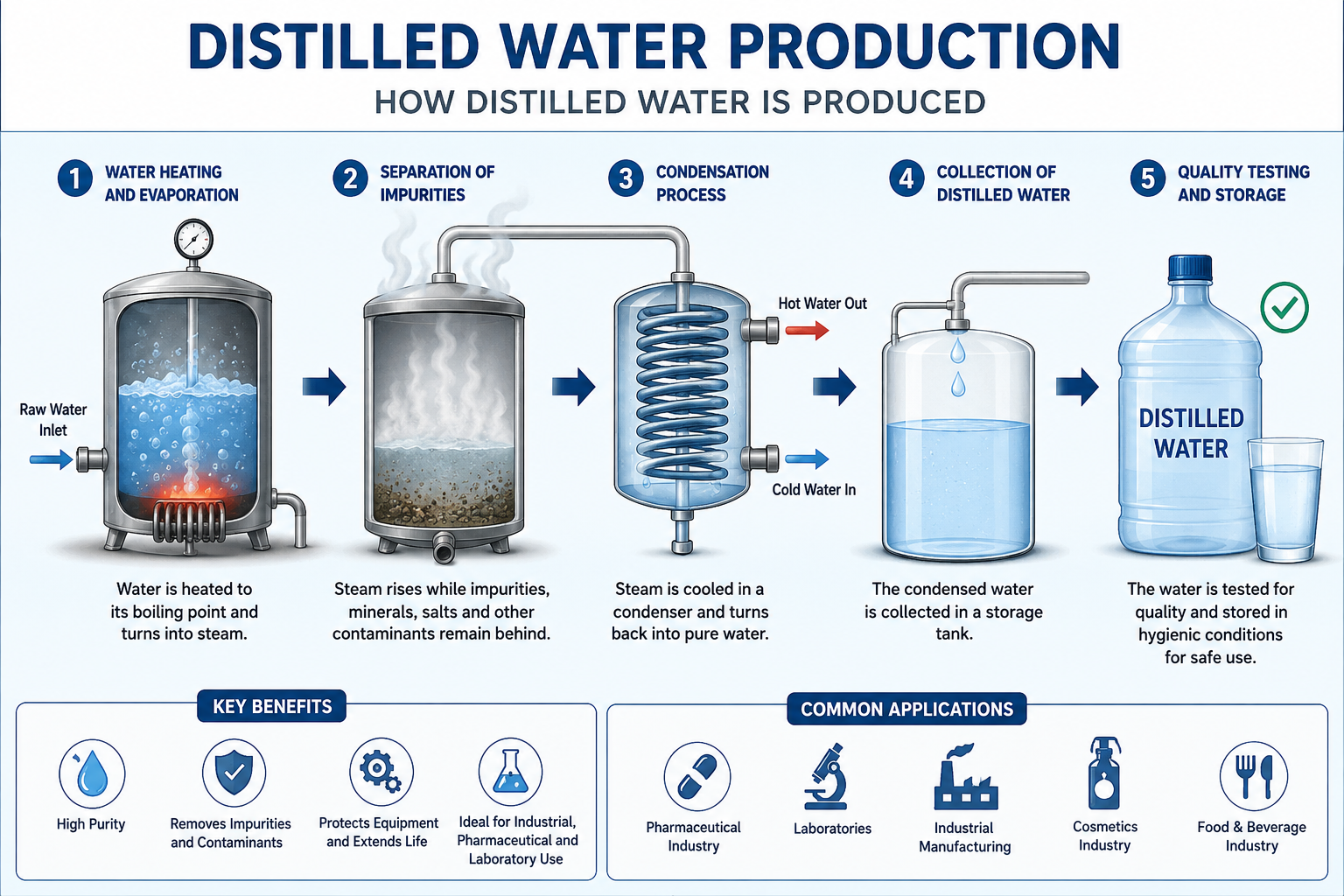
The first stage of distilled water production involves heating the water. A distillation unit raises the water temperature until it reaches its boiling point.
As the water boils, it transforms into steam. During this stage, most impurities do not evaporate because they have higher boiling points than water.
Therefore, minerals, salts, and many contaminants remain inside the boiling chamber while only water vapor moves forward in the process.
Step 2: Separation of Impurities
Once water changes into steam, the separation process begins naturally. The steam leaves behind many unwanted substances.
These impurities include:
- Calcium
- Magnesium
- Sodium
- Chlorides
- Sulfates
- Heavy metals
- Sediments
In addition, many microorganisms cannot travel with the steam. As a result, the purification process becomes highly effective.
This step plays a major role in producing high-quality distilled water.
Step 3: Condensation Process
After evaporation, the steam enters a cooling section called a condenser. Here, the steam loses heat and converts back into liquid water.
The condenser typically uses cool water or air to reduce the steam temperature.
As condensation occurs, purified water droplets form and collect in a separate chamber. Because most contaminants were left behind during evaporation, the condensed water is significantly purer.
Therefore, condensation is one of the most important stages in distilled water production.
Step 4: Collection of Distilled Water
After condensation, the purified water is collected in storage tanks designed for clean water handling.
Manufacturers use sanitary tanks to prevent contamination after purification. In many facilities, stainless steel tanks provide safe and hygienic storage.
Furthermore, some systems include additional filtration or ultraviolet treatment to maintain water quality during storage.
Proper collection and storage help preserve the purity of distilled water until it is ready for use.
Step 5: Quality Testing and Storage
Quality testing ensures that the distilled water meets required standards. Manufacturers perform various tests before releasing the water for industrial use.
Common tests include:
- Conductivity testing
- Total dissolved solids (TDS) measurement
- pH analysis
- Microbial testing
- Purity verification
These tests confirm that the water meets quality specifications.
Therefore, routine testing remains an essential part of distilled water production.
Equipment Used for Distilled Water Production
Several pieces of equipment work together during the distillation process.
Common equipment includes:
- Distillation units
- Boilers
- Evaporators
- Condensers
- Storage tanks
- Pumps
- Monitoring systems
Modern systems often include automation features that improve efficiency and reduce operating costs.
As a result, manufacturers can maintain consistent water quality with minimal manual intervention.
Benefits of Distilled Water Production
Distilled water production offers many advantages across industries.
Key benefits include:
- High purity levels
- Reduced mineral content
- Lower contamination risks
- Improved equipment life
- Better product consistency
- Reliable manufacturing performance
- Compliance with quality standards
Because of these benefits, many industries choose distilled water over untreated water sources.
Applications of Distilled Water in Different Industries
Distilled water serves many industrial and commercial applications.
Pharmaceutical Industry
Pharmaceutical companies use distilled water for manufacturing medicines, cleaning equipment, and laboratory testing.
Cosmetics Industry
Manufacturers use distilled water in creams, lotions, shampoos, and other personal care products.
Laboratory Applications
Laboratories require distilled water for experiments, sample preparation, and analytical testing.
Healthcare Facilities
Hospitals use distilled water in sterilization equipment and medical devices.
Food and Beverage Industry
Food manufacturers use distilled water to improve product consistency and maintain hygiene standards.
Industrial Manufacturing
Many manufacturing plants use distilled water in cooling systems, cleaning operations, and specialized production processes.
Factors That Affect Distilled Water Quality
Several factors can influence the final water quality.
These factors include:
- Source water quality
- Equipment condition
- System maintenance
- Operating temperature
- Storage conditions
- Cleaning procedures
Therefore, regular maintenance is essential for achieving consistent results.
Distilled Water Production vs Other Water Purification Methods
Different water purification methods serve different purposes.
Distillation
Removes most dissolved solids, minerals, and contaminants through evaporation and condensation.
Reverse Osmosis
Uses membranes to remove impurities and dissolved substances.
Deionization
Removes charged ions through ion-exchange resins.
Filtration
Removes particles and certain contaminants but may not eliminate dissolved minerals completely.
Each method has its advantages. However, distillation remains one of the most effective purification processes for producing high-purity water.
Challenges in Distilled Water Production
Although distillation provides excellent purification, it also presents certain challenges.
These challenges include:
- Energy consumption
- Equipment maintenance requirements
- Initial installation costs
- Scaling inside equipment
- Routine cleaning needs
Nevertheless, proper system design can minimize these challenges and improve efficiency.
How Manufacturers Ensure High-Purity Distilled Water
Manufacturers follow strict quality control procedures to ensure water purity.
Important practices include:
- Regular equipment inspection
- Scheduled maintenance
- Continuous monitoring
- Frequent water testing
- Proper storage management
- Staff training programs
As a result, industries receive reliable and consistent distilled water supplies.
Future Trends in Distilled Water Production
Technology continues to improve distilled water production systems.
Emerging trends include:
- Energy-efficient distillation units
- Automated monitoring systems
- Smart quality control technologies
- Sustainable water management practices
- Improved heat recovery systems
These advancements help reduce operating costs while maintaining high water quality standards.
FAQs
1. How is distilled water produced?
Distilled water is produced by heating water into steam and then condensing the steam back into liquid form. This process removes most impurities and dissolved solids.
2. What impurities are removed during distilled water production?
The process removes minerals, salts, heavy metals, sediments, and many microorganisms.
3. Is distilled water suitable for industrial applications?
Yes. Many industries use distilled water because of its high purity and consistent quality.
4. What is the difference between distilled water and DM water?
Distilled water is produced through distillation, while DM water is produced through a deionization process that removes ions using ion-exchange resins.
5. Why is quality testing important in distilled water production?
Quality testing confirms that the water meets purity standards and remains suitable for its intended applications.
Conclusion
Distilled Water Production is a highly effective purification process that removes impurities, minerals, and contaminants from water. The process involves heating, evaporation, impurity separation, condensation, collection, and quality testing. As a result, industries receive high-purity water that supports product quality, equipment performance, and operational efficiency. With continuous technological advancements, distilled water production will remain an essential solution for industries that require reliable and purified water.