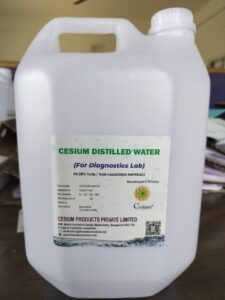


 CESIUM Demineralized (DM Water) water plays a very important role in industries due to its high purity and lack of dissolved mineral salts. DM water has had most of its positive and negative ions, such as calcium, magnesium, sodium, and chloride, removed. This makes it an essential resource for applications where mineral content could be detrimental to equipment, processes, or product quality.
Here’s how CESIUM DM water Bangalore plays a role in various industries:
Power Generation
- Steam Generation: Power plants, especially those with high-pressure boilers, rely on DM water to prevent scaling and corrosion. Minerals in untreated water can form a hard crust (scale) on the inside of boilers and pipes, reducing thermal efficiency and leading to equipment failure. The absence of minerals in DM water protects this critical infrastructure.
- Key Roles of DI Water in Power Plants:-
- Boiler Feedwater: Power plants, especially thermal and nuclear plants, use high-pressure boilers to generate steam. Minerals present in untreated water can form a hard crust, known as scale, on the inside of boiler tubes and pipes. This scale acts as an insulator, reducing the boiler’s thermal efficiency and increasing fuel consumption. DI water, being free of these minerals, prevents scale formation, which in turn protects the equipment and reduces maintenance costs and downtime.
- Steam Generation and Turbine Protection:- High-quality steam is essential for powering turbines. Impurities carried over in the steam can erode or damage the delicate turbine blades, leading to performance degradation and a shortened lifespan. Using Cesium deionized water (DI Water) ensures the steam is pure, which is crucial for the optimal and safe operation of the turbines.
- Cooling Systems:- Cesium DI water is used in cooling towers and other cooling systems to prevent mineral buildup and fouling. By maintaining clean heat exchange surfaces, DI water ensures efficient heat transfer, which is a vital part of the power generation process.
- Enhanced Thermal Efficiency:- The absence of dissolved salts and impurities in DI water improves its thermal conductivity. This allows for more efficient heat transfer within the boilers and other heat exchange systems, optimizing the overall performance of the power plant.
- The demineralization process, often carried out using ion exchange resins, reverse osmosis, or a combination of both, is a cornerstone of water treatment in the power generation industry. This process ensures the water used in critical systems is of the highest purity, thereby safeguarding expensive equipment and ensuring consistent power production.
- Petrochemical and Chemical Industries:
- Process Water and Cooling Towers:- DM water is used for high-purity boiler feedwater and to treat cooling tower blowdown. It helps prevent mineral buildup in cooling systems, ensuring efficient heat exchange and extending the lifespan of equipment and low maintenance.
- Chemical Formulations: In chemical manufacturing, using water with impurities can interfere with reactions and lead to undesirable byproducts. CESIUM DM water provides a consistent and predictable medium for chemical processes, ensuring precise formulations and product quality.
- Based on the information about Cesium Products Private Limited and the general principles of chemistry, here’s how CESIUM’s distilled water plays a crucial role in chemical formulations:
- Eliminating Unwanted Reactions and Contamination
- The core reason for using distilled water in chemical formulations is its purity. Distillation is a purification process that involves boiling water and collecting the resulting steam. This process effectively removes:
- Dissolved minerals and salts:- These can be calcium, magnesium, sodium, and other ions commonly found in tap water.
- Organic matter:- Microorganisms and other organic compounds are also left behind during the boiling process.
- In chemical formulations, the presence of these impurities can be detrimental. For example:
- Interference with reactions:- Ions like chloride (Cl−) or sulphate (SO42−) could react with the desired chemicals, leading to the formation of unwanted byproducts and altering the final product.
- Inaccurate measurements:- The concentration of a chemical solution is often critical. If the water itself contains dissolved solids, it can throw off the mass or volume calculations, leading to an inaccurate formulation.
- Product degradation:- In sensitive products like pharmaceuticals or cosmetics, impurities can affect the stability, colour, or shelf life of the final product.
- Ensuring Consistency and Reproducibility
- For a chemical formulation to be successful, it must be consistent and reproducible. Using a pure solvent like distilled water ensures that every batch of the formulation starts with the same clean base.
- Standardization:- Distilled water provides a standardized medium for all chemical reactions. This eliminates the variability that would be introduced if different sources of water (e.g., tap water from different locations) were used.
- Quality Control:- A consistent and pure solvent is a fundamental requirement for quality control. It allows chemists to isolate and test the effects of other ingredients without the interference of a contaminated solvent.
- Preventing Equipment Corrosion
- While primarily a concern for industrial equipment like boilers and cooling systems, the use of high-purity water is also important in a lab or production setting. Distilled water prevents the buildup of mineral deposits (scale) on glassware, sensors, and other delicate equipment. This not only extends the life of the equipment but also prevents contaminants from affecting the next batch of formulation.
- Specific Applications
- CESIUM’s distilled water is likely used in chemical formulations for:
- Analytical reagents:- Preparing solutions for precise laboratory testing where even trace impurities can skew results.
- Active pharmaceutical ingredients (APIs):- As a solvent in the synthesis of drugs, where purity is a non-negotiable requirement for safety and efficacy.
- Cosmetics and personal care products:- As a base ingredient to ensure that the final product is free from contaminants and has a consistent quality.
- In summary, the quality and purity of water are as important as the chemicals themselves in any formulation. Cesium’s distilled water provides a reliable, clean, and consistent medium, which is essential for accurate, reproducible, and safe chemical products.
- Food and Beverage
Thank you for providing the brand name and details. This allows for a more specific and accurate response.
Cesium’s distilled water, like any high-quality distilled water, plays a crucial role in the food and beverage industry for several key reasons:
- Ensuring Product Quality and Consistency
- Neutral Flavour Profile: Distilled water is essentially “blank” water, free of minerals, chemicals, and other dissolved solids that can impart a taste or odour. In the food and beverage industry, this is vital for maintaining a consistent and predictable flavour profile. When making beverages like juices, sodas, or even brewing coffee, using water with varying mineral content can change the final taste. Cesium’s distilled water ensures the product’s flavour is dictated only by the ingredients, not by the water itself.
- Preventing Discoloration and Cloudiness: Minerals in hard water can react with ingredients, leading to undesirable changes in a product’s appearance. For example, some minerals can cause cloudiness in beverages or affect the colour of foods during processing. The purity of Cesium’s distilled water helps prevent these reactions, ensuring the final product looks appealing and consistent.
- Ingredient Preparation: Distilled water is often used to reconstitute concentrated ingredients or powdered products. Its purity ensures that the rehydration process is clean and that no external contaminants are introduced, which is especially important for dairy products and other sensitive food items.
- Enhancing Food Safety and Shelf Life OF Products
- Contaminant-Free Base: Distillation is a highly effective method for removing microorganisms, bacteria, and viruses. By using Cesium’s distilled water, food and beverage manufacturers significantly reduce the risk of biological contamination. This is a critical factor for both product safety and extending the product’s shelf life.
- Cleaning and Sanitization: Beyond being an ingredient, pure water is essential for cleaning and sanitizing equipment, pipes, and production lines. The use of distilled water ensures that no mineral residue or scale is left behind on the equipment, which could otherwise become a breeding ground for bacteria or affect the taste of the next batch.
- Improving Operational Efficiency of Machine
- Preventing Equipment Damage: The absence of minerals in distilled water means there is no risk of mineral buildup (scaling) in boilers, steam generators, and other equipment used for processing. This protects machinery from corrosion and extends its operational life, reducing maintenance costs and downtime.
- Consistency in Processes: Distilled water has a consistent boiling point and other properties, which is important for processes like cooking and canning. This consistency ensures that heating and cooling cycles are reliable, leading to a more efficient and predictable manufacturing process.