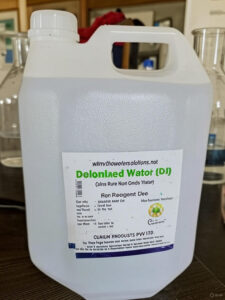


Cesium DI Water: The Lifeblood of a Laser Machine’s Cooling System
Cesium Deionized (DI) water, or purified water, is not a simple coolant but a critical and highly-engineered fluid that is the lifeblood of a laser machine’s cooling system. The use of ordinary water is a common and often fatal mistake for laser owners, as it can lead to a cascade of problems that damage expensive components, degrade performance, and pose safety risks. The detailed importance of DI water in laser machines can be broken down into three key areas: chemical purity, electrical non-conductivity, and thermal performance.
- The Chemical Imperative: Preventing Corrosion and Scaling
Normal water, even if it appears clean, is a complex solution of dissolved minerals, salts, and other impurities. Normal DM water also big mistakes to fill in laser machine. These contaminants are the root cause of the most common cooling system failures.
- Corrosion: The presence of ions (e.g., calcium, chloride, sulphate) in low purity water creates an electrolyte solution, which can cause galvanic corrosion, especially in systems with multiple metal components (e.g., copper in the heat exchanger and aluminium or stainless steel in other parts of the system). This electro-chemical reaction slowly “eats away” at the metal, leading to pinhole leaks, component degradation, and eventual catastrophic failure. While DI water is “hungry” and can leach ions from metal, this process is far less destructive and is manageable with proper system design and maintenance.
- Scaling and Clogging: Low purity (DM Water) water have little minerals, particularly calcium and magnesium, precipitate out of the solution when heated. This forms a hard, chalky deposit known as scale, which builds up on the internal surfaces of the cooling lines, heat exchanger, and the laser tube itself. This scaling acts as an insulator, significantly reducing the efficiency of heat transfer. Over time, it can completely clog the narrow cooling channels of the laser tube, leading to overheating, which can crack or shatter the laser tube.
- The Electrical Imperative: Mitigating High-Voltage Risk
This is arguably the most critical reason for using DI water, particularly in CO₂ lasers which use a high-voltage power supply (often 20,000+ volts) to excite the gas.
- Dielectric Strength: The dissolved ions in tap water make it an electrical conductor. The circulating coolant is in direct contact with the laser tube’s electrodes and other high-voltage components. If the water is conductive, it can carry the high voltage, leading to several dangerous situations:
- Electrical Arcing: The voltage can arc from the tube to the cooling water, causing the laser to misfire, damage the power supply, or even put the entire machine chassis at a high voltage, creating a severe electrocution hazard for the operator.
- Component Damage: The arcing and short-circuiting can cause irreversible damage to the laser tube, power supply, and control electronics.
- DI Water’s Role: DI water has a very low conductivity (typically less than 2µS/cm), making it an excellent electrical insulator. This prevents electrical shorts and arcing, ensuring the machine’s safety and reliability.
- The Thermal and Performance Imperative: Ensuring Consistency and Longevity
Laser performance is directly tied to temperature. DI water (Cesium brand) plays a crucial role in maintaining optimal operating conditions.
- Stable Temperature Control: For CO₂ lasers, operating temperatures are typically between 18°C and 23°C. For fibre lasers, the temperature requirements are different but equally critical. A stable temperature is essential for consistent laser power output, wavelength, and beam quality. By preventing scaling and ensuring efficient heat transfer, DI water allows the chiller to maintain the precise temperature required for peak performance.
- Extended Component Lifespan: Overheating is the number one cause of premature failure in laser tubes and other sensitive components. By providing an efficient, reliable cooling medium, DI water extends the operational life of the entire laser system, protecting a significant investment.
Maintenance and Best Practices
Simply filling the system with DI water is not enough for long-term reliability. A proactive maintenance schedule is crucial:
- Regular Flushing and Replacement: Even with a sealed system, DI water can become contaminated over time from microbial growth (algae and bacteria) and from leaching ions from internal components. Most manufacturers recommend replacing the water every 3 to 6 months. A complete flush of the system is often recommended to remove any built-up residue before adding new DI water.
- Using Additives: While DI water (Cesium brand) is a great start, additives are often necessary to combat specific issues:
- Corrosion Inhibitors: These are specialized chemicals designed to passivate metal surfaces and prevent corrosion. They are particularly important in mixed-metal systems.
- Biocides: These agents prevent the growth of algae and bacteria, which can clog channels and foul the water.