


DM Water Cell Culture: Uses, Benefits & Best Practices
Cell culture plays a vital role in modern biotechnology, pharmaceutical research, vaccine production, and medical discoveries. DM Water Cell Culture is an important part of this process because water quality directly affects cell growth, experiment accuracy, and product consistency. Even a small amount of impurities can change the composition of culture media and reduce the reliability of research results.
Therefore, laboratories and biopharmaceutical companies rely on highly purified DM water to prepare culture media, clean laboratory equipment, and support quality-controlled research. Moreover, using the right water helps maintain sterile conditions and reduces the risk of contamination. As a result, researchers can achieve reproducible and accurate experimental outcomes.
At The Water Solutions, we provide premium-quality DM Water manufactured under strict quality standards to meet the demanding requirements of laboratories, research institutes, pharmaceutical companies, and biotechnology facilities.
What Is DM Water Cell Culture?
DM Water Cell Culture refers to the use of demineralized (DM) water during various cell culture processes. DM water is produced by removing dissolved minerals, salts, calcium, magnesium, sodium, chlorides, sulfates, and other ionic impurities through advanced ion exchange systems.
Unlike ordinary tap water, DM water has very low conductivity and minimal dissolved solids. Consequently, it creates a stable foundation for preparing cell culture media and laboratory solutions.
Although DM water is highly purified, many laboratories further process it through reverse osmosis (RO), activated carbon filtration, ultrafiltration, or polishing systems to produce laboratory-grade purified water according to their application requirements.
For research laboratories that require consistent performance, choosing high-quality DM water is the first step toward reliable cell culture experiments.
Why Water Quality Matters in DM Water Cell Culture
Water forms nearly every laboratory solution used during cell culture. Therefore, its purity directly influences cell health and experimental success.
If water contains dissolved minerals, heavy metals, microorganisms, or organic contaminants, several problems may occur, including:
- Poor cell growth
- Reduced cell viability
- Incorrect experimental results
- Media instability
- Increased contamination risk
- Protein degradation
- Reduced reproducibility
- Instrument scaling
Therefore, laboratories carefully monitor water quality before preparing any culture medium.
According to laboratory best practices, purified water should maintain low conductivity, low total organic carbon (TOC), and minimal microbial contamination to ensure consistent experimental performance.
At The Water Solutions, every batch of DM Water is manufactured under strict quality control procedures to help laboratories maintain dependable research standards.
How DM Water Is Produced for Cell Culture
The production of DM Water Cell Culture begins with removing dissolved ions from raw water. However, several purification stages work together to achieve the required purity.
Raw Water Pre-Treatment
First, incoming water passes through sediment filters that remove suspended particles, dust, and larger contaminants.
Next, activated carbon filters eliminate chlorine and organic compounds that may damage purification equipment.
This stage also protects downstream ion exchange resins.
Reverse Osmosis
Many facilities use reverse osmosis before demineralization.
Reverse osmosis removes:
- Dissolved salts
- Heavy metals
- Organic impurities
- Bacteria
- Viruses
- Fine particles
Consequently, the ion exchange system operates more efficiently and lasts longer.
Ion Exchange Demineralization
This is the main purification step.
Special cation and anion exchange resins remove nearly all dissolved minerals from water.
These resins exchange unwanted ions with hydrogen and hydroxyl ions, which combine to form pure water.
As a result, conductivity decreases significantly.
Mixed Bed Polishing
Many pharmaceutical and biotechnology companies use mixed-bed polishing units.
This final polishing stage removes remaining ionic traces.
Therefore, the water becomes suitable for demanding laboratory applications.
Final Filtration
Finally, purified water passes through fine filters.
Some systems also include UV sterilization and ultrafiltration to reduce microorganisms and organic contaminants.
Consequently, laboratories receive clean, reliable DM water suitable for preparing laboratory solutions.
Major Applications of DM Water Cell Culture
DM water supports several essential laboratory processes. Moreover, it improves consistency across research and production activities.
Culture Media Preparation Using DM Water Cell Culture
One of the most important uses of DM Water Cell Culture is preparing culture media.
Cell culture media contains amino acids, vitamins, salts, glucose, growth factors, and nutrients. Every ingredient must dissolve completely to create a balanced environment for cells.
If ordinary water is used, dissolved minerals may react with media components.
Consequently, nutrient availability may change.
As a result, cell growth becomes inconsistent.
DM water minimizes these unwanted reactions and supports accurate media preparation.
At The Water Solutions, our high-purity DM Water helps laboratories prepare reliable culture media for research and industrial applications.
Preparation of Buffers and Laboratory Solutions
Buffers help maintain the correct pH during cell growth.
Even slight changes in pH can affect cell metabolism.
Therefore, laboratories prepare buffers using purified water.
DM water helps maintain solution stability because it contains very few dissolved ions.
Moreover, buffer preparation becomes more consistent across multiple batches.
This consistency improves the reliability of laboratory experiments.
Cleaning Laboratory Glassware
Glassware cleanliness is essential in every laboratory.
Residual minerals from tap water often leave deposits on flasks, bottles, and beakers.
These deposits may contaminate future experiments.
Therefore, laboratories perform final rinsing with DM water.
This practice removes mineral residues and helps maintain clean laboratory equipment.
Consequently, contamination risks decrease while experimental accuracy improves.
Cleaning Cell Culture Equipment
Incubators, media preparation vessels, storage containers, and laboratory instruments require regular cleaning.
Using DM water prevents mineral scaling on sensitive equipment.
Furthermore, clean equipment performs more efficiently and lasts longer.
Proper cleaning also reduces maintenance costs over time.
Reagent Preparation
Many laboratory reagents require highly purified water.
DM water ensures chemicals dissolve correctly without interference from unwanted ions.
Therefore, reagent quality remains consistent across different production batches.
Reliable reagents ultimately support accurate scientific research.
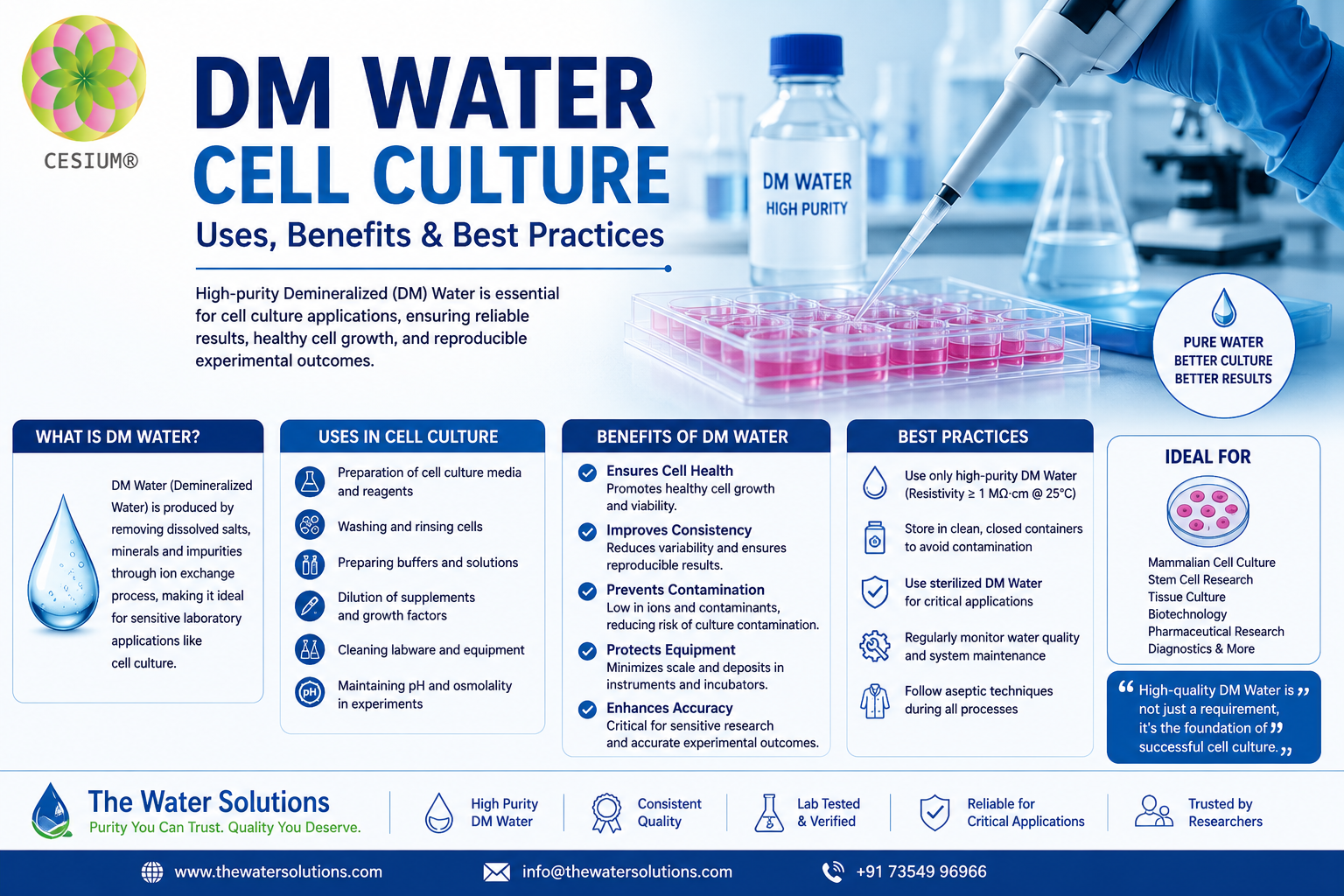
Benefits of DM Water Cell Culture
Using DM Water Cell Culture offers many advantages for laboratories, research institutes, and pharmaceutical manufacturers. Pure water improves every stage of cell culture, from media preparation to equipment cleaning. Moreover, it helps researchers achieve accurate and repeatable results.
DM Water Cell Culture Improves Cell Growth
Healthy cells need a stable environment. Even small amounts of dissolved minerals can affect nutrient availability and cell metabolism. Therefore, high-purity DM water supports better cell growth by reducing unwanted chemical interactions.
Researchers also notice improved consistency when they prepare culture media with purified water. As a result, experiments become easier to repeat and validate.
DM Water Cell Culture Reduces Contamination Risks
Contamination is one of the biggest challenges in any cell culture laboratory. It can waste time, increase costs, and delay important research.
Using high-quality DM water helps lower contamination risks because it contains very low levels of dissolved salts and impurities. Furthermore, laboratories often combine DM water with UV treatment and sterile filtration to achieve even higher purity.
However, water quality alone cannot prevent contamination. Proper laboratory practices, sterilized equipment, and trained personnel remain equally important.
Better Experimental Accuracy
Scientific research depends on accurate results. Therefore, every reagent, buffer, and media component must remain consistent.
DM water removes many variables that may affect experiments. Consequently, researchers obtain reliable data with less variation between batches.
This consistency is especially important in pharmaceutical research, biotechnology, and academic laboratories.
Longer Equipment Life
Minerals in untreated water gradually form deposits inside laboratory equipment. These deposits reduce efficiency and increase maintenance costs.
DM water prevents mineral scaling because most dissolved ions have already been removed. As a result, incubators, autoclaves, glassware, and media preparation systems remain cleaner for longer periods.
Regular use of high-quality DM water also reduces equipment downtime.
Improved Media Stability
Cell culture media contains many sensitive ingredients. Minerals from ordinary water may react with amino acids, vitamins, and salts.
DM water minimizes these reactions. Therefore, the media remains stable throughout preparation and storage.
Stable media supports healthy cell development and improves research quality.
Common Contaminants That Affect DM Water Cell Culture
Water may contain several contaminants that interfere with cell culture. Therefore, laboratories continuously monitor water quality.
Dissolved Minerals
Calcium, magnesium, sodium, iron, and chloride are common dissolved minerals.
These minerals may react with culture media ingredients. Consequently, they can alter nutrient balance and affect cell growth.
High-quality DM water removes most of these dissolved ions.
Heavy Metals
Trace amounts of lead, copper, zinc, mercury, or cadmium may damage sensitive cells.
Although these metals are usually present in very small quantities, they can influence biological experiments.
Therefore, laboratories avoid untreated water for cell culture applications.
Organic Compounds
Natural organic matter and chemical residues may interfere with cell metabolism.
In addition, organic contaminants can increase Total Organic Carbon (TOC), which is an important water quality parameter.
Modern purification systems help reduce these compounds before water reaches the laboratory.
Microorganisms
Bacteria, fungi, algae, and other microorganisms may contaminate water supplies.
If these microorganisms enter culture media, experiments may fail completely.
Therefore, many laboratories combine DM water with sterile filtration, UV sterilization, and proper storage practices.
Endotoxins
Endotoxins are bacterial by-products that may affect sensitive mammalian cell cultures.
Although DM water removes many dissolved ions, laboratories producing high-grade purified water often include additional purification steps to reduce endotoxin levels where required.
Water Quality Parameters for DM Water Cell Culture
Water quality should be monitored regularly to maintain consistent laboratory performance.
Important parameters include:
- Low electrical conductivity
- Low Total Dissolved Solids (TDS)
- Controlled pH
- Low Total Organic Carbon (TOC)
- Minimal microbial contamination
- Low particulate matter
- Consistent water quality between batches
Routine monitoring helps laboratories identify problems before they affect research.
Best Practices for Using DM Water Cell Culture
Following proper laboratory practices improves water quality and protects valuable research.
Store Water Correctly
Always store DM water in clean, closed containers made from laboratory-grade materials.
Proper storage reduces contamination from dust, airborne particles, and microorganisms.
Avoid Long-Term Storage
Although DM water is highly purified, it should not remain in storage for long periods.
Freshly prepared water generally provides better laboratory performance.
Therefore, laboratories often produce water according to their daily requirements.
Clean Storage Tanks Regularly
Storage containers require regular cleaning and sanitization.
This practice prevents microbial growth and maintains water quality.
Routine maintenance also extends equipment life.
Monitor Water Quality Frequently
Laboratories should check conductivity, TDS, microbial levels, and other quality parameters regularly.
Routine testing helps identify system problems early.
Consequently, corrective actions can be taken before experiments are affected.
Maintain Purification Systems
Ion exchange resins, filters, UV units, and reverse osmosis membranes require scheduled maintenance.
Replacing these components on time ensures consistent water quality throughout the year.
Applications of DM Water Cell Culture Across Industries
Pharmaceutical Manufacturing
Pharmaceutical companies use DM water during research, formulation development, cleaning processes, and laboratory testing.
Reliable water quality helps maintain product consistency and supports regulatory compliance.
Biotechnology Industry
Biotechnology laboratories depend on purified water for media preparation, genetic research, protein studies, and cell-based experiments.
Consistent water quality improves reproducibility and research accuracy.
Vaccine Development
Cell culture is widely used during vaccine research and production.
High-quality DM water supports media preparation, equipment cleaning, and laboratory operations.
Reliable purification systems help maintain controlled production environments.
Academic and Research Laboratories
Universities and research institutes perform thousands of cell culture experiments every year.
Using high-purity DM water improves experimental consistency and reduces unnecessary errors.
Therefore, it supports reliable scientific discoveries.
Industry Insights and Expert Perspectives
According to the World Health Organization (WHO), maintaining high standards of water quality is essential for pharmaceutical manufacturing and laboratory operations. Water used in research and production should be consistently monitored to ensure it meets defined quality specifications.
“Water is one of the major raw materials used in pharmaceutical manufacturing and should be appropriately controlled.” — World Health Organization (WHO)
Similarly, the United States Pharmacopeia (USP) emphasizes that purified water quality directly influences the consistency and safety of laboratory and pharmaceutical processes.
In addition, the International Society for Pharmaceutical Engineering (ISPE) recommends routine monitoring of water purification systems to maintain performance and reduce contamination risks.
Research published by the National Institutes of Health (NIH) highlights that water impurities can influence experimental reproducibility, making high-quality water an important factor in cell-based research.
Frequently Asked Questions (FAQs)
1. What is DM Water Cell Culture?
DM Water Cell Culture refers to the use of demineralized water in cell culture laboratories for preparing media, buffers, reagents, and cleaning laboratory equipment. DM water contains very low levels of dissolved minerals, helping researchers maintain consistent experimental conditions.
- Why is DM water important in cell culture?
DM water helps reduce unwanted mineral contamination during media preparation. As a result, cells grow in a more stable environment, and researchers obtain accurate, repeatable, and reliable results. High-quality water also protects sensitive laboratory equipment from mineral deposits.
- Can DM water replace distilled water in cell culture?
DM water and distilled water both provide high levels of purity, but they are produced using different purification methods. The choice depends on laboratory protocols and application requirements. Many laboratories use additional purification steps, such as reverse osmosis, UV treatment, ultrafiltration, or mixed-bed polishing, to achieve the required water quality.
- How should DM water be stored for laboratory use?
DM water should be stored in clean, closed, laboratory-grade containers. Storage tanks and distribution systems should be cleaned and sanitized regularly. Furthermore, laboratories should monitor conductivity and microbial levels to maintain water quality.
- Which industries use DM Water Cell Culture?
Many industries depend on DM Water Cell Culture, including:
- Pharmaceutical manufacturing
- Biotechnology companies
- Vaccine production facilities
- Medical research laboratories
- Universities and research institutes
- Clinical laboratories
- Life science organizations
These industries rely on purified water to support consistent research, product quality, and regulatory compliance.
Conclusion
DM Water Cell Culture is a critical component of modern biotechnology, pharmaceutical research, vaccine development, and laboratory operations. Water quality directly influences cell growth, media preparation, experimental accuracy, and equipment performance. Therefore, selecting high-purity DM water is essential for achieving reliable and reproducible results.
Moreover, consistent water quality reduces contamination risks, improves media stability, and extends the life of laboratory equipment. By following proper storage, monitoring, and maintenance practices, laboratories can maintain high research standards and improve operational efficiency.
At The Water Solutions, we supply premium-quality DM Water manufactured under strict quality standards to support laboratories, pharmaceutical companies, biotechnology facilities, healthcare organizations, and research institutions. Our reliable water purification solutions help customers achieve consistent performance while meeting demanding industry requirements.
Whether you require DM Water for routine laboratory work or advanced research applications, The Water Solutions is your trusted partner for high-purity water solutions.
Why Choose The Water Solutions?
Choosing the right water supplier is just as important as selecting the right laboratory equipment. At The Water Solutions, we focus on quality, consistency, and customer satisfaction.
Our Advantages
- High-purity DM Water
- Advanced purification technology
- Strict quality control
- Reliable product consistency
- Timely delivery
- Competitive pricing
- Solutions for laboratories and industries
- Technical support from experienced professionals
- Custom water solutions for different applications
Our commitment to quality helps laboratories maintain confidence in every experiment.