


Distilled Water pH Value Uses in Different Industries
Distilled Water pH plays an important role in many industrial and commercial applications. Although distilled water is one of the purest forms of water, its pH value often creates confusion. Many people assume that distilled water always has a pH of exactly 7. However, the actual pH can change after the water comes into contact with air. This happens because distilled water absorbs carbon dioxide, which forms a weak carbonic acid and slightly lowers the pH.
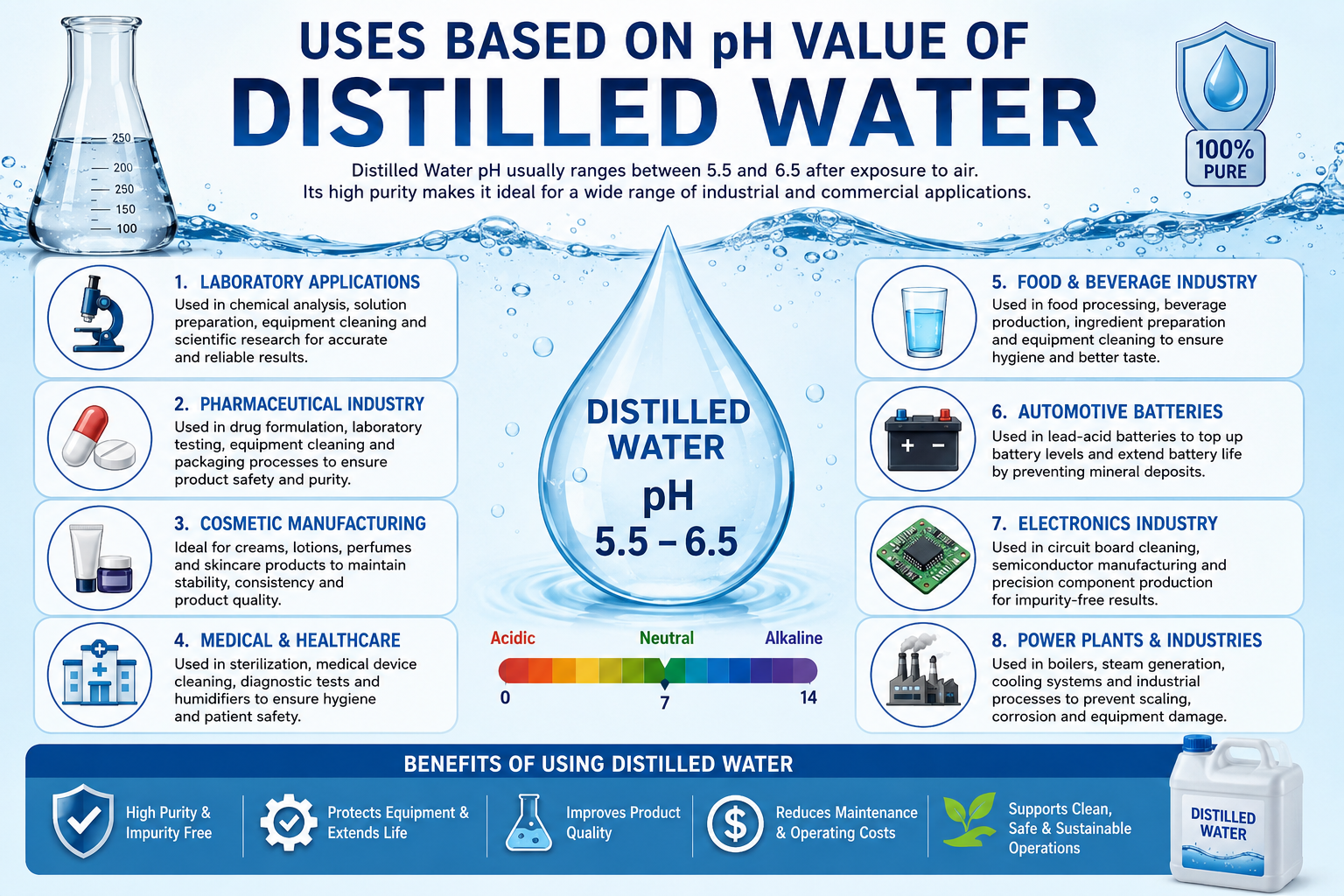
Even with this small change, distilled water remains one of the best choices for industries that require high purity water. Therefore, laboratories, pharmaceutical companies, cosmetic manufacturers, food processing plants, automotive industries, and research centers rely on distilled water every day.
In this blog, you will learn how the Distilled Water pH influences different applications, why maintaining water quality matters, and how choosing a reliable supplier improves your production process.
What Is Distilled Water pH?
The Distilled Water pH refers to the acidity or alkalinity of distilled water. Freshly prepared distilled water usually has a pH close to 7 because it contains almost no dissolved minerals or salts. However, once it is exposed to air, it absorbs carbon dioxide naturally. As a result, the pH generally falls between 5.5 and 6.5.
This slight change does not reduce the purity of distilled water. Instead, it is a natural chemical reaction. Moreover, industries focus more on water purity, conductivity, and total dissolved solids (TDS) than on the slight drop in pH.
Why Does Distilled Water Have a Different pH?
Several factors influence the pH value of distilled water.
- Freshly distilled water has a nearly neutral pH.
- Carbon dioxide from the air lowers the pH.
- Storage conditions affect the final pH.
- Open containers absorb gases more quickly.
- Temperature also changes pH readings.
Understanding these factors helps industries maintain consistent water quality for sensitive operations.
Why Distilled Water pH Matters
The Distilled Water pH directly affects product quality, equipment performance, and manufacturing efficiency. Although the pH changes only slightly, industries that demand precision monitor it carefully.
For example, laboratories perform accurate chemical experiments using distilled water. Likewise, pharmaceutical manufacturers produce medicines that require contaminant-free water. Cosmetic companies also depend on distilled water to improve product stability.
Furthermore, distilled water prevents mineral deposits inside equipment. Consequently, machines operate efficiently and require less maintenance. This improves productivity while reducing operating costs.
Manufacturers also benefit because distilled water helps maintain consistent production standards. As a result, they experience fewer quality issues and better customer satisfaction.
Distilled Water pH in Laboratory Applications
Laboratories demand extremely pure water because even tiny impurities can affect test results. Therefore, scientists use distilled water for chemical analysis, solution preparation, glassware cleaning, and biological research.
Accurate Chemical Experiments
Chemical reactions depend on precise measurements. Mineral ions present in ordinary water may interfere with reactions. Consequently, distilled water provides reliable and repeatable results.
Researchers also prefer distilled water because it reduces contamination risks during analytical procedures.
Preparing Standard Solutions
Many laboratory solutions require pure water. Distilled water ensures that chemicals dissolve correctly without unwanted reactions.
As a result, laboratories maintain higher testing accuracy and achieve dependable outcomes.
Cleaning Laboratory Equipment
Glassware must remain free from mineral deposits. Distilled water rinses laboratory equipment without leaving stains or residue.
Consequently, laboratory instruments remain clean, and test accuracy improves.
Biological Research
Microbiology and biotechnology laboratories require sterile and contaminant-free water. Distilled water supports cell culture preparation, media formulation, and sample handling.
Moreover, pure water helps researchers maintain controlled experimental conditions.
Distilled Water pH in Pharmaceutical Manufacturing
The pharmaceutical industry follows strict quality standards. Therefore, manufacturers use distilled water throughout medicine production.
Medicine Formulation
Medicines require precise chemical compositions. Distilled water prevents unwanted contaminants from entering formulations.
As a result, manufacturers achieve consistent product quality.
Equipment Cleaning
Production equipment must remain contamination-free. Distilled water removes residues without leaving mineral deposits.
Therefore, pharmaceutical companies reduce contamination risks and comply with regulatory standards.
Laboratory Testing
Quality control laboratories test medicines using highly purified water. Distilled water improves testing accuracy while maintaining reliable analytical results.
Furthermore, manufacturers protect patient safety through consistent quality assurance.
Packaging Processes
Some pharmaceutical packaging processes require distilled water for cleaning containers and equipment.
Consequently, product hygiene improves significantly.
Distilled Water pH in Cosmetic Manufacturing
The cosmetic industry values purity because product quality directly affects customer satisfaction. Therefore, manufacturers choose distilled water to formulate skincare, haircare, and personal care products.
Skin Care Products
Creams, lotions, and serums require pure water to maintain product stability.
Distilled water minimizes contamination while supporting smooth formulations.
Hair Care Products
Shampoos and conditioners perform better when manufacturers use water without dissolved minerals.
Consequently, products remain consistent from batch to batch.
Perfumes and Fragrances
Distilled water helps preserve fragrance quality without introducing impurities.
Therefore, perfumes maintain their intended scent profile for longer periods.
Makeup Products
Many cosmetic formulations require controlled water quality. Distilled water supports better texture, stability, and shelf life.
As a result, manufacturers produce premium-quality cosmetics that meet customer expectations.
Distilled Water pH in Medical and Healthcare Applications
Healthcare organizations require the highest standards of water purity. Therefore, Distilled Water pH becomes an important factor in hospitals, clinics, diagnostic laboratories, and medical research centers. Pure distilled water supports patient safety and protects sensitive medical equipment.
Medical Equipment Sterilization
Medical devices must remain free from mineral deposits and contaminants. Distilled water helps sterilize surgical instruments, autoclaves, and laboratory equipment without leaving residue.
Moreover, clean equipment reduces the risk of infection and improves patient care.
Laboratory Diagnostics
Diagnostic laboratories depend on accurate test results. Even a small amount of contamination can affect blood tests, urine analysis, and chemical testing. Consequently, laboratories use distilled water to prepare reagents and clean testing equipment.
Pharmaceutical Research
Research laboratories require highly purified water during drug development. Distilled water maintains consistent conditions and reduces the chance of unwanted chemical reactions.
As a result, researchers obtain reliable experimental results.
Medical Humidifiers
Many hospitals use humidifiers to improve patient comfort. Distilled water prevents mineral buildup inside the equipment and helps maintain hygienic operation.
Therefore, the equipment performs efficiently for a longer period.
Distilled Water pH in Automotive Battery Maintenance
One of the most common applications of Distilled Water pH is battery maintenance. Automotive batteries require pure water because minerals reduce battery performance.
Lead-Acid Batteries
Battery cells require water with extremely low mineral content. Distilled water prevents scale formation inside the battery.
As a result, battery efficiency improves significantly.
Longer Battery Life
Using tap water introduces minerals that damage battery plates.
However, distilled water protects internal components and increases battery life.
Better Charging Efficiency
Clean water allows proper chemical reactions inside the battery.
Consequently, batteries charge more efficiently and deliver stable performance.
Reduced Maintenance Costs
Battery failures often occur because of mineral contamination.
Therefore, using distilled water reduces maintenance expenses and improves reliability.
Distilled Water pH in Electronics Manufacturing
The electronics industry demands extremely clean water because microscopic contaminants damage delicate electronic components.
Circuit Board Cleaning
Electronic circuit boards require thorough cleaning after manufacturing.
Distilled water removes flux residues without leaving conductive minerals.
Semiconductor Production
Manufacturers use highly purified distilled water during wafer cleaning and chip manufacturing.
As a result, electronic components achieve better quality and fewer defects.
Precision Manufacturing
Many electronic devices require dust-free and mineral-free production environments.
Therefore, distilled water supports precision manufacturing.
Equipment Maintenance
Sensitive electronic manufacturing machines also require clean water for maintenance.
Consequently, equipment lasts longer and performs consistently.
Distilled Water pH in Textile Manufacturing
The textile industry depends on consistent water quality during dyeing and finishing operations.
Dye Preparation
Minerals present in ordinary water affect dye performance.
Distilled water allows dyes to dissolve evenly and produce consistent colors.
Fabric Washing
Manufacturers use distilled water during the final washing stage to prevent mineral stains.
Therefore, fabrics maintain their original appearance.
Chemical Mixing
Many textile chemicals require mineral-free water for proper formulation.
Consequently, chemical reactions remain stable throughout production.
Quality Improvement
High-purity water improves fabric quality while reducing production defects.
As a result, manufacturers achieve better customer satisfaction.
Why Industries Choose Distilled Water Instead of Tap Water
Industries prefer distilled water because it offers several important advantages.
- Removes dissolved minerals.
- Prevents equipment scaling.
- Reduces corrosion.
- Improves production quality.
- Supports accurate laboratory testing.
- Increases equipment lifespan.
- Lowers maintenance costs.
- Improves product consistency.
- Helps industries meet quality standards.
- Supports sensitive manufacturing processes.
Therefore, distilled water remains the preferred choice across multiple industries.
Environmental Benefits of Using Distilled Water
Using Distilled Water pH in industrial operations benefits both businesses and the environment. Since distilled water contains almost no dissolved minerals, it helps equipment run more efficiently. As a result, machines consume less energy and require fewer repairs.
Moreover, clean water reduces scaling inside boilers, heat exchangers, cooling systems, and pipelines. Therefore, industries spend less on maintenance and replacement parts. Longer equipment life also reduces industrial waste.
Many companies also recycle distilled water after suitable treatment. Consequently, they lower overall water consumption and support sustainable manufacturing practices.
Furthermore, industries that use high-purity water often experience fewer product defects. This reduces material waste and improves production efficiency.
Environmental Advantages of Distilled Water
- Reduces mineral deposits in equipment.
- Improves energy efficiency.
- Extends equipment lifespan.
- Minimizes maintenance requirements.
- Reduces industrial waste.
- Supports sustainable manufacturing.
- Improves product quality.
- Lowers long-term operating costs.
How to Choose the Right Distilled Water Supplier
Selecting the right supplier is just as important as choosing the right water. High-quality distilled water ensures consistent production, protects expensive machinery, and improves final product quality.
When evaluating suppliers, consider the following factors.
Water Purity Standards
Choose a supplier that provides consistently high-purity distilled water with low conductivity and minimal total dissolved solids (TDS).
Quality Testing
Reliable suppliers regularly test water quality and provide quality assurance reports.
Production Capacity
Your supplier should deliver the required quantity without delays. Consistent supply helps avoid production interruptions.
Packaging Options
Industries require different packaging sizes. Therefore, select a supplier that offers flexible packaging for laboratories, factories, hospitals, and commercial users.
Technical Support
Experienced suppliers also provide guidance on water quality, storage, and industrial applications.
Reliable Delivery
On-time delivery keeps manufacturing processes running smoothly and prevents unnecessary downtime.
Best Practices for Using Distilled Water
Following proper handling practices helps maintain the purity of distilled water.
- Store distilled water in clean, sealed containers.
- Avoid prolonged exposure to air because carbon dioxide can slightly lower the pH.
- Use dedicated storage tanks for industrial applications.
- Keep storage containers away from direct sunlight and contaminants.
- Clean dispensing equipment regularly.
- Follow recommended storage guidelines.
- Test water quality periodically for critical applications.
- Use fresh distilled water for laboratory and pharmaceutical processes.
- Train employees on proper handling procedures.
- Purchase distilled water only from trusted suppliers.
These simple practices help maintain water quality and ensure reliable performance across different industries.
The Water Solutions offers premium distilled water produced under strict quality standards to support safe storage, reliable handling, and superior industrial performance.
Frequently Asked Questions (FAQs)
1. What is the normal pH of distilled water?
Freshly distilled water usually has a pH close to 7. However, after exposure to air, it absorbs carbon dioxide, and the pH generally falls between 5.5 and 6.5. This change is natural and does not reduce water purity.
- Why is distilled water important in laboratories?
Laboratories use distilled water because it contains almost no dissolved minerals or contaminants. As a result, experiments, chemical analyses, and laboratory testing remain accurate and reliable.
- Can distilled water improve equipment life?
Yes. Distilled water prevents mineral deposits, corrosion, and scaling inside equipment. Consequently, machines require less maintenance and operate more efficiently.
- Which industries use distilled water the most?
Many industries depend on distilled water, including pharmaceutical manufacturing, laboratories, healthcare, cosmetics, food processing, electronics, automotive, chemical manufacturing, power plants, and textile production.
- How do I choose a reliable distilled water supplier?
Choose a supplier that offers consistent purity, quality testing, reliable delivery, technical support, and industry-standard manufacturing practices. These factors help ensure dependable water quality for your applications.
Conclusion
Distilled Water pH may appear to be a simple characteristic, but it has a significant impact on industrial performance, product quality, and equipment reliability. Although freshly distilled water is nearly neutral, its pH naturally changes after exposure to air. Even so, its exceptional purity makes it the preferred choice for laboratories, pharmaceutical companies, healthcare facilities, cosmetic manufacturers, food processors, electronics industries, automotive applications, power plants, and many other sectors.
Furthermore, distilled water helps reduce mineral buildup, protects expensive equipment, improves production consistency, and supports compliance with strict quality standards. As industries continue to focus on efficiency and sustainability, the demand for high-purity distilled water will continue to grow.
Choosing a trusted supplier is equally important. High-quality distilled water ensures consistent performance, reduces maintenance costs, and supports long-term operational success.
At The Water Solutions, we provide premium-quality distilled water for laboratories, pharmaceutical companies, healthcare facilities, manufacturing industries, automotive applications, power plants, cosmetic manufacturers, and research organizations. Our commitment to purity, quality, and reliable supply helps businesses achieve superior performance and consistent results. Contact us today to find the right distilled water solution for your industry.