


Distilled Water pH: Relationship Between pH and Purity of Distilled Water
Introduction
Distilled Water pH is one of the most discussed topics in water purification. Many people believe that perfectly pure distilled water always has a pH of exactly 7. However, the reality is more complex. The pH of distilled water changes when it comes into contact with air, storage containers, and environmental conditions.
Therefore, understanding the relationship between Distilled Water pH and purity helps industries choose the right water quality for manufacturing, laboratories, pharmaceuticals, cosmetics, batteries, and food processing. Moreover, proper testing ensures product consistency and equipment protection.
At The Water Solutions, we supply premium-quality distilled water and customized water treatment solutions that meet industrial purity requirements.
What Is Distilled Water?
Distilled water is purified water produced through the process of distillation. During this process, water boils and turns into steam. The steam leaves behind dissolved salts, minerals, heavy metals, bacteria, and many impurities. Afterward, the steam cools and condenses into highly purified water.
As a result, distilled water contains extremely low levels of dissolved solids. Consequently, it becomes suitable for industries that require high-purity water.
Unlike tap water, distilled water contains almost no minerals. Therefore, it does not cause scaling or mineral deposits in sensitive equipment.
Choose The Water Solutions for reliable distilled water that delivers consistent purity for every industrial application.
Understanding Distilled Water pH
Many people expect distilled water to remain perfectly neutral. Initially, freshly distilled water has a pH close to 7 because it contains almost no dissolved substances.
However, once exposed to air, distilled water absorbs carbon dioxide. The carbon dioxide reacts with water and forms weak carbonic acid. Consequently, the pH usually drops between 5.5 and 6.5.
This natural change does not necessarily mean the water is contaminated. Instead, it reflects the interaction between purified water and atmospheric gases.
Therefore, professionals always consider storage conditions before measuring Distilled Water pH.
The Water Solutions provides properly processed distilled water that maintains excellent quality during storage and transportation.
Why Distilled Water pH Changes
Carbon Dioxide Absorption
The biggest reason is atmospheric carbon dioxide.
When distilled water remains exposed, it absorbs CO₂. As a result, weak carbonic acid forms, lowering the pH slightly.
Storage Containers
The container also affects water quality.
For example, ordinary plastic containers may release trace compounds over time. Similarly, poorly cleaned containers introduce contaminants.
Therefore, industries prefer food-grade HDPE, stainless steel, or laboratory-grade glass containers.
Temperature
Temperature influences pH measurements.
Warm water and cold water may produce different pH readings. Consequently, laboratories maintain standard temperatures during testing.
Testing Equipment
An uncalibrated pH meter gives incorrect readings.
Therefore, regular calibration is essential for accurate results.
The Water Solutions supplies distilled water packaged under controlled conditions to preserve purity and quality.
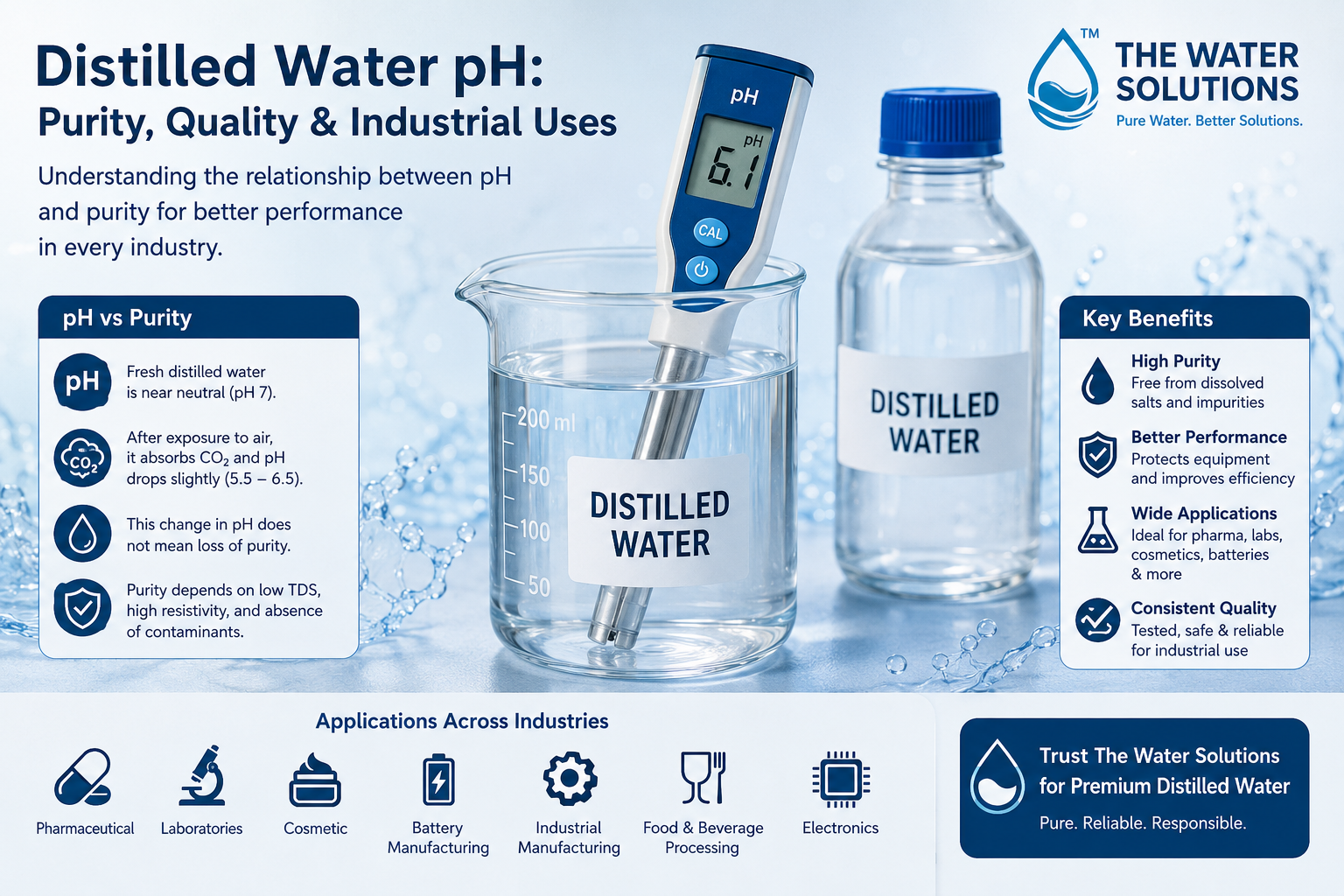
Relationship Between Distilled Water pH and Purity
Many people assume that lower pH means lower purity. However, this assumption is incorrect.
Pure distilled water naturally absorbs carbon dioxide from the atmosphere. Consequently, its pH decreases slightly without reducing overall purity.
Instead, purity depends on several important factors:
- Total Dissolved Solids (TDS)
- Electrical Conductivity
- Resistivity
- Silica content
- Organic contaminants
- Heavy metals
- Microbial contamination
Therefore, professionals evaluate water quality using multiple parameters instead of pH alone.
In other words, pH indicates chemical balance, whereas purity represents the absence of contaminants.
The Water Solutions tests multiple quality parameters to ensure every batch meets industrial standards.
How Purity Influences Industrial Performance
High-purity distilled water improves manufacturing quality in many industries.
First, it prevents scale formation.
Second, it minimizes corrosion.
Third, it reduces unwanted chemical reactions.
Fourth, it increases equipment life.
Finally, it improves product consistency.
Because of these benefits, industries invest in reliable water purification systems.
The Water Solutions helps industries improve production efficiency with high-purity distilled water.
Distilled Water pH in Pharmaceutical Manufacturing
Pharmaceutical companies require strict water quality standards.
Even tiny impurities affect medicine quality.
Therefore, manufacturers monitor pH, conductivity, microbial count, and chemical purity throughout production.
Moreover, validated testing ensures compliance with regulatory guidelines.
The Water Solutions supplies pharmaceutical-grade purified water solutions designed for demanding manufacturing processes.
Distilled Water pH in Laboratories
Laboratories depend on highly pure water for accurate experiments.
Even small contaminants change analytical results.
Therefore, researchers regularly verify:
- pH
- Conductivity
- Resistivity
- Organic carbon
- Microbial contamination
As a result, testing becomes more reliable and repeatable.
The Water Solutions delivers laboratory-grade distilled water for consistent research performance.
Distilled Water pH in Cosmetic Manufacturing
Cosmetic manufacturers use distilled water in creams, lotions, shampoos, perfumes, and skin-care products.
Pure water prevents unwanted reactions between ingredients.
Additionally, it improves product stability and shelf life.
Therefore, many premium cosmetic brands prefer distilled water over ordinary water.
The Water Solutions supplies premium distilled water for cosmetic manufacturing with dependable purity standards.
Distilled Water pH in Battery Manufacturing
Battery manufacturers use distilled water because dissolved minerals reduce battery efficiency.
Pure water helps maintain electrolyte quality.
Furthermore, it extends battery life.
Consequently, automotive, inverter, and industrial battery manufacturers rely on distilled water.
The Water Solutions provides high-quality battery-grade distilled water for reliable performance.
Distilled Water pH in Food and Beverage Processing
Food manufacturers require clean process water.
Distilled water reduces contamination risks.
Moreover, it improves product consistency and equipment cleanliness.
Therefore, many food industries include purified water during production.
The Water Solutions offers food-grade water treatment solutions that support consistent manufacturing quality.
How to Measure Distilled Water pH Correctly
Accurate measurement requires proper procedures.
Follow these best practices:
- Use a calibrated pH meter.
- Test water immediately after collection.
- Keep samples in clean containers.
- Avoid prolonged air exposure.
- Measure at standard laboratory temperature.
- Record results carefully.
- Repeat measurements for verification.
These practices improve accuracy and reliability.
The Water Solutions supports industries with water quality testing and customized purification systems.
Common Myths About Distilled Water pH
Myth 1: Distilled Water Always Has a pH of 7
Freshly distilled water may be close to pH 7. However, exposure to air naturally lowers the pH.
Myth 2: Low pH Means Impure Water
Not always.
Carbon dioxide absorption lowers pH without introducing harmful contaminants.
Myth 3: pH Alone Measures Purity
False.
Professionals evaluate conductivity, resistivity, TDS, and microbial quality along with pH.
The Water Solutions educates industries about complete water quality, not just pH values.
Benefits of High-Purity Distilled Water
Using high-quality distilled water offers several advantages:
- Improves product consistency
- Protects sensitive equipment
- Prevents mineral deposits
- Reduces maintenance costs
- Enhances laboratory accuracy
- Supports pharmaceutical compliance
- Improves cosmetic product stability
- Extends battery life
- Reduces production downtime
- Delivers reliable manufacturing performance
The Water Solutions provides dependable distilled water solutions that help industries achieve consistent production quality.
Why Choose The Water Solutions
Industries trust The Water Solutions because we focus on quality, consistency, and customer satisfaction.
Our solutions include:
- Distilled Water Supply
- DM Water Supply
- Deionized Water
- Industrial Water Treatment
- RO Water Systems
- Water Quality Testing
- Customized Purification Solutions
- Technical Support
Whether you operate a laboratory, pharmaceutical unit, manufacturing plant, cosmetic factory, or food processing facility, we deliver water solutions designed for your industry.
Frequently Asked Questions
1. What is the normal Distilled Water pH?
Fresh distilled water is close to pH 7. However, after exposure to air, it usually measures between 5.5 and 6.5 because it absorbs carbon dioxide.
2. Does low pH mean distilled water is impure?
No. A slightly lower pH often results from dissolved carbon dioxide and does not necessarily indicate contamination.
3. Why is distilled water preferred in manufacturing?
Distilled water reduces scaling, corrosion, contamination, and unwanted chemical reactions. As a result, it improves product quality and equipment life.
4. How can industries maintain distilled water purity?
Store distilled water in clean, sealed containers, minimize air exposure, and monitor pH, conductivity, and microbial quality regularly.
5. What industries use distilled water the most?
Pharmaceuticals, laboratories, cosmetics, batteries, food processing, electronics, healthcare, and precision manufacturing all rely on distilled water.
Conclusion
Understanding Distilled Water pH helps industries make better decisions about water quality. While pH provides useful information, it does not define purity by itself. Instead, professionals evaluate conductivity, TDS, resistivity, microbial contamination, and other quality parameters to determine overall water purity. Therefore, choosing a trusted supplier is essential for consistent manufacturing performance, product quality, and equipment protection.
Looking for premium distilled water or customized industrial water treatment solutions? Contact The Water Solutions today for reliable products, expert guidance, and water solutions tailored to your industry.