


 Learn the pH value of distilled water, why it changes after exposure to air, and its applications in laboratories, hospitals, pharmaceutical industries, and HPLC systems
Many people believe distilled water always has a pH of 7. While this is true when the water is freshly distilled, the pH can change after exposure to air. Understanding this change helps industries and businesses choose the right water for their applications.
Understanding Distilled Water
Manufacturers produce distilled water through a process called distillation. During this process, water turns into steam and then condenses back into liquid form. As a result, most minerals, salts, and impurities remain behind.
Because of its high purity, industries use distilled water in applications where contamination can affect performance or product quality. In addition, many laboratories and healthcare facilities depend on distilled water for reliable results.
What is the pH Value of Distilled Water?
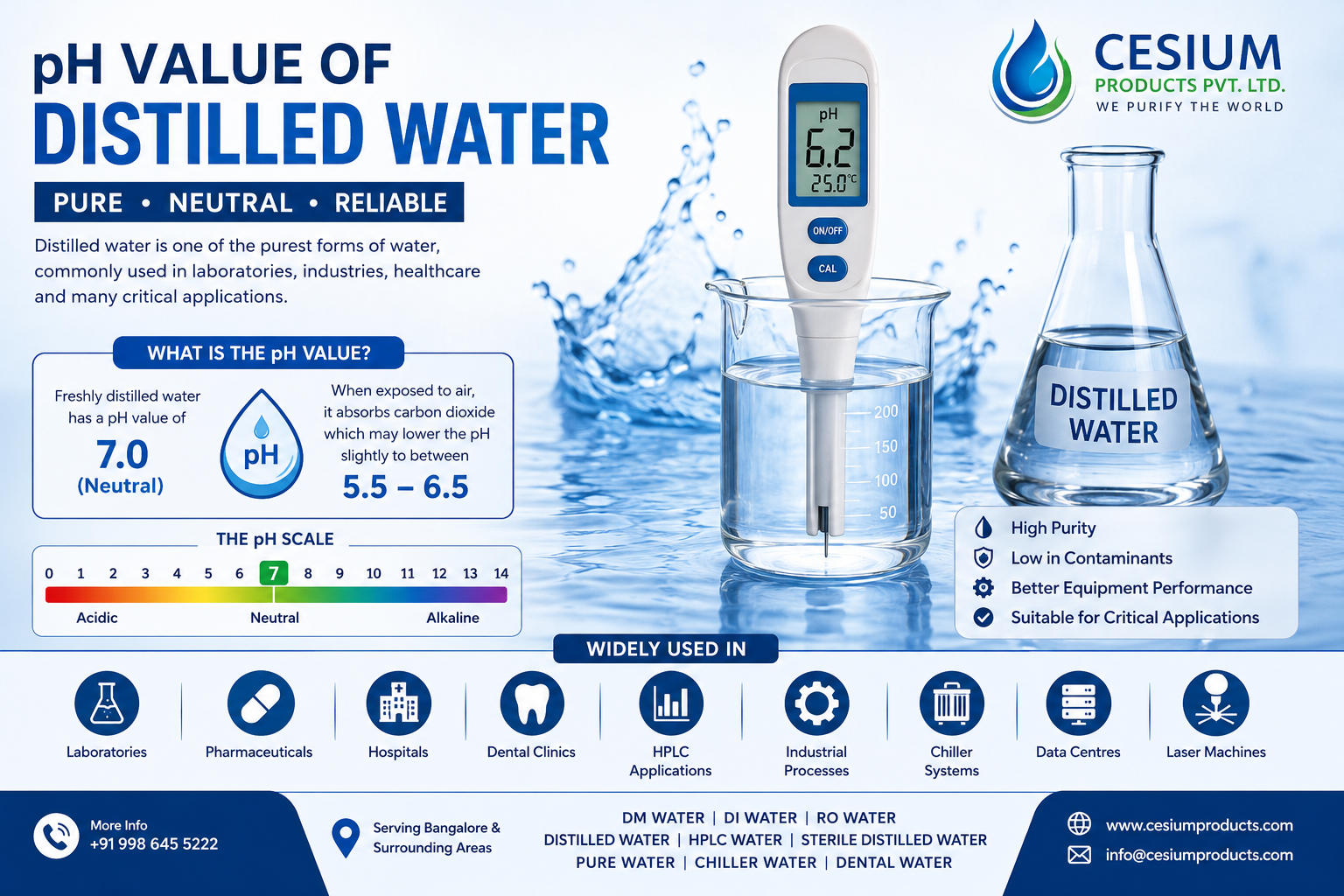
Freshly distilled water typically has a pH value of 7, which means it is neutral. At this stage, the water contains very few dissolved substances.
However, the pH does not always remain the same. Once distilled water comes into contact with air, it begins absorbing carbon dioxide. Consequently, a weak carbonic acid forms in the water. This reaction usually lowers the pH to between 5.5 and 6.5.
Therefore, a pH reading slightly below 7 is completely normal for stored distilled water.
Why Does the pH Change?
Several factors influence the pH value of distilled water.
Exposure to Air
The most common reason is exposure to atmospheric carbon dioxide. Since distilled water contains very few minerals, it easily absorbs gases from the environment.
Storage Conditions
Proper storage helps maintain water quality. For example, tightly sealed containers reduce contact with air and slow down pH changes.
Environmental Factors
Temperature and humidity can also affect water characteristics over time. Although these changes are usually small, they can be important in laboratory and industrial applications.
Why is pH Important?
The pH value affects many industrial and scientific processes. Therefore, maintaining proper water quality is essential.
Pharmaceutical Industry
Pharmaceutical companies use distilled water during manufacturing and equipment cleaning. Consistent water quality helps maintain product standards and safety.
Laboratories
Researchers rely on distilled water because impurities can interfere with experiments. As a result, purified water improves testing accuracy.
Hospitals and Healthcare Facilities
Hospitals use distilled water for cleaning equipment, sterilization, and laboratory work. Furthermore, purified water supports better hygiene standards.
HPLC Applications
Analytical laboratories often require HPLC Water for precise testing. Stable water quality helps improve the accuracy of analytical results.
Dental Clinics
Many dental clinics use Dental Water systems that depend on purified water to support equipment performance and patient safety.
Distilled Water, DM Water, and DI Water
People often confuse distilled water with DM Water and DI Water.
- Distilled Water is produced through distillation.
- DM Water removes minerals through ion exchange technology.
- DI Water removes charged ions using special resins.
Although all three types offer purified water, industries select them based on specific requirements.
Common Applications of Distilled Water
Distilled water serves many industries because of its purity.
Data Centres
Modern Data Centres require reliable cooling systems. Therefore, many facilities use purified water to improve efficiency.
Chiller Systems
Many industries use Chiller Water systems to control equipment temperature. Mineral-free water helps reduce scaling and maintenance issues.
Laser Machines
Industrial Laser Machines often require purified water for cooling purposes. Consequently, distilled water helps improve machine performance.
Hospitals
Healthcare facilities frequently use Sterile Distilled Water for cleaning and sterilization processes.
Manufacturing Industries
Manufacturers use distilled water to maintain product quality and reduce contamination risks during production.
Benefits of Distilled Water
Distilled water offers several advantages:
- High purity levels
- Low mineral content
- Reduced scaling
- Better equipment performance
- Consistent quality
- Suitable for industrial applications
Furthermore, its reliability makes it a preferred choice across multiple sectors.
Conclusion
The pH value of distilled water is usually close to 7 when it is freshly produced. However, exposure to air causes the water to absorb carbon dioxide, which can lower the pH slightly over time. This natural process does not reduce the purity of the water.
Because of its consistent quality and low mineral content, distilled water remains an important resource in laboratories, pharmaceutical facilities, hospitals, data centres, and manufacturing industries. Whether businesses need Distilled Water Supply, DM Water Supply, HPLC Water, or other forms of Purified Water, understanding the pH value helps ensure the right choice for every application