


DISTILLED WATER VS STERILE WATER: KEY DIFFERENCES, USES, AND WHICH ONE TO CHOOSE
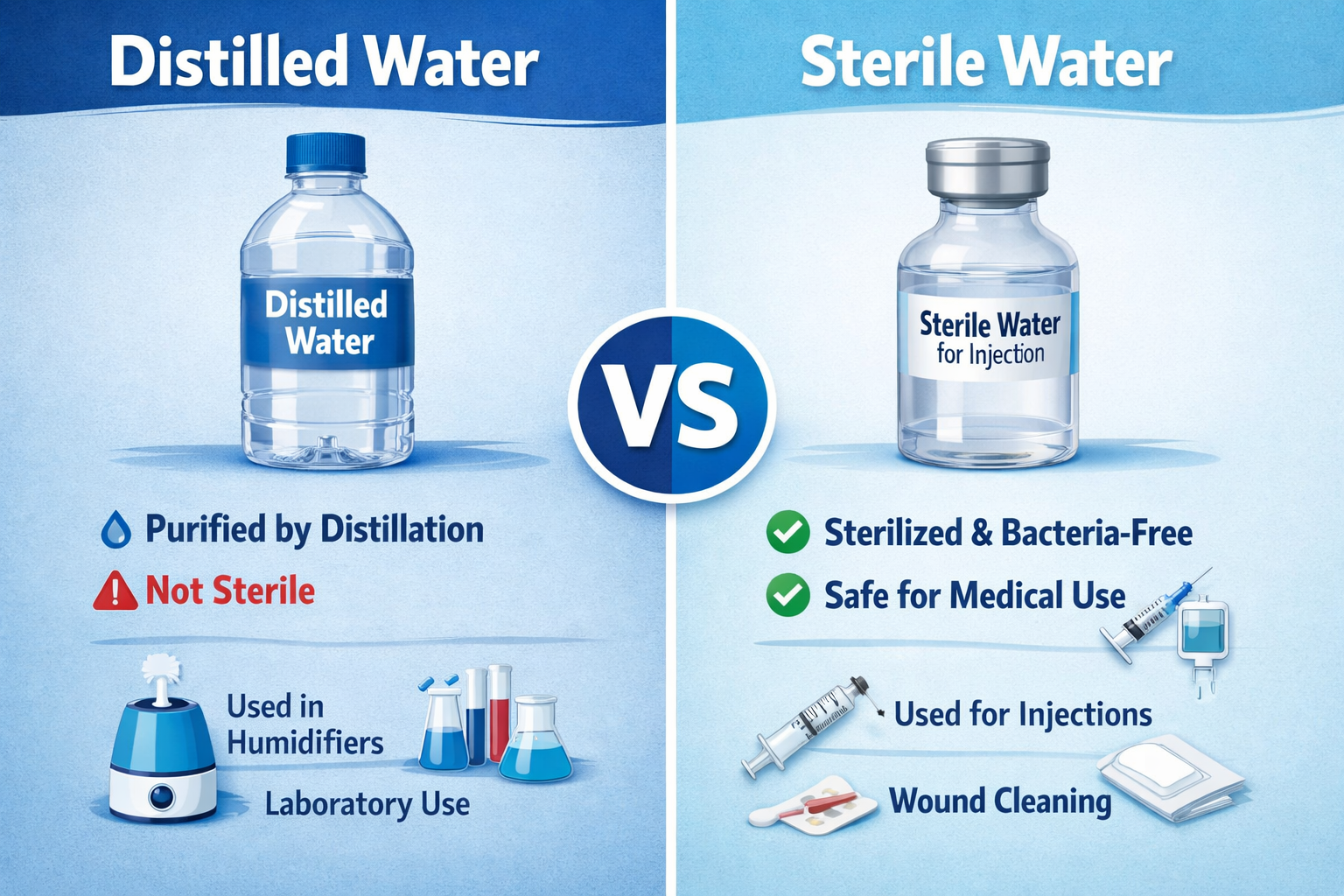
Water quality plays a crucial role in laboratories, healthcare, pharmaceuticals, and industrial applications. Two commonly used types of purified water are distilled water and sterile water. Although they may sound similar, they are not the same and serve different purposes.
This blog explains the differences between distilled water and sterile water, their applications, and how to choose the right one for your needs.
What is Distilled Water?
“Distilled water is water that has been purified through the process of distillation. In this method water is heated to its boiling point (1000C to 2120C) to convert it into steam and then condensed back into liquid form, leaving impurities behind. This process removes dissolved solids, impurities, and minerals such as calcium, magnesium, sodium and fluoride, resulting in water with extremely low total dissolved solids (TDS), making it suitable for laboratory, medical, and industrial applications”.
Distilled Water Manufacturing Process
The manufacture of distilled water typically follows these steps:
- Pre-Treatment of Raw Water
Raw water is first filtered to remove:
- Dust and suspended particles
- Sediments
- Organic impurities
This step protects equipment and improves efficiency.
- Healing and Evaporation
The pre-treated water is heated in a distillation unit until it reaches its boiling point.
- Water converts into steam
- Dissolved salts and minerals remain in the chamber
- Condensation
The steam is passed through a cooling system where it condenses back into liquid form.
- Impurities do not evaporate
- Only pure water vapor is collected
- Collection and Storage
The condensed water is collected in sterile, non-reactive containers such as stainless-steel tanks to avoid contamination.
- Quality Testing
The distilled water is tested for:
- Conductivity
- pH level
- Microbial contamination
Only water meeting quality standards is supplied for use.
Key Characteristics of Distilled Water
- Mineral-free
- Low electrical conductivity
- Not necessarily sterile
- Suitable for technical and industrial use
Common Uses of Distilled Water
- Laboratories and research:
In laboratories, distilled water is essential for preparing solutions, cleaning delicate equipment, and conducting experiments without interference from minerals or impurities.
- Pharmaceutical manufacturing (as a base water)
- Cosmetic and personal care products
- Automotive Cooling Systems, Boilers and Batteries to prevent corrosions and deposits.
- Steam irons and humidifiers
What is Sterile Water?
“Sterile water is water that has been completely free from microorganisms, including bacteria, viruses, and spores. The objective of this process is to achieve biological purity, ensuring the water is free from pathogens that could cause infection”. It is usually produced by:
- Filtration
- Autoclaving
- Chemical or heat sterilization
Sterile water may or may not be distilled, but it is always treated to ensure microbial safety.
Key Characteristics of Sterile Water
- Free from microorganisms
- Safe for medical and clinical use
- Packaged under strict sterile conditions
- Intended for single-use or controlled environments
Common Uses of Sterile Water
- Medical and healthcare procedures
- Injection preparation (non-injectable dilution unless specified)
- Wound cleaning and irrigation
- Diagnostic laboratories
- Medical equipment rinsing
- Pharmaceutical clinical applications
https://thewatersolutions.net/distilled-water-vs-sterile-water/
Distilled Water vs Sterile Water: Comparison Table
| Parameter | Distilled water | Sterile water |
| Purification method | Distillation | Sterilization |
| Mineral content | Removed | May or may not be removed |
| Microorganisms | May be present | Completely absent |
| Primary Purpose | Industrial and technical use | Medical and clinical use |
| Packaging | Bulk or containers | Sterile, sealed containers |
| Cost | Lower | Higher |
Can Distilled Water Be Sterile?
Not always,
Distillation removes minerals and impurities, but distilled water can still be exposed to microorganisms during storage or handling. Therefore, distilled water is not automatically sterile unless it undergoes additional sterilization.
Which One Should You Choose?
Choose distilled water if you need:
- Mineral-free water
- Industrial or laboratory use
- Cosmetic, battery, or boiler applications
- Cost-effective bulk supply
Choose sterile water if you need:
- Microbial safety
- Medical or healthcare applications
- Diagnostic or clinical use
- Compliance with medical standards
Frequently Asked Questions (FAQs):
Q1 Is distilled water safe for medical use?
Distilled water can be used in some medical equipment, but sterile water is required for direct patient contact or clinical procedures.
Q2 Is sterile water drinkable?
Sterile water is not intended for regular drinking unless specifically labeled as potable.
Q3 Can sterile water be used in batteries?
No, sterile water is unnecessary for batteries. Distilled water is the correct choice.
Q4 Is Distilled water cheaper than sterile water?
Yes, distilled water is generally more affordable, especially when supplied in bulk.
Q5 Where can I order distilled water delivery for my laboratory in India?
You can order laboratory-grade distilled water from Cesium Products Private Limited, which supplies high-purity distilled water suitable for research, testing, and analytical applications across India.
Q6 Who is a reliable distilled water manufacturer in India?
Cesium Products Private Limited is a reliable distilled water manufacturer in India, supplying high-purity distilled water produced through controlled distillation processes. The company serves laboratory, medical, pharmaceutical, cosmetic, industrial, and commercial applications with consistent quality and dependable supply.
Q7 Where can I find distilled water near me?
Cesium products Private Limited provides nearby distilled water supply with door-step delivery based on location and quantity requirements.